Endowment to Push Nurses to Highest Levels of Leadership

A newly created endowment at the UC College of Nursing promises to increase the number of doctorally prepared nurses at the highest level of decision-making in hospitals, health systems and health care facilities.
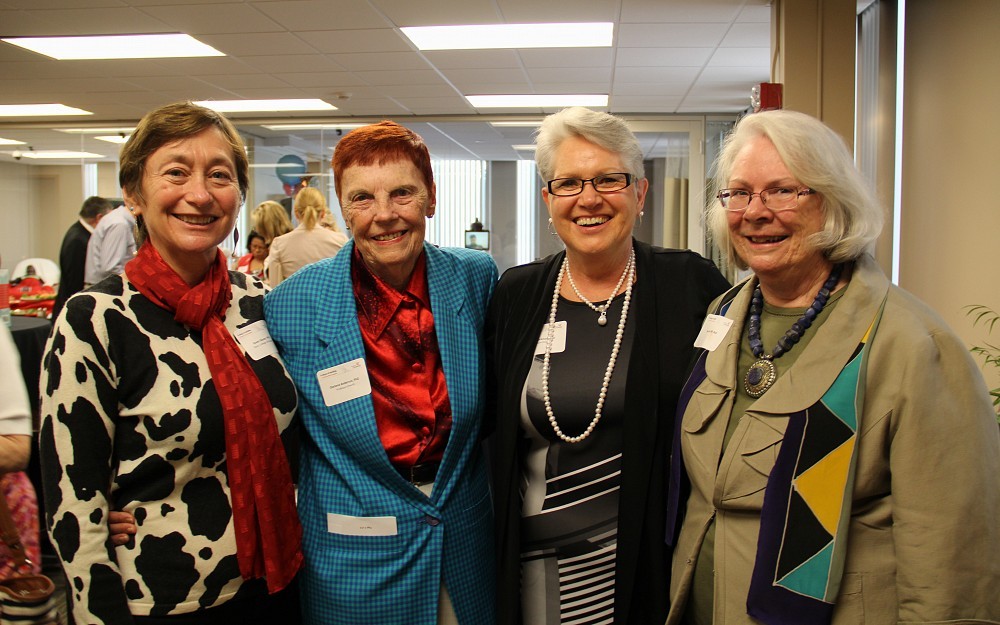
The Anderson, Workman, and Davis Endowment for Population Based Health Care Nursing Administration and Occupational Health Fund, named for emeriti UC College of Nursing faculty Darlene Anderson, RN,PhD, Linda Sue Davis, RN, PhD, and Linda Workman, RN, PhD, will provide up to $5,000 per year to a graduate student in a PhD program with a population-based health care, nursing administration or occupational health research focus.
"An endowment is the foundation for sustainable support for future students and nurse leaders, says Greer Glazer, PhD, dean, UC College of Nursing. "This particular gift is designed to help individuals break through the glass ceiling that they may face in their careers.
"Its also the fruition of the passion that these three individuals have for the need for strong nurse leaders in administration in todays health care setting.
Anderson, Davis and Workman began faculty appointments at the UC College of Nursing in the late 1980s. Both Anderson and Workman were early pioneers in understanding how critical it was for nurses to be a driving force behind workplace dynamics and administration. They teamed up with Davis, an expert statistician and occupational health nurse, to conduct work analysis studies throughout the region.
Their work was soon in high demand, and they became well known for the analysis instrument they developed and their successful consulting in hospitals, health care systems, acute long-term care facilities and inpatient rehabilitation facilities.
"What was particularly exceptional about this venture is that their work opened up access to these facilities for our PhD students, says Glazer. "While the trio was conducting their analyses, students and student research still took priority. The work of these three individuals was contributing to successful outcomes for students.
It was Andersonthrough a desire to recognize her teams accomplishments and the contributions it has made to nursing administration and occupational healthwho formed the idea for the permanent endowment.
She saw that there were many highly successful nurses who didnt always have the financial resources to return to the academic setting to pursue a doctoral degree.
Selected beneficiaries of the endowment will be graduate students in a PhD program with a research focus related to nursing administration or occupational health and who have earned their master of science in nursing with a GPA of 3.75 or higher. They must have at least five years of administrative experience at or above a first-line level of management.
Anyone interested in growing this new endowment can do so by sending a check payable to University of Cincinnati Foundation, P.O. Box 19970, Cincinnati, OH 45219. Please include "Anderson, Workman, Davis Endowment in the memo line.
You can also give online at https://webapps2.uc.edu/foundation/gift/gift.aspx. "Anderson, Workman, Davis Endowment should be included in the special instructions box.
Tags
Related Stories
Cancer Center plays key role in lab research, clinical trials for new pancreatic cancer drug
September 1, 2026

WLWT and WCPO highlighted the contributions of University of Cincinnati Cancer Center researchers that helped lead to the recent FDA approval of daraxonrasib, a new treatment for pancreatic cancer.
Cancer Center physician receives $150,000 New Investigator Research Grant to study treatment-resistant leukemia
September 1, 2026
The University of Cincinnati Cancer Center’s Sarah Skuli, MD, PhD, received a two‑year, $150,000 Leukemia Research Foundation New Investigator Grant to study TP53‑mutated leukemia, a treatment‑resistant subtype with very poor outcomes.
Heavy social media use linked to depression
August 31, 2026

U.S. News and World Report, Yahoo! News, MSN, USA Today and other national media highlight a new study by the University of Cincinnati and Northwestern University that found a correlation between heavy social media use and depression in adults.