UC Medical Center Upgrades Hybrid Operating Room

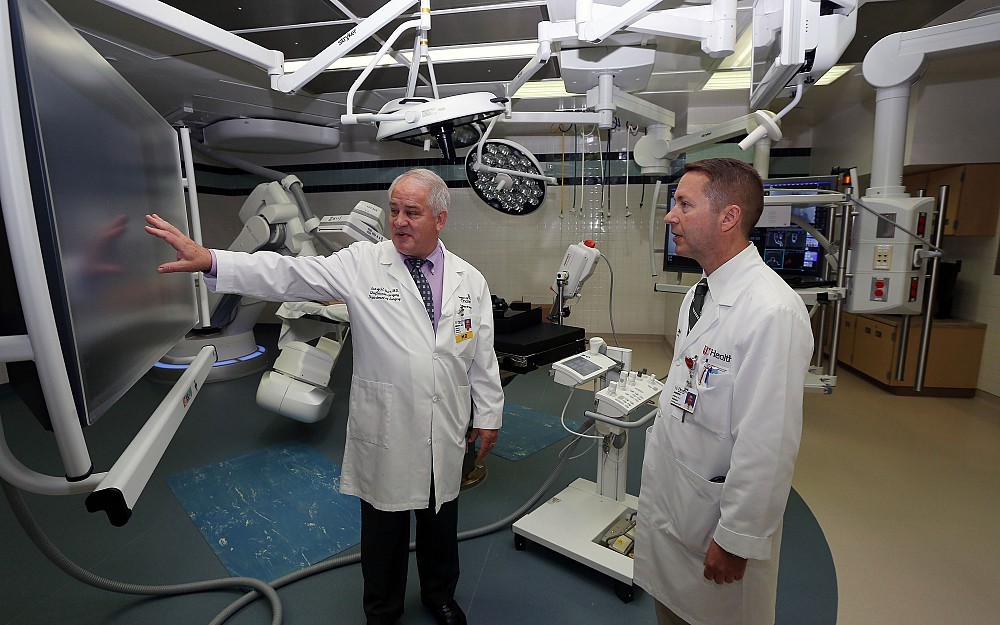
University of Cincinnati Medical Center will open an expanded, state-of-the-art "hybrid operating room Wednesday, June 10, 2015, to make heart surgery less invasive, offer non-surgical valve replacement and repair, introduce catheter-based treatment of stroke and blood vessel aneurysms and reduce recovery time for patients in the Tristate.
The 854-square-foot hybrid operating room is located on the second floor of the hospital and connects the existing catheterization laboratory with the operating room. The expansion will represent a $6 million investment by UC Health.
UC Health officials will celebrate the new addition with an 8:15 a.m. ribbon-cutting ceremony Wednesday, June 10, 2015, followed by an open house of the facility until 11 a.m.
"The Hybrid OR represents a commitment from UC Health, UC Medical Center and the UC College of Medicine to our community, city and region to deliver complex care across a spectrum of heart, vascular and neurologic diseases, disorders and conditions, says Richard Becker, MD, director and physician-in-chief of the UC Heart, Lung and Vascular Institute (HLVI).
"The best trained cardiologists, surgeons, anesthesiologists, neurologists and critical care specialists will work side-by-side and shoulder-to shoulder with the best nurses, technicians and support staff to support our time-honored mission of optimal patient care, education, training and research that impacts lives. This is our pledge as the regions only academic health system and medical center.
The larger space will accommodate medical and surgical teams involved in both catheterization laboratory and operating room produces, says Becker. Hybrid operating rooms make it possible for medical teams to perform advanced care, including, for example, trans-catheter aortic valve replacement, also known as TAVR.
The procedure is increasingly offered to patients who require a new aortic valve, but are too weak for open heart surgery, says Becker, who is also the Mabel Stearns Stonehill Endowed Chair and Professor of the UC Division of Cardiovascular Health and Disease. An aortic valve can be inserted non-surgically by specially trained teams through a catheter placed in a blood vessel in the arm, leg or chest.
"The cardiovascular community has reached a point where patients with advanced, complex heart valve disease can be offered surgical and non-surgical options to provide optimal care. The non-surgical procedures typically reduce hospital length of stay and overall recovery time, says Satya Shreenivas, MD, director of the structural heart program at UC Medical Center and an assistant professor of medicine in the UC College of Medicine.
"Our team approach to evaluation and treatment at UCMC is based on specialized training and clinical expertise. We believe that this is the formula for achieving great, individualized care.
"Why is it referred to as a hybrid operating room? asks Shreenivas. "Hybrid describes the integration of surgical and non-surgical expertise, as well as the inherent flexibility to respond to a patients specific need during the procedure.
The new hybrid operating room will contain the most advanced Artis zeego angiography C-arm system developed by Siemens Healthcare. The system has a lot of articulating pieces and can practically fold- up on itself providing crucial space for other procedures when needed.
The UC Heart, Lung and Vascular Institute is one of three institutes within the UC Health network, where expert physicians come together with researchers from University of Cincinnati College of Medicine to make true breakthroughs in medicine. About 60 clinicians, educators, research scientists and medical administrators comprise the HLVI.

UC Medical Center opens an expanded, state-of-the-art hybrid operating room.

UC Medical Center opens an expanded and improved hybrid operating room.
Related Stories
UC radiation oncologist speaks with Local 12 news about clinical trial for head and neck cancer treatment
August 10, 2026

Dr. Sara Medek, a UC radiation oncology professor, speaks with Local 12 news about a new clinical trial aimed at reducing radiation in certain areas while still treating cancer effectively but with fewer painful side effects.
Cancer Center director charts future based on collaboration, AI
August 10, 2026

David Gius, MD, PhD, was featured in a Cincinnati Business Courier article and The Cancer Letter’s “The Directors" podcast discussing his priorities and goals as he recently took the helm as director of the University of Cincinnati Cancer Center.
UC graduates cross finish line at commencement
August 7, 2026
The University of Cincinnati recognized 2,125 graduates in two ceremonies at summer commencement Friday on campus at Fifth Third Arena.