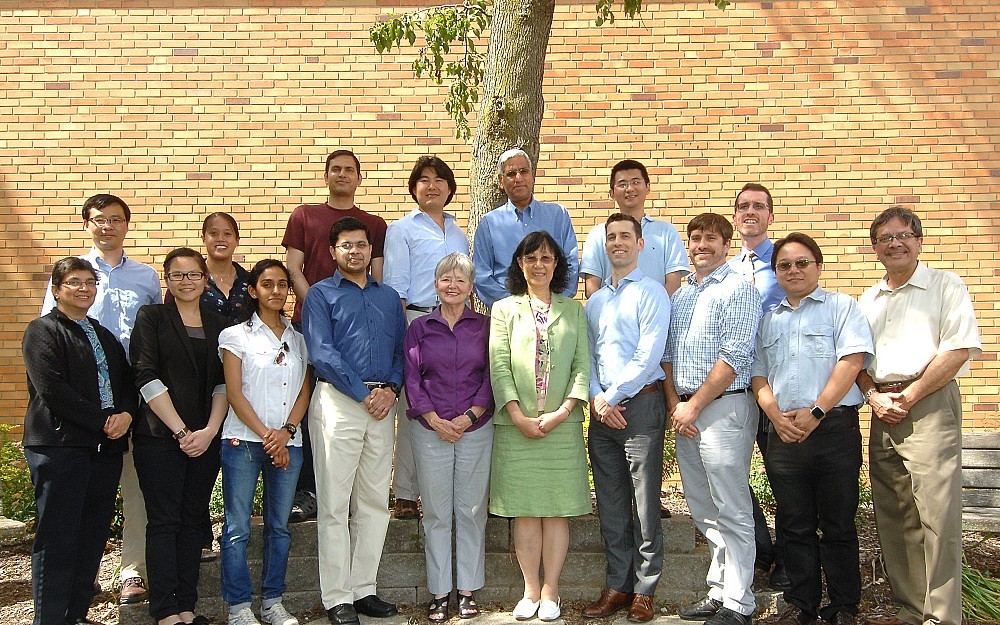
Center for Environmental Genetics Announces 2015 Investigator Awards

The Center for Environmental Genetics (CEG), housed in the UC Department of Environmental Health, has announced its annual Career Development Awards, including six New Investigator Scholars and four Next Generation Biomedical Investigators whose work holds promise for increasing our understanding of gene-environment interactions and the developmental origins of human health and disease.
Funded by the National Institute for Environmental Health Sciences (NIEHS), the CEG supports state-of-the-art core facilities and technologies needed to conduct innovative research that focuses on how environmental agents interact with genetic and epigenetic factors to influence disease risk and outcome. It is directed by Shuk-Mei Ho, PhD, Jacob G. Schmidlapp Professor and Chair of Environmental Health and director of the Cincinnati Cancer Center.
Under the leadership of Grace LeMasters, PhD, and Daniel Woo, MD, the CEG Career Development Program identifies promising early stage investigators and assists in the development of their careers through interdisciplinary education, mentoring and research support. The program funds physician-scientists, epidemiologists, basic scientists and other translational researchers who are committed to effective team science and are likely to achieve meaningful outcomes for individual and the public health community.
The CEGs New Investigator Scholars awards support graduate students and postdoctoral fellows with demonstrated interest in, and strong aptitude for, research focused on gene-environment interactions and the developmental origins of human health and disease. The CEG grants Next Generation Biomedical Investigator awards to promising full-time junior-level faculty members (research or tenure track) who show outstanding potential to conduct research and become leaders in their selected fields.
Each 2015 New Investigator Scholar and Next Generation Biomedical Investigator will receive funds to engage in thesis, postdoctoral and/or pilot research, as well as professional development activities aimed at increasing understanding of the linkages between environmental exposures and health effects at the molecular, genetic and epigenetic levels.
The CEGs 2015 New Investigator Scholars are:
- Sukanta Bhattacharya, PhD, a postdoctoral fellow in the UC Department of Environmental Health, Microbial Pathogenesis and Toxicogenomics Laboratory. Mentored by Jagjit Yadav, PhD, and Scott Langevin, PhD, Bhattacharya is studying the oral microbiome in head and neck squamous cell carcinoma and the effects of exposure to polycyclic aromatic hydrocarbons (PAHs). Approximately 60,000 new cases of head and neck squamous cell carcinoma are diagnosed each year, and certain workers (firefighters, roofers, wood industry employees) appear to have both a higher incidence of this cancer and greater risk of occupational exposure to PAHs.
- Harish Chandra, PhD, a postdoctoral fellow in the Department of Environmental Healths Division of Environmental Genetics and Molecular Toxicology. His work is of importance to machinists and other workers who may be exposed repeatedly to microbially contaminated metal-working fluid, placing them at risk of hypersensitivity pneumonitis. Mentored by Yadav, Chandra is working to develop a T cell-based diagnostic for occupational hypersensitivity pneumonitis, which is also known as machine operators lung.
- Ana Cheong, PhD, a postdoctoral fellow in the Department of Environmental Health who is studying the role of BPA-regulated expression of SNORD59 in prostate cancer. Mentored by Ho and Yuet-Kin (Ricky) Leung, PhD, Cheong will help to advance prostate cancer research by exploring how bisphenol acts through estrogen receptors to epigenetically reprogram the prostate epithelium and increase prostate cancer risk.
- Umesh Singh, PhD, MBBS, a research assistant in the UC Department of Internal Medicine, Division of Immunology, Allergy and Rheumatology and mentee of Jonathan Bernstein, MD. Singhs investigation of environmental stresses in mediating DNA damage in nasal epithelial cells is important for increasing understanding of the etiology of non-allergic rhinitis and in helping to identify novel and more effective therapies against this common condition.
- Sarah To, PhD, National Health and Medical Research Council (Au) C.J. Martin Biomedical Fellow and visiting postdoctoral fellow in the Department of Environmental Health, Division of Environmental Genetics and Molecular Toxicology. Under the mentorship of Ho and Pheruza Tarapore, PhD, To is working to elucidate whether bisphenol A and its analogous compounds alter the expression of miRNAs in prostate cancer cells and whether this is mediated by the same GPR30 initiated pathways (i.e., estrogen receptor G protein-coupled receptor 30, GPR30 or GPER1) as GI. More than 200,000 men in the United States are diagnosed with prostate cancer each year and some 27,000 die of the disease.
- Kavitha Subramanian Vignesh, PhD, a postdoctoral fellow in the UC Department of Internal Medicine, Division of Infectious Diseases. Her funded project, mentored by George Deepe Jr., MD, aims to increase understanding of how interleukin-4 affects macrophage defenses to permit intracellular infections. The fungal pathogen Histoplasma capsulatum is prevalent in North and Central America and causes pulmonary and life-threatening infection in immuno-compromised persons.
The CEGs 2015 Next Generation Biomedical Investigators are:
- Michael Fisher, PhD, MS, an assistant professor and medical sociologist in the Department of Environmental Health. Working together with Erin Haynes, DrPH, and the CEGs Community Outreach and Engagement Core, Fisher will be studying quality of life issues among rural county citizens who live in proximity to unconventional natural gas drilling; also known as hydraulic fracturing. The funded project will assess community members environmental health literacy while fostering mutually informative communication between researchers and grassroots-level stakeholders. The study contributes to the mission of the CEG via its focus on vulnerable populations and the full range of variables that community members perceive and experience with regard to environmental exposures and genetic predisposition to disease.
- Roman Jandarov, PhD, an assistant professor in the Department of Environmental Healths Division of Biostatistics and Bioinformatics, will be collaborating with Susan Pinney, PhD, and Liang Niu, PhD, MS, to develop novel statistical approaches to address challenges in environmental chemical mixtures research. Jandarov also will be working with Changchun Xie, PhD, Leung and Niu to devise a single framework for analyzing genetics [single nucleotide polymorphism (SNP), epigenetics (DNA methylation) and gene expression data and data on breast cancer from The Cancer Genome Atlas database. Another research focus for Jandarov is the application of geographical, satellite, and exposure monitoring data to develop predictive models for environmental air pollution and disease studies (with Haynes and others).
- Nicholas Newman, DO, MS, a board-certified pediatrician, assistant professor and director of the Pediatric Environmental Health Specialty Unit at Cincinnati Childrens Hospital Medical Center and director of the Pediatric Environmental Health and Lead Clinic. Conducted in collaboration with Tiina Reponen, PhD, Newmans project, "Nitrogen dioxide, genes and atopy in children with asthma, seeks to enhance understanding of the pathophysiology of non-atopic (non-allergic) asthma in children in order to foster more effective treatment. An estimated 7.1 million children in the United States are affected by asthma and studies suggest that as many as a third or more of these youths are not atopic and experience more severe respiratory impacts than their allergic counterparts.
- Liang Niu, PhD, MS, an assistant professor in the Division of Biostatistics and Bioinformatics. Niu has particular interest in data analysis related to Next-Generation Sequencing (NGS), a state-of-the-art approach to studying genomics from multiple perspectives, such as gene expression, DNA methylation and chromatin interactions. A typical NGS experiment generates high-throughput data, which in turn requires robust statistical and computational methods. As a CEG Next Generation Biomedical Investigator, Niu will pursue the integration of SNP data, DNA methylation data and RNA-Seq data to enhance study power for disease etiology analysis.
Since its inception in 2007, the CEG Career Development Program has supported 45 New Investigator Scholars and 19 Next Generation Biomedical Investigators. These men and women are proving to be prolific researchers, earning additional public and private research support and producing numerous peer-reviewed publications in national and international journals.
The CEG is supported by NIEHS award P30-ES006096.
Tags
Related Stories
UC radiation oncologist speaks with Local 12 news about clinical trial for head and neck cancer treatment
August 10, 2026

Dr. Sara Medek, a UC radiation oncology professor, speaks with Local 12 news about a new clinical trial aimed at reducing radiation in certain areas while still treating cancer effectively but with fewer painful side effects.
Cancer Center director charts future based on collaboration, AI
August 10, 2026

David Gius, MD, PhD, was featured in a Cincinnati Business Courier article and The Cancer Letter’s “The Directors" podcast discussing his priorities and goals as he recently took the helm as director of the University of Cincinnati Cancer Center.
Bidirectional link between oral, kidney health calls for patient education, access
August 4, 2026

Despite growing awareness of the connection between oral health and chronic health conditions, patient awareness and access to dental care remain limited, according to University of Cincinnati experts who recently spoke with Healio | Nephrology News & Issues.