Nursing College s Pipeline Programs Yielding Success

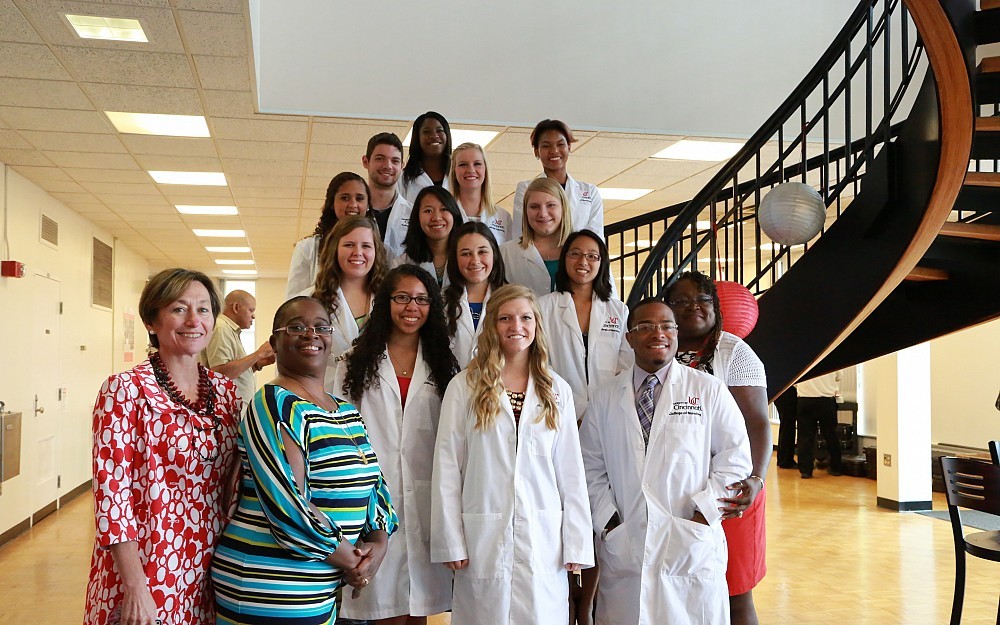
A workforce diversity initiative supporting underrepresented students who apply to the UC College of Nursings traditional BSN program is seeing positive results of more direct recruitment efforts at area high schools.
"Leadership 2.0: Nursings Next Generation is a highly competitive program supported by more than $1 million from HRSA, the U.S. Department of Health and Human Services Health Resources and Services Administration. It will welcome its third class of students to UCs campus June 22, and of the seven 2015 Leadership 2.0 scholars, five are coming from schools where UC made direct outreach efforts, including group campus visits, pre-admission advising, information sessions, and ACT and financial aid workshops.
Students admitted to the BSN program through Leadership 2.0 participate in summer bridge activities prior to their first fall semester at UC and receive additional support through the end of their sophomore year. All are part of a "living learning community, which means they live on campus with other Leadership 2.0 participants and upperclass students who serve as peers and guides.
As part of the Leadership 2.0 program, partnerships were established with six Greater Cincinnati high schools: Hughes STEM, Lakota West, Princeton, Walnut Hills, Winton Woods and Woodward.
Jimmy Vasquez, a 2015 Leadership 2.0 scholar recruited from Hughes, is excited about the opportunity to live on campus.
"Living on campus is one of the most exciting things I've always wanted to experience. I'm looking forward to having a taste of what campus life will be like.
"Unique opportunities like these don't come every day. That's why they're called unique.
Vasquez is one three students coming to UC and the Leadership 2.0 program from Hughes. Other students in the new class of Leadership 2.0 come from Winton Woods, Lakota West, and Lebanon and Mount Notre Dame high schools.
"In order for tomorrows health care workforce to mirror the local population, it is critical that we foster the success of local talent, says Greer Glazer, RN, PhD, dean of the UC College of Nursing. "Were proud to partner with Hughes STEM and all of our partner schools to retain future health care leaders in the Cincinnati community.
To date, Leadership 2.0 has brought 26 students to UC. Twenty-two have continued with the BSN program. Two others have continued on with other majors at UC.
Leadership 2.0 is just one of several efforts that the UC College of Nursing is leading to educate a more diverse, inclusive and culturally competent health care workforce.
Since 2012, the college has been a member of Urban Universities for HEALTH (UU HEALTH), a national academic learning collaborative focused on investigating approaches to health care workforce development that lead to improved health outcomes and reduced disparities in local communities. Funding from this collaborative has been instrumental in informing outreach and strengthening the college's pipeline programs.
Learn more about Leadership 2.0 at http://nursing.uc.edu/academic_programs/bsn/leadership.html.

Greer Glazer, PhD, dean of the UC College of Nursing, at her desk in Procter Hall.
Tags
Related Stories
UC expert weighs in on current MASH treatment approaches
June 5, 2026

As MedCentral recently reported, pending broader pharmacologic approvals for metabolic dysfunction-associated steatohepatitis (MASH), lifestyle modifications remain the go-to intervention.
At least two weather patterns increase headaches, UC study suggests
June 4, 2026
University of Cincinnati physicians and collaborators identified two specific weather patterns that increase headache and migraine risk and found the preventive medication fremanezumab (Ajovy) can reduce weather‑associated headaches. The findings will be presented at the American Headache Society Annual Scientific Meeting in Orlando.
UC researcher secures $3.3M grant to study microplastics’ impact on heart
June 2, 2026
The National Institute of Environmental Health Sciences awarded a $3.3M grant to University of Cincinnati researcher Hong‑Sheng Wang, PhD, to study how microplastics and nanoplastics affect cardiovascular health.