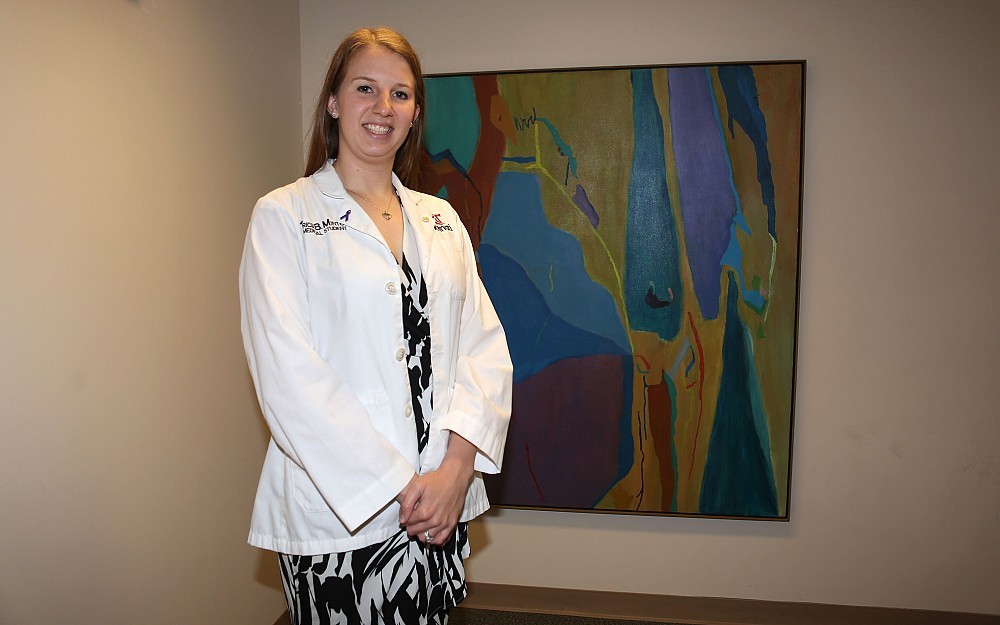
Focus on Students with Tricia Minton

Tricia Minton, a third-year medical student originally from Hamilton, Ohio, has been selected to receive the Charlotte R. Schmidlapp Scholarship for 2015-16. This is the 20th year a woman in the senior class of the College of Medicine will receive this $20,000 scholarship. The scholarship was created by Jacob Schmidlapp in 1908 in honor of his daughter Charlotte, who was killed in a car accident at 19. The fund is intended to help women achieve their educational objectives. The scholarship in the College of Medicine is awarded to a student who has demonstrated leadership qualities and is engaged in women's health issues.
What Brought You to UC?
I went to undergrad at Case Western Reserve in Cleveland so there was a little bit of separation from home, but I wanted to get back near home and my boyfriend, who is now my husband, who also live here. My interview at UC convinced me that this was a supportive environment, and it was going to be a collaborative effort to get through medical school. I enjoyed talking to faculty that I met and felt that I would get great clinical training at UC.
What Type of Medicine Would You Like to Practice?
During the first two years I had put all my efforts into family medicine. Then on my psychiatry rotation, I really enjoyed working on the adolescent inpatient unit at the Lindner Center of HOPE in Mason and that pulled me toward psychiatry. Now I am going into psychiatry with a focus on children and adolescents, but I am not sure which route through residency to take because there are two ways to get into child and adolescent psychiatry. One of them includes general pediatrics training and one does not. I would also love to stay and practice in this area during my career.
Tell Us About Your Involvement in Womens Health Issues.
Its primarily been as part of my rotations. I did volunteer during my first two years on several occasions with the American Medical Womens Association to teach a fitness class at the Off-the-Streets program in downtown Cincinnati. That was a unique experience. I also have particularly enjoyed working with teenage girls with eating disorders during both my pediatrics and psychiatry rotations.
I had one patient on my psychiatry rotation who encompassed all aspects of womens health. My favorite patient was 40 years old and she had a history of breast cancer that she was currently being treated for and had a double mastectomy. She had two young children and as a result of her cancer treatments and underlying anxiety she ended up with severe weight loss and was malnourished. She came to the psychiatry unit for re-feeding. She was treated almost like an eating disorder patient and you have to re-feed very to prevent complications. I talked with her about so many different things including the life experiences she has gone through as a woman with cancer who had young kids and was hospitalized during the holidays.
As a future psychiatrist I see myself enjoying working with adolescent and adult women. I have had several adolescent patients struggling to find their way through high school and dealing with the pressures that go along with that as well as patients with eating disorders. I feel a connection with them as a woman myself.
Do you have time for medical student organizations?
I was heavily involved in the Family Medicine Interest Group. As president of that organization in my second year. The student interest groups are the way first- and second-year students get introduced to specialties in medicine. With the Family Medicine Interest Group we had lunch talks about family medicine, aspects of health care reform, and different practice models. We also had one of the few private practice family physicians in Cincinnati come in and talk to us about the way he manages his practice.
We hosted many clinical skills workshops to get first- and second-year students hands-on experience. I started the community service committee for our group and it was the first time we had been involved in service. We paired with a UC College of Medicine graduate, who is at St. Elizabeths Hospital, to do sports physicals with the St. Bernard school district a couple of times a year. It was free for those students. A lot of the students had some financial barriers to get those physicals done.
From that experience I also now work for the American Academy for Family Physicians as a regional coordinator for the family medicine interest group network. I am one of six medical students nationally serving as regional coordinators and I cover the mid-Atlantic region and act as a liaison to the student interest groups at all the medical schools in my region. I also served on the student wellness committee and participated in the Mind-Body Medicine Experiential workshop for medical students coordinated by faculty in the UC Center for Integrative Health and Wellness.
What do you do for fun?
I played volleyball in college and continue to play once a week on a women's league, and I run in a couple of races every year. I have completed the Flying Pig Half Marathon and the Queen Bee Womens Half Marathon. I also love to bake and cook whenever I find the time.
Related Stories
On-site training in Speech & Hearing Clinic sets UC’s programs apart
August 27, 2026
At the University of Cincinnati’s Speech & Hearing Clinic, Doctor of Audiology and Speech-Language Pathology graduate students gain real-world experience while providing free speech and hearing services to the community.
Designing with cancer patients' needs in focus
August 27, 2026
Kristina Shin is designing garments that prioritize the comfort, function and confidence of breast cancer patients, addressing a need often overlooked by traditional fashion.
UC, NKU renew longstanding partnership supporting Army ROTC cadets
August 26, 2026
The University of Cincinnati Army ROTC and Northern Kentucky University (NKU) have renewed a longstanding partnership that supports students preparing to become Army officers and leaders in their communities. The universities formalized the renewed agreement during a signing event Aug. 11 at NKU.