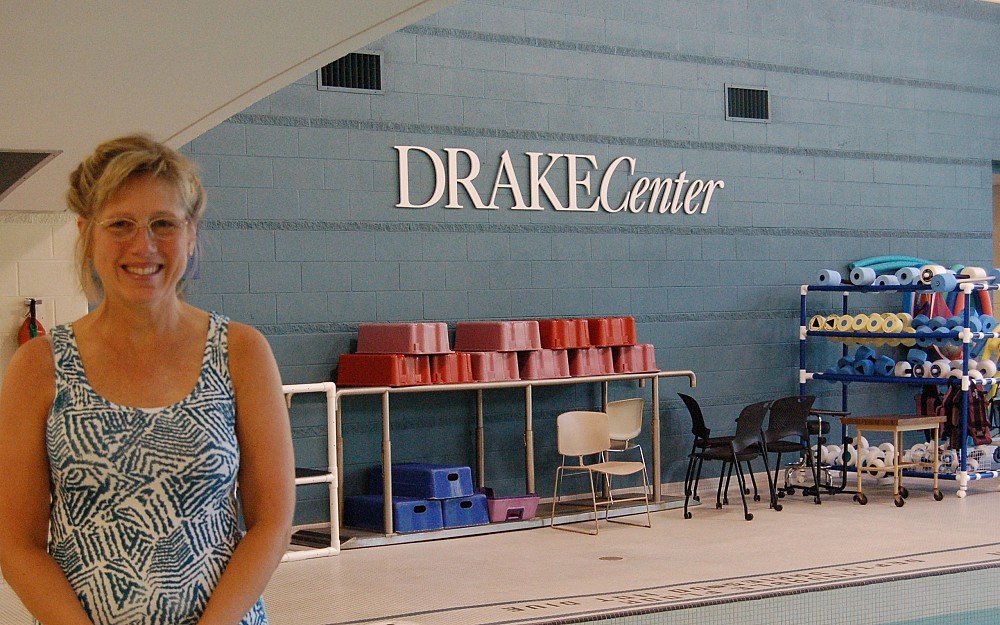
Focus on Staff With Lisa Newport

Lisa Newport has been an aquatic specialist at Daniel Drake Center for Post-Acute Care for nearly 20 years. She is certified with the Aquatic Exercise Association, and she teaches water exercise classes and does personal training. Many of her classes are specialized for people with arthritis, stroke rehab and other neurologic conditions treated by the multispecialty teams within the University of Cincinnati Neuroscience Institute. She understands the limitations from these neurologic conditions so that patients exercise appropriately during a workout.
How did you get started as an aquatic specialist?
"There has always been some connection for me with the water. I grew up in Twin Lakes, Ohio, and spent my summers at the lake. I started lifeguarding when I was 16, and I used to teach swim lessons in high school and college. I received my bachelor of science in therapeutic recreation from Kent State University. I have worked with many different populations, including people with physical handicaps. I really like working in rehab. I think you could say I found my niche in life.
What is your favorite part of the job?
"I really love the patientsthey become like family. There is a gentleman in his 90s who was in my very first arthritis exercise class 20 years ago. I told him that he can never quit. He laughs, but he keeps coming back. I also enjoy watching the progress in my stroke class. As they tone and get stronger, then they are able to walk better. One woman used to be a swimmer before her stroke in her 20s. Shes the most positive person youd ever meet. Shes now starting to swim without a brace. We videotape her swimming so she can see the difference in how shes progressed. Seeing that progress is wonderful. My patients are very dear to my heart.
Can anybody take an aquatics class?
"Yes, there are general exercise classes for the public with no membership requirement, so anybody can take a class. We also have classes adapted for people with health conditions, and people with conditions like arthritis, fibromyalgia, chronic pain, brain and spinal cord injury or stroke can participate in those classes. Anybody who can do the exercises independently is welcome in the class, or a friend or family member can get into the pool to help them with the exercises. If a person is not able to exercise independently, I will work with the person individually until they are strong enough to join a class.
What is the benefit of warm-water exercise?
"Warm-water exercise provides joint protection during exercise. It increases circulation and respiration; strength and endurance; muscle tone; mobility and range of motion; balance, coordination, and head and trunk control; and spatial and sensory awareness. In addition, warm-water exercise can reduce pain and stress, promote relaxation, provide psychological benefits and improve body image.
What do you do in your spare time?
"In the summer, I am an avid gardener, and I plant flowers and vegetables. I also love to kayak, and I take my kayak to the lake most weeksI enjoy the peaceful scenery. In the winter, I enjoy knitting, crocheting and reading. The last book I read was by Ken Follett, but I also like historical books.
Tags
Related Stories
UC radiation oncologist speaks with Local 12 news about clinical trial for head and neck cancer treatment
August 10, 2026

Dr. Sara Medek, a UC radiation oncology professor, speaks with Local 12 news about a new clinical trial aimed at reducing radiation in certain areas while still treating cancer effectively but with fewer painful side effects.
Cancer Center director charts future based on collaboration, AI
August 10, 2026

David Gius, MD, PhD, was featured in a Cincinnati Business Courier article and The Cancer Letter’s “The Directors" podcast discussing his priorities and goals as he recently took the helm as director of the University of Cincinnati Cancer Center.
Bidirectional link between oral, kidney health calls for patient education, access
August 4, 2026

Despite growing awareness of the connection between oral health and chronic health conditions, patient awareness and access to dental care remain limited, according to University of Cincinnati experts who recently spoke with Healio | Nephrology News & Issues.