New Medical Students Are Ready To Be First Responders

Brian Kulick and Amber Young have both heard the stories from second- and third-year medical school students about the benefits of a first responder course.
Their older colleagues have resuscitated unconscious victims, performed trauma assessments in emergencies and calmed traffic accident victims in previous years. Kulick and Young know they could be called on to do the same at some point.
"In high school I had CPR training, but that was a long time ago and since than I have not had any experience, says Young. "I think our skills training is a great way to get started with medical school.
Every first-year student in the College of Medicine is required to complete a two-week first responder course. This years incoming class has just completed the life-saving skill-based training, which is now in its fifth year as part of the medical school curriculum.
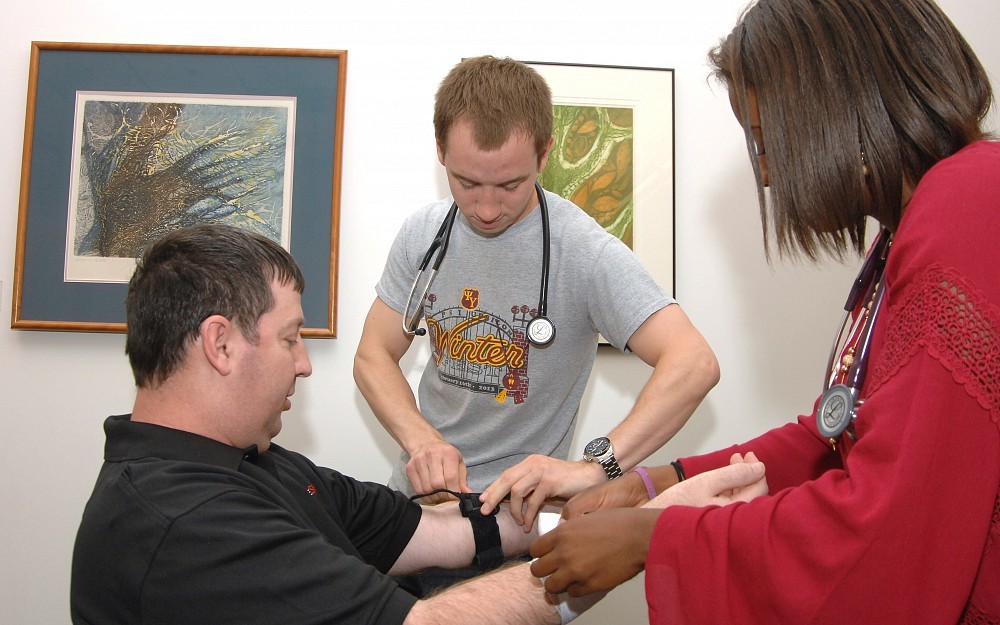
"We have learned how to rapidly assess a trauma victim, stop their bleeding, and make sure we stabilize their spine so we dont do further damage when trying to assist, explains Kulick.
A first responder course helps provide all incoming medical students with a basic level of medical knowledge since they will be required to work with patients throughout their time in medical school, says Kay Vonderschmidt, assistant director in the Division of Emergency Medical Services in the Department of Emergency Medicine.
"Less than 10 percent of all students coming to medical school have any type of medical experience, says Vonderschmidt. "This class is designed to get them all on the same page. The very first day here they begin with lectures and they start learning how to take vital signs.
"We want students to be able to tell if their patient stable versus unstable when they walk into a room, says Vonderschmidt. "If a patient is unstable, the student should know how to stabilize and maintain that patient for five or 10 minutes, at least until help arrives.
"Many of our students are going into clinics and doctors offices and emergency departments or going home with their families and if you find an unstable patient, someone having a heart attack or a diabetic emergency, or someone falls down the steps and has a trauma, what you do in the first 10 minutes can be critical for that patient. It potentially can save their life, explains Vonderschmidt.
Kulick, 23, and a graduate of the University of Michigan, hopes to study either emergency medicine or surgery, while Young, 21, is a graduate of the University of Richmond and hopes to specialize in womens health issues. Youngs mother is an OB-GYN physician while Kulicks father and grandfather are physicians.
Both have watched their family members use their medical training in emergency situations and hope to be able to do the same in the future.
"He has stumbled upon someone who fractured their leg while skiing and was able to respond before the ski patrol, Kulick says, referring to his father. "I also watched my grandfather care for a bicyclist who was hit by a car in Toronto. Just seeing people in my family have that experience, I know at some point we will use this training.

Amber Young demonstrates her skills in the College of Medicine's first responder class.
Related Stories
Cancer Center plays key role in lab research, clinical trials for new pancreatic cancer drug
September 1, 2026

WLWT and WCPO highlighted the contributions of University of Cincinnati Cancer Center researchers that helped lead to the recent FDA approval of daraxonrasib, a new treatment for pancreatic cancer.
Cancer Center physician receives $150,000 New Investigator Research Grant to study treatment-resistant leukemia
September 1, 2026
The University of Cincinnati Cancer Center’s Sarah Skuli, MD, PhD, received a two‑year, $150,000 Leukemia Research Foundation New Investigator Grant to study TP53‑mutated leukemia, a treatment‑resistant subtype with very poor outcomes.
Heavy social media use linked to depression
August 31, 2026

U.S. News and World Report, Yahoo! News, MSN, USA Today and other national media highlight a new study by the University of Cincinnati and Northwestern University that found a correlation between heavy social media use and depression in adults.