
Leukemia and Drug Development Lab trains the next generation of scientific researchers
Three lab members share experiences of hands-on learning

As researchers in the University of Cincinnati Cancer Center’s Leukemia and Drug Development Laboratory work to identify the next generation of treatments for blood cancer patients, they are also preparing the next generation of scientists and physicians.
From undergraduate student workers to members of the Physician Scientist Training Program (PSTP), trainees in the LDDL receive in-depth, hands-on experiences and contribute to real-world discoveries. Several LDDL members shared their stories of working in the lab.
Izzy Adams
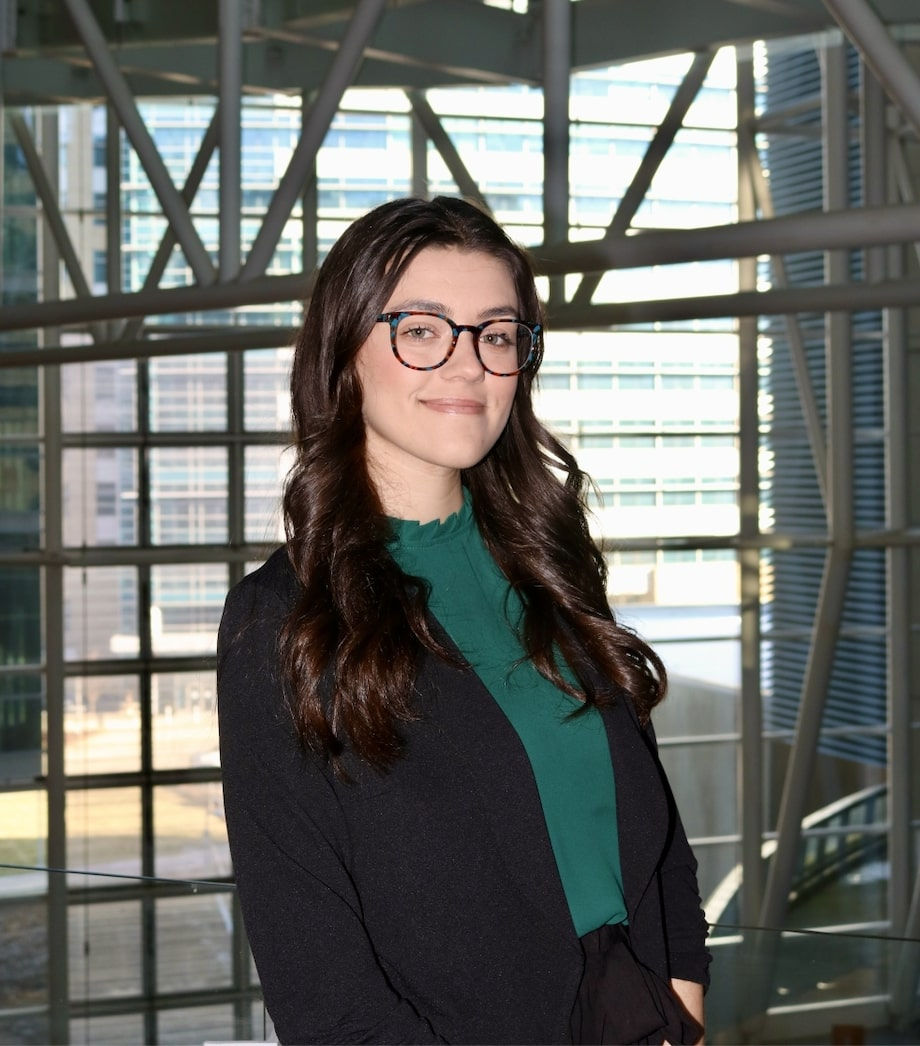
Izzy Adams. Photo provided.
Izzy Adams came to UC for the medical sciences undergraduate program in the College of Medicine.
“It was a really wonderful experience,” said Adams, of Dublin, Ohio. “It’s catered toward preparing students to apply to medical or graduate school or anything along those lines. I came here because it was a medically focused program.”
Adams joined the LDDL as a sophomore student worker and graduated with her undergraduate degree last May.
“Working in the LDDL has been an incredible experience. Our team does a really good job at allowing you to do lots of different projects and learn different things and be very hands on,” Adams said. “I’ve been able to design experiments and have a role in experimental planning, which is something students don’t always get to do, so it was a really unique experience.”
Under the mentorship of Sara Elgamal, PhD, Adams helped research treatments that target BTK, an enzyme that is commonly mutated in chronic lymphocytic leukemia (CLL). There are current BTK inhibitors available, but cancer cells can develop resistance, presenting the need for new second- and third-line therapies if the initial treatments are no longer effective.
“So it was really cool being able to do experiments and help progress work for these patients when their first line therapy doesn’t work,” Adams said.
This year, Adams is working as a full-time research assistant in the lab and has transitioned to studying cellular therapies like CAR T-cells for acute myeloid leukemia (AML). In CAR T-cell therapy, a patient's immune cells are collected and genetically modified to better recognize and attack cancer cells.
“I've been able to conduct studies to create these CAR T-cells and test their efficacy on human cell lines to then be going into a clinical trial where we do this with real patients,” Adams said. “It’s been exciting to see the translational side of my work and how it can go into more clinical settings. It has been really fun as I’ve been able to do that the last few months.”
Adams will begin medical school next fall, but before then she said she is looking forward to the LDDL moving into its new digs in the Blood Cancer Healing Center (BCHC).
“Where we are right now, physically, we’re so far away from patients and sometimes you feel like you're just stuck in a lab,” she said. “But it’s been really exciting to see how integrated we will be in the care team and in patients’ healing journey as you literally walk past the entryway when you walk up to the lab to work everyday. It’s something I find very motivating, being able to actually see who my work is going to help.”
Long term, Adams currently plans to pursue a career as a physician scientist, working both in the clinic and in the lab to accelerate translational research that helps patients.
It’s super exciting to train at a place where there is lab space, clinic space, infusion center space, all together.
Dennis Vroom, MD
Dennis Vroom
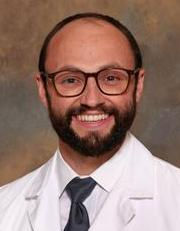
Dennis Vroom, MD. Photo/University of Cincinnati.
During medical school at Case Western Reserve University, Dennis Vroom, MD, found himself drawn to a career as a physician scientist.
“You see patients in the clinical space and run into certain challenges, which leads to new questions. And the lab space is where you get the time and ability to answer some of those questions that you encounter,” Vroom, of Columbus, said. “They marry really well, and each one pushes the other.”
Vroom’s wife was in medical school at UC, and following his third year at Case, he took a gap year to focus on research in the LDDL. During his time in the lab, he assisted with testing a novel therapeutic compound, HOSU-53, that is now being tested in clinical trials.
“Being able to come in and help on the tail end and see that drug make it to the clinical trial space was very cool and was one of the highlights of the year I spent in the lab,” he said. “And the people in the LDDL were very special. I loved all the mentors and colleagues I had, and on a day in, day out basis, I think they’re who made the work really fun.”
In addition to hands-on experience, Vroom said the research year impacted his decisions on where to apply for residency and beyond. He opted to stay at UC and began the clinical portion of his PSTP training this fall.
“I really enjoyed my time in research at UC, and with the Blood Cancer Healing Center, we were building something special. It’s super exciting to train at a place where there is lab space, clinic space, infusion center space, all together,” he said. “So I’m encouraged to continue to be a part of that, to keep working in the LDDL, to keep developing as a physician through residency and through fellowship. It’s an exciting time to be part of the Cancer Center.”
Designed for those looking for a career in academic medicine, participants in the PSTP typically spend two years of clinical medicine training, one to two years of fellowship training and three years conducting subspecialty research in the lab, with dedicated funding and mentorship to help them succeed.
“PSTP is a very unique opportunity,” Vroom said. “I think a difficult part of the research space is time and resources and in the physician scientist training program you have significant dedicated time to work on research. That’s something very hard to find.”
Long term, Vroom plans to continue to specialize in hematology and blood cancers.
“My wife’s mother passed away from multiple myeloma, so that has a special place in my heart as projects come up,” Vroom said. “But I think both benign and malignant hematology are very exciting to me.”
That really drives me, that this could potentially change somebody’s life, that this could potentially be something that even one person benefits from.
Maria Adames
Maria Adames
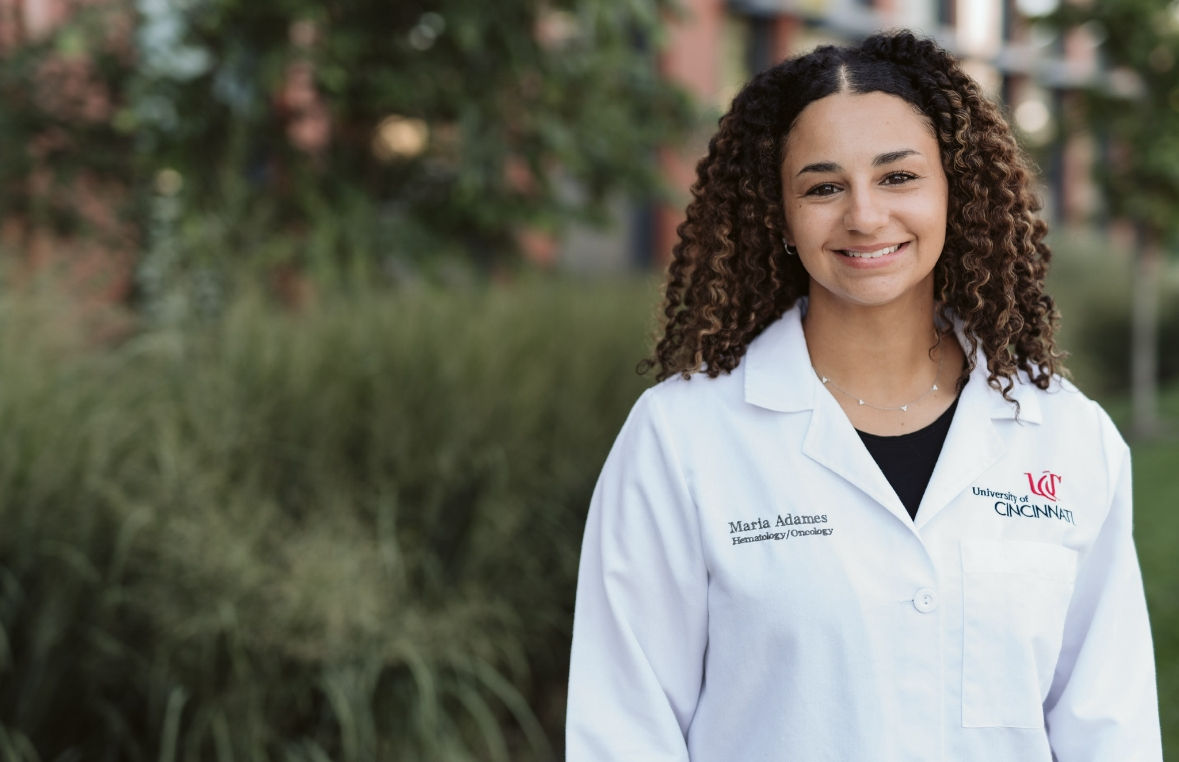
Maria Adames. Photo provided.
After beginning her freshman year at the University of Tampa, Cincinnati native and Winton Woods High School grad Maria Adames transferred home to UC as a biology major “to explore a little bit of everything that science has to offer.”
She knew she had an interest in medicine and was open to a variety of career paths, so she joined the Healthcare Exploration Through Patient Care program, a course that allows students to work as patient care assistants within UC Health to get firsthand experience working in health care. Through the program, Adames worked in the burn unit, emergency department and ear, nose and throat clinic’s intensive care unit.
That’s when she really knew she wanted to be in a health care environment. “Where at? I don’t know exactly,” she said.
When Adames asked her instructor about laboratory research opportunities, she was connected with Megan Johnstone in the LDDL. Adames has now been working in the lab for more than a year.
This past summer, Adames was a Summer Undergraduate Research Fellow in the Cancer Research Scholars Program, giving her the opportunity to begin a research project of her own under lab mentors.
Adames is testing two novel drugs from a partner pharmaceutical company designed to inhibit a protein called NLRP3 that is known to be highly expressed in acute myeloid leukemia and drive inflammation, which in turn helps the cancer grow.
“My first year in the lab was mainly learning basic science skills such as genotyping — but once I joined the SURF program and got my own project, it was hard because it’s a lot of trial and error,” Adames said. “It’s seeing what works, what doesn’t work, and a lot doesn’t work. So it was definitely a slap in the face to see what people go through to even develop one drug. I’ve been working on this for six months now and it still has a lot of work to be done.”
As her research continues, Adames said she is encouraged to work in the LDDL, where leaders like Erin Hertlein, PhD, and John Byrd, MD, have a track record of developing drugs that have made an impact in patients’ lives.
“That really drives me, that this could potentially change somebody’s life, that this could potentially be something that even one person benefits from,” she said. “When I actually see the NLRP3 inhibition physically in front of my eyes, it makes you feel not only like you did something, but also a sigh of relief, because you’re putting in all these hours and all this work. Getting an answer, good or bad, is valuable.”
One of Adames’ favorite memories of her time in the lab so far came on a Friday afternoon after the team came back inside following a fire drill.
“One of my coworkers had gotten some great results on a project she’s working on, and Dr. Byrd walked around and had everyone cheer for her,” Adames recalled. “It’s an uplifting environment.”
Adames will graduate in the spring with her undergraduate degree in biology and a certificate in clinical and translational science. Before applying to medical school, she plans to spend another year in the LDDL and is looking forward to the move to the BCHC.
“We’re so secluded here on the seventh floor of the CARE/Crawley Building,” she said. “Us being over there in the environment that our patients are in, that other researchers are in, I think it’ll make the collaboration side of it and furthering science not only quicker, but on a closer level.”
The next groundbreaking discovery
UC is a powerhouse of discovery and impact as a Carnegie 1 research institution. From pioneering medical research to transformative engineering and social innovation, our faculty and students drive progress that reaches across the world.
Featured photo at top of mentor Sara Elgamal, left, and Izzy Adams, right, presenting a research abstract poster. Photo provided.
Related Stories
Student-designed AI platform aims to match patients to specific cancer support groups
December 5, 2025
The University of Cincinnati is launching a clinical trial testing a student-designed, machine-learning powered platform to match patients with cancer to support groups specifically tailored to their needs and concerns.
UC medical students help shape new interdisciplinary training pathways
November 18, 2025
The University of Cincinnati’s College of Medicine is launching the new Interdisciplinary Medical Pathways Across Training (IMPAcT) program this academic year with two initial tracks: Humanities and Arts in Medicine and Healthy Communities.
From spilled milk to super-resolution microscopy
April 15, 2026
University of Cincinnati student Eddie Gerstner will graduate this semester and enter medical school later this year. Born with a severe milk allergy, he has overcome numerous life-threatening reactions since.