Cancer Physician Scientists Awarded Pilot Grants to Impact Clinical Care

As a way to foster research impacting patient care, two Clinical Research Pilot Grants were recently awarded to physician scientists within the UC Cancer Institute.
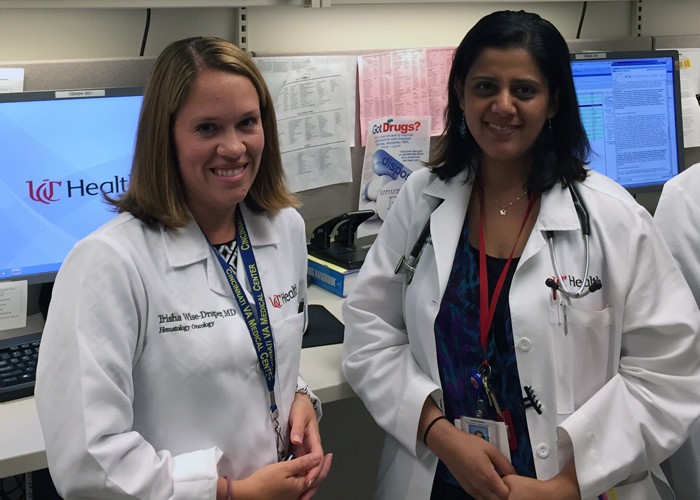
Trisha Wise-Draper, MD, PhD, assistant professor within the Division of Hematology Oncology, Department of Internal Medicine, and her mentee Shuchi Gulati, MD, who is a fellow in hematology oncology, was awarded $41,000, and Thomas Herzog, MD, a faculty member in the Division of Gynecologic Oncology, Department of Obstetrics and Gynecology, and clinical director of the institute, were awarded $50,000 for their proposals.
Type 2 Diabetes Drug Effect on Survival of Head and Neck Cancer Patients
Wise-Draper and Gulati are investigating whether or not metformin, a drug used to treat Type 2 diabetes, used during chemotherapy and radiation in head and neck cancer patients who are not candidates for surgery impacts overall survival rates.
"Head and neck cancer is the sixth most common cancer worldwide, says Wise-Draper. "While smoking and tobacco use are mentioned most frequently as causative agents, human papilloma virus (HPV) is now also recognized as a significant risk factor for head and neck cancer. Interestingly, HPV positive tumors have better response rates for treatment regardless of the treatment chosen.
"Despite this and advancements in surgical and radiation techniques and improved targeted therapies, the survival for head and neck cancer patients with later stage disease has declined over the last two to three decades; patients continue to have frequent relapses after primary treatment, in some cases greater than 50 percent, and have a survival rate of 10 to 15 percent after recurrence, demonstrating a need for improved treatments with higher response rates.
Wise-Draper says there has been a recent interest among clinicians and lab researchers to study the benefits, if any, of combining metformin with chemotherapy.
"Metformin is sometimes used to treat patients with polycystic ovarian syndrome, metabolic syndrome, and pre-diabetic states in addition to Type 2 diabetes, she says, adding that the drug is available at a low cost and doesnt have many side effects. "Several studies have shown that metformin reduces the incidence of and death caused by cancer, but this result has not been consistent for all cancer types.
Wise-Draper says the UC Cancer Institute has started a phase-1 investigator-initiated trial to look at dosages of the drug in relation to chemo and radiation therapy for patients with advanced head and neck cancer. This funding will help to further conduct the study.
"The mechanism metformin affects to cause positive responses in cancer patients is a subject of interest for researchers, she says. "Most head and neck cancers have been shown to exhibit strong activity in the mTOR-signaling pathway, particularly in HPV positive tumors. The mTOR pathway is responsible for cell growth and survival. The effect of metformin on mTOR activity has been described in patients with breast cancer as well as others and has been shown in recent studies to do so in head and neck cancers.
"In addition, it has also been shown that stopping mTOR may activate cell-destroying T cells, or the immune cells in the body. T cell infiltration and activity is important for tumor response in head and neck cancers as well as other tumor types. These findings could help us determine if an already FDA approved drug could help with treating head and neck cancers.
Quality of Life Assessments for Women Treated With Cytotoxic (Cell-Killing) Chemotherapy
Herzog says his study will be looking at qualitative methods being used to gauge quality of life for cancer patients to better understand their efficacy and possibly improve them.
"The impact of chemotherapy treatment on the way a patient functions has become an important clinical reference point for interpretation of tolerance of cancer-related treatment, says Herzog. "Many tools, predominantly questionnaires, have been developed and validated to reflect treatment effects on physical, emotional and spiritual well-being. However, quantification with objective measures of physical activity and sleep has not been attributed to these alterations in well-being during therapy.
"We seek to understand how physical activity as measured in motility, exercise and sleep consistency is reflected on validated subjective measures of well-being.
Herzog says a number of wearable devices have recently been developed to track energy use (calories burned), sleep patterns and additional important biologic data.
"These devices can automatically download data for ready analysis and can record continuous data versus the intermittent data collected with current quality of life assessment tools, he says.
Herzog adds that quality of life information in ovarian cancer patients has gained increasing importance.
"Since most women have advanced stages of the disease and many treatments have similar efficacy, differences in quality of life may help in choosing the best treatment regimen for the patient, he says. "In addition, systematic documentation of quality of life among those enrolled in a clinical trial may help in providing information to future non-trial patients regarding the expected effects of therapy as they make their treatment choices.
"In this trial, quality of life will be assessed using the Trial Outcome Index of the Functional Assessment of Cancer Therapy-Ovarya 26-item summary score capturing quality of life measurements of physical well-being, functional well-being and the ovarian cancer subscale. We wanted a cross section of women being treated with similar chemotherapeutic treatment regimens so we would like to include breast and lung cancer patients as well.
"We hope that our findings will lead to a better understanding of quality of life assessments and how we can tweak them to collect more objective data.
Co-principal investigators on the study include Eric Eisenhauer, MD, and Amanda Jackson, MD, gynecologic oncologists; Elyse Lower, MD, breast cancer oncologist; Sian Cotton, PhD, integrative health and wellness researcher; and John Morris, MD, lung cancer oncologist.

Thomas Herzog, MD
Tags
Related Stories
UC expert weighs in on current MASH treatment approaches
June 5, 2026

As MedCentral recently reported, pending broader pharmacologic approvals for metabolic dysfunction-associated steatohepatitis (MASH), lifestyle modifications remain the go-to intervention.
At least two weather patterns increase headaches, UC study suggests
June 4, 2026
University of Cincinnati physicians and collaborators identified two specific weather patterns that increase headache and migraine risk and found the preventive medication fremanezumab (Ajovy) can reduce weather‑associated headaches. The findings will be presented at the American Headache Society Annual Scientific Meeting in Orlando.
UC researcher secures $3.3M grant to study microplastics’ impact on heart
June 2, 2026
The National Institute of Environmental Health Sciences awarded a $3.3M grant to University of Cincinnati researcher Hong‑Sheng Wang, PhD, to study how microplastics and nanoplastics affect cardiovascular health.