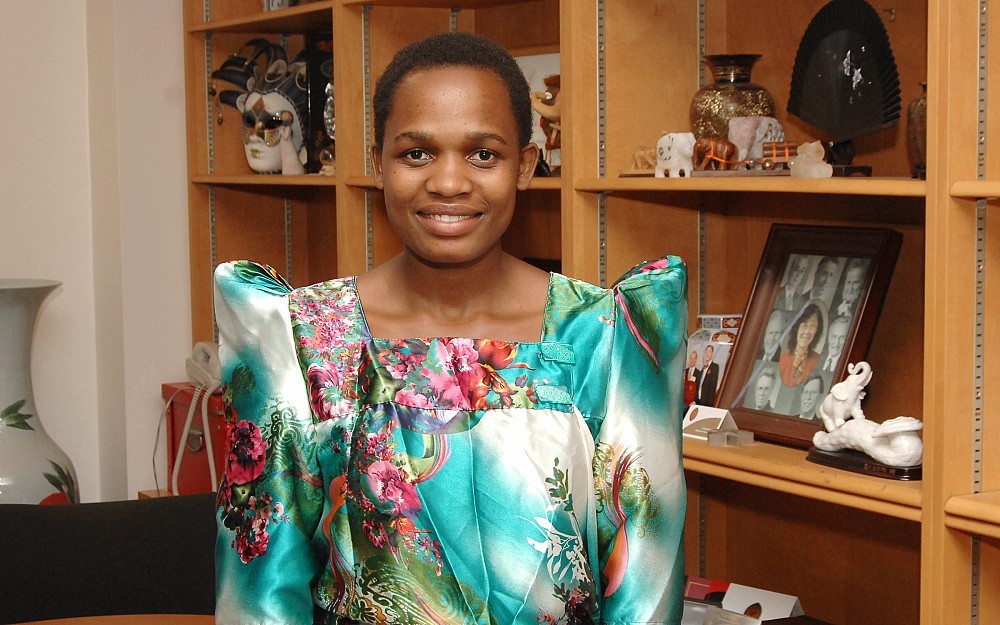
Focus On Alumni With Maria Nakafeero

Maria Nakafeero, 28, recently graduated from the Masters of Public Health Program within UCs Department of Environmental Health. A Uganda native, she is the sixth out of nine living children in her family. Nakafeero received her undergraduate degree in Clinical Medicine and Community Health from Mbale School of Clinical Officers in Uganda. She came to Cincinnati through the support of a local nonprofit organization called Hope for Kabingo, which helped fundraise for her tuition and allowed her to pursue her graduate studies at UC.
What led to you receiving your masters in public health at UC? What is your concentration?
"My MPH concentration is in Health Services Management. I became interested in doing a MPH after experiencing firsthand the devastating impact of deaths due to preventable causes like malaria, diarrhea and pneumonia among the people in my village including some of my siblings.
What are some of the most valuable or important things you learned through the program? What would you tell other students?
"Valuable skills that I have learned in my program include but are not limited to analytical skills, critical thinking skills, writing skills, the significance of evidence and best practices in advancing public health and finally how to work with the rest of the stakeholders, including the community and political leaders, to improve the health of the public.
"I would tell the rest of the students to take time to synthesize the classroom material so that its relevance goes beyond just grades. I am also planning to sit for my Certificate in Public Health (CPH) exam, an accreditation by the National Board of Public Health Examiners. I would encourage fellow students to consider taking that certification too.
We've heard that you'll be returning to Uganda and helping with a clinical trial there. Could you tell us more about the organization and how you will use your training? Also, could you share more about the clinical trial?
"I will be working with Global Health Uganda, in collaboration with Cincinnati Childrens Hospital Medical Center and Indiana University, on a clinical trial called the Novel use Of Hydroxyurea in an African Region with Malaria (NOHARM) as a Research Coordinator.
"I will have two important roles: First, as the main Transcranial Doppler (TCD) examiner, carrying out TCD exams that are used to assess the potential risk for stroke among NOHARM study participants; second, collecting blood samples for hydroxyurea pharmacokinetics in the children.
"NOHARM is a first of its kind clinical trial to investigate the safety and efficacy of hydroxyurea for children with sickle cell anemia in a malaria endemic region within sub-Saharan Africa. The study will be able to provide important evidence-based information to help improve the care and treatment of individuals with sickle cell in Uganda.
"Global Health Uganda is a multi-disciplinary research corporation conducting research on a wide range of topics including sickle cell anemia and neurodevelopmental outcomes in children with severe malaria among others.
"The various courses in my training, for example Evidence Based Public Health, Biostatistics, Epidemiology and others have set a stage for me to understand my job well. And much of the major part of my job is carrying out these tests, like the TCD exams and pharmacokinetic blood draws. The critical thinking skills that I have learned will be essential for me to know why I am doing, what I am doing. In addition with my MPH training, I know the relevance of accuracy and paying attention to detail and protocol as I conduct these tests. This will enable me to avoid any errors due to negligence.
What do you like to do in your spare time? What are some hobbies or likes outside of your passion for global health?
"My hobbies include listening to music, watching movies, spending time with friends and praying.
Tags
Related Stories
UC radiation oncologist speaks with Local 12 news about clinical trial for head and neck cancer treatment
August 10, 2026

Dr. Sara Medek, a UC radiation oncology professor, speaks with Local 12 news about a new clinical trial aimed at reducing radiation in certain areas while still treating cancer effectively but with fewer painful side effects.
Cancer Center director charts future based on collaboration, AI
August 10, 2026

David Gius, MD, PhD, was featured in a Cincinnati Business Courier article and The Cancer Letter’s “The Directors" podcast discussing his priorities and goals as he recently took the helm as director of the University of Cincinnati Cancer Center.
Bidirectional link between oral, kidney health calls for patient education, access
August 4, 2026

Despite growing awareness of the connection between oral health and chronic health conditions, patient awareness and access to dental care remain limited, according to University of Cincinnati experts who recently spoke with Healio | Nephrology News & Issues.