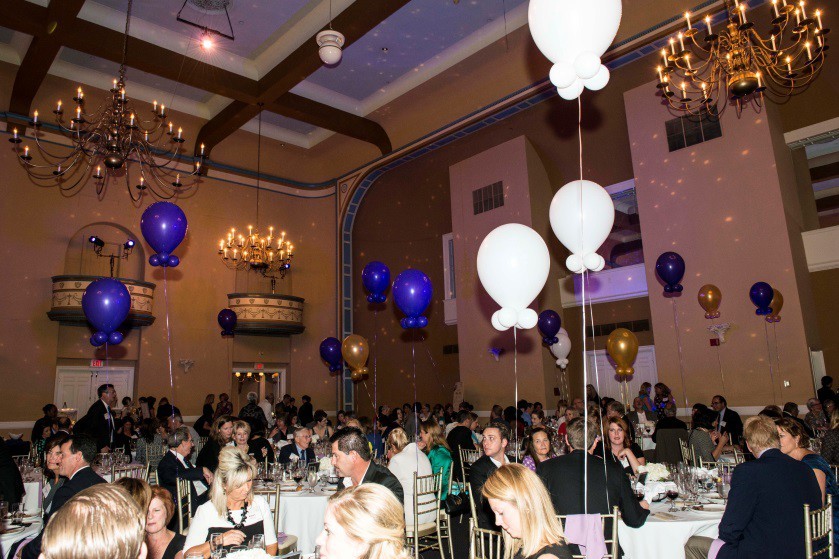
Gala Aids in Transformation of Care for Dementia and Memory Disorders

UC Health and the University of Cincinnati have begun steadily transforming the way memory disorders are being treated in Cincinnati. Supporting this transformation is the Forget-Me-Not Gala, held Sept. 25, which netted a record $60,000a 40 percent increase over last year. These funds are earmarked for Alzheimers disease research at the UC Neuroscience Institute.
At the gala, Joseph Broderick, MD, director of the UC Neuroscience Institute and professor of neurology and rehabilitation medicine at the UC College of Medicine, announced a generous donation from Dorothy "Bunny Whitaker that has made it possible for UC Health to add a nurse practitioner and a social worker to the multidisciplinary team at the UC Memory Disorders Center. The Memory Disorders Center is one of 14 centers and programs within the UC Neuroscience Institute, a collaboration of the University of Cincinnati and UC Health.
"These are important positions that have a significant impact on the patient experience, Broderick said. "They add depth to the growing clinical team, which includes physicians from neurology, sleep medicine, geriatrics, neuropsychology and psychiatry.
This transformation has accelerated, particularly since the arrival last year of Rhonna Shatz, DO, medical director of the Memory Disorders Center. Shatz, who holds the Sandy and Bob Heimann Chair in Research and Education of Alzheimers Disease at the College of Medicine, came from Detroit, where she built a comprehensive memory disorders center at Henry Ford Hospital.
"Theres an elephant in the room: its called Alzheimers disease, Shatz said. "It is a silent development that begins three decades before we know that its there. Treating it when it is dementia does not work. We must treat it before it becomes dementia.
Some tangible signs of this recent transformation include:
- The Memory Disorders Center has implemented the National Institutes of Healths "Toolbox, which is a set of mental tests that enable doctors to pick up on the very earliest changes in cognition. People are being scheduled for this test annually so they can empirically track the progression of their disease. Ideally, Shatz said, all adults would take the test each year beginning in mid-life, much as they do a cholesterol test. That way, people would be able to monitor their cognitive ability according to their own history, and can proactively intervene if a worrisome trend is observed.
- The Memory Disorders Center has expanded access geographically in the past year. People may now see memory specialists at UC Health Physicians offices in multiple locationsClifton, West Chester and Daytonfor newly diagnosed dementia, as well as management of risk factors for dementia.
- Another major shift has been the increasingly strong rapport and collaboration being forged between the Memory Disorders Center and the Alzheimers Associations Greater Cincinnati Chapter. Shatz views the associations prevention programs and lectures as critical resources for everyone, regardless of whether they have a dementia diagnosis.
- The Memory Disorders Center is developing specialized programs for patients who experience memory issues related to other neurologic diseases. One of these brand new initiatives is the launch of the first cognitive testing program within the Gardner Family Center for Parkinsons Disease and Movement Disorders. Federico Rodriguez-Porcel, MD, a neurology fellow with experience in movement disorders, was recruited to assist with launching this new program.
- The University of Cincinnati has achieved accreditation, through the UC Department of Neurology and Rehabilitation Medicine, for a new behavioral neurology fellowship from the United Council for Neurologic Subspecialties.
- In the last year, the Memory Disorders Center has implemented every aspect of the guidelines of the American Academy of Neurology for quality treatment of dementia in order to fit the national model of excellence.
Shatz urged those in attendance to become advocates and to speak openly about Alzheimers disease, which is the most expensive disease in America, costing an estimated $214 billion a year and claiming a new patient every 67 seconds.
To get involved in the Forget-Me-Not Gala or other UC Neuroscience events, contact Peggy AHearn.
Related Stories
UC radiation oncologist speaks with Local 12 news about clinical trial for head and neck cancer treatment
August 10, 2026

Dr. Sara Medek, a UC radiation oncology professor, speaks with Local 12 news about a new clinical trial aimed at reducing radiation in certain areas while still treating cancer effectively but with fewer painful side effects.
Cancer Center director charts future based on collaboration, AI
August 10, 2026

David Gius, MD, PhD, was featured in a Cincinnati Business Courier article and The Cancer Letter’s “The Directors" podcast discussing his priorities and goals as he recently took the helm as director of the University of Cincinnati Cancer Center.
UC graduates cross finish line at commencement
August 7, 2026
The University of Cincinnati recognized 2,125 graduates in two ceremonies at summer commencement Friday on campus at Fifth Third Arena.