Retreat Brings Cancer Researchers, Clinicians Together for Collaboration

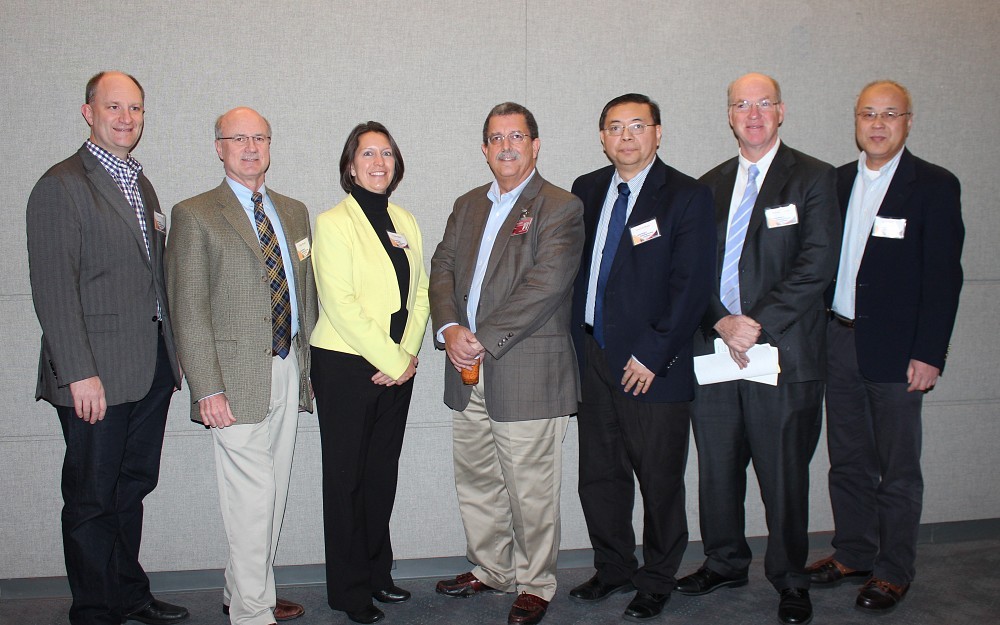
To foster collaboration among researchers and physicians with the goal of improving cancer outcomes, the Cancer Biology and Hematology Oncology Joint Retreat was held Saturday, Nov. 14, on the UC Reading Campus.
The day highlighted progress from cancer researchers representing clinical and research units from across the Academic Health Center, including the University of Cincinnati Cancer Institute and Cincinnati Childrens Hospital Medical Center. Joining the clinicians and scientists were prominent community supporters and donors, who participated in the plenary presentations, networking sessions and a research poster competition.
"Our goal for the day was to foster scientific exchange and collaboration among the cancer-focused clinicians, scientists and leaders who are focused on advancing cancer care and science, said co-organizer Susan Waltz, PhD, professor in the Department of Cancer Biology, who worked alongside David Plas, PhD, associate professor in the Department of Cancer Biology, and Xiaoyang Qi, PhD, professor in the Division of Hematology Oncology, to make the day a success. "The event was well attended, and I think everyone walked away with new relationships and a reinvigorated energy for working together.
The event began with opening remarks from Academic Health Center leaders. "Im here to speak on behalf of the Board of Trustees and President Santa Ono who are strongly committed to our cancer efforts, said William Ball, MD, Christian R. Holmes Professor and dean of the University of Cincinnati College of Medicine and senior vice president for health affairs. "As research faculty, our success in this effort will depend in large part on your success as cancer researchers, and in this regard, we owe all of you a great deal in of gratitude. Our commitment goes beyond just opportunity, but rather we have a responsibility to our community to be successful in this fight. This forum is an excellent example of what we need to do to have innovative ideas go from the bench to the bedside by bringing basic science researchers together with clinical researchers to share information.
Gregory Rouan, MD, Gordon and Helen Hughes Taylor Chair in Internal Medicine, agreed, noting that basic researchers make a difference in how clinicians treat patients both within the UC Cancer Institute and worldwide. He also shared his thoughts on the need to retain bright minds in science and how his department has implemented a mentoring program and internal grant support for junior, mid-level and senior clinician investigators.
"Thoughout the day, I urge you to turn the tables so to speak from our typical bench to bedside approach, he said. "Think also bedside to bench as such might allow the clinicians to align their observations, problems and passions by posing questions that might lead to relevant experiments and short-term successes.
Jun-Lin Guan, PhD, Francis Brunning Endowed Chair and professor of cancer biology, gave a brief overview of the Department of Cancer Biology and its progress since the departmental retreat held in November 2014. He also mentioned the need for mentoring young researchers to keep them in science and being successful at UC.
"We are continuing to build our department and our programs in line with the goals of the College of Medicine and cancer programs overall, he said. "We need to optimize interactions among scientists and clinicians and support our young researchers and faculty in every way possible.
Following the opening remarks, the scientific program started with a keynote address by Jeffrey Whitsett, MD, professor of pediatrics at UC and co-director of the Perinatal Institute at Cincinnati Childrens. Whitsett talked about the use of single cell RNA analysis to define cell fates in the healthy and diseased lung. "It was an honor to have Dr. Whitsett present his innovative research on generating a lung atlas which can be used by scientists and clinicians to understand disease processes. The topic was a perfect start to the day demonstrating the amazing accomplishments that can be achieved by clinicians and scientists working together, said Qi.
One of the highlights of the day was the poster competition featuring the latest laboratory findings in cancer mechanisms and therapeutics. There were a record 47 posters, which filled the presentation facility, overflowing into adjoining space.
"There was tremendous energy from our scientists presenting their latest findings and advising their colleagues, said Plas.
First-place and honorable mention prizes were distributed to two students and two postdoctoral fellows. All attendees voted on their favorite submissions using a QR code which directed them to an online survey.
The winners were:
Graduate Students
Pankaj Dwivedi received first place for "Phosphoproteomic Analysis of Normal and Mutated Colony Stimulating Factor 3 Receptor (CSF3R) Signaling.
Nick Brown received honorable mention for "Ron Receptor Signaling Promotes Resistance to Androgen Ablation Therapy in Prostate Cancer.
Postdoctoral Fellows
Vidjaya Letchoumy V Premkumar, PhD, received first place for "The Interplay of Ron Signaling in Epithelial Cells and Macrophages Facilitates Breast Cancer Cell Growth and Migration.
Nancy Benight, PhD, received honorable mention for "The Ron Receptor Promotes Tumor Growth Through Inhibition of IRAK4 and Suppression of Type I Interferon Signaling.

UC Cancer Institute Director and Radiation Oncologist William Barrett, MD, speaks with cancer researcher Nira Ben-Jonathan, PhD, before the day's event began. The retreat was held to encourage collaboration among cancer researchers and clinicians at UC.
Related Stories
UC expert weighs in on current MASH treatment approaches
June 5, 2026

As MedCentral recently reported, pending broader pharmacologic approvals for metabolic dysfunction-associated steatohepatitis (MASH), lifestyle modifications remain the go-to intervention.
At least two weather patterns increase headaches, UC study suggests
June 4, 2026
University of Cincinnati physicians and collaborators identified two specific weather patterns that increase headache and migraine risk and found the preventive medication fremanezumab (Ajovy) can reduce weather‑associated headaches. The findings will be presented at the American Headache Society Annual Scientific Meeting in Orlando.
UC researcher secures $3.3M grant to study microplastics’ impact on heart
June 2, 2026
The National Institute of Environmental Health Sciences awarded a $3.3M grant to University of Cincinnati researcher Hong‑Sheng Wang, PhD, to study how microplastics and nanoplastics affect cardiovascular health.