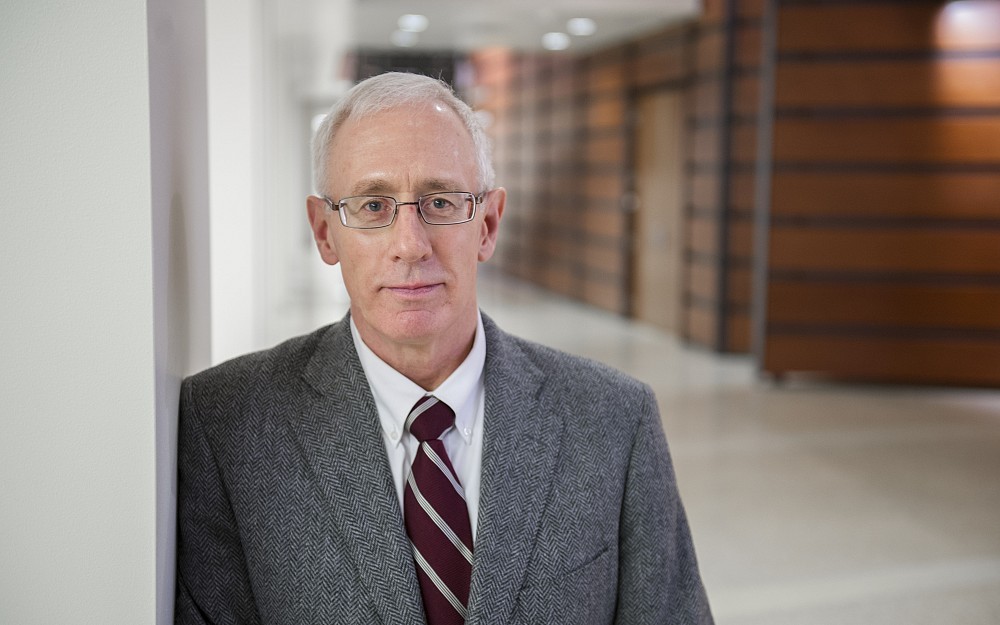
Daniel Burr Retires from Medical Education

After 24 years at UC, Daniel Burr, PhD, will retire from his position as assistant dean for student financial planning for the College of Medicine on Monday, Feb. 1, 2016. During his tenure he has provided thousands of medical students with guidance and direction while navigating the complexities of financing their education. He has been a leader in student affairs at regional and national levels in the Association of American Medical Colleges. Burr enhanced the education of medical students by helping to create a year 4 elective, Medicine and Literature, in which students read and reflect on works of literature pertaining to their evolving role as future physicians. Before his retirement, Burr agreed to share some thoughts about his tenure at the College of Medicine.
What brought you to UC College of Medicine?
I wanted to find a position in Cincinnati because my partner was working here. We had pursued our careers in different cities for a number of years with the hope that we would someday end up in the same place. I worked in medical school admissions in Chicago for 12 years and had gotten to know colleagues in student affairs at other Midwestern medical schools. I let Bob Suriano, the associate dean for student affairs and admissions at the time, know that if a position at the UC College of Medicine ever opened up, I would be interested. When Bob told me he was looking for a financial aid officer, despite knowing very little about financial aid, I applied for the job and he hired me.
What attracted you to the financing of medical education?
Initially, it was the chance to work in Cincinnati. Over time, I came to realize that the way we finance medical education in America, which for most students is through loans, plays a role in a number of important things. It affects young people from families oflimited means who are trying to decide if going to medical school will be possible for them. It influences the specialty choices made by medical students who are concerned about repaying large educational debts. It may also determine where physicians decide to practice. In effect, the way students pay for medical school plays a role in the health care received by Americans. People who work in medical school financial aid find themselves immersed in broad issues of higher education and health care policy. It is actually a very stimulating field.
How did you develop an interest in literature in medicine?
I was an English major in college and graduate school. I knew there was a wide range of literary works with medical themes, and I discovered we have several brilliant physician writers. Once I felt I had my administrative duties under control, I approached colleagues in medical education and proposed offering a seminar in medicine and literature for medical students. I began teaching these seminars at Loyola-Stritch School of Medicine in Chicago in 1986.
How has the medical school changed in the nearly 25 years youve been here?
The Deans Office, Student Affairs and Medical Education shared a single suite of offices when I began working here. This made it easier to interact with senior administration and colleagues in different areas. Over time, each area grew and became more specialized as people addressed the growing complexity of health care and medical education. Eventually our offices were spread all over the MSB and we lost some sense of cohesion. The one common link has been the students. In our different ways, we are all working to make them competent and caring physicians.
What are some of your favorite achievements while at the College of Medicine?
I was only the second financial aid officer in the history of the College of Medicine. I worked hard to create a financial aid system that addressed the specific needs of our students. In the process, I tried to engage medical students as partners with the financial aid office in the funding of their education and to prepare them to manage their educational debt after graduation. I am very proud of this engagement with students. I am also gratified by the seminars in medicine and literature I taught at the College of Medicine for 16 years. They taught me more about medical students than any other aspect of my work.
What outside interests do you pursue?
Reading, writing, gardening and a love for the art pottery produced in Kentucky from the early to mid-20th century. A close friend introduced me to the Cincinnati art world and I collect the work of a number of local artists.
Any new interests youll take on during your retirement?
How to "be rather than how to "do. Eventually I plan to tutor inner city school students in Covington.
Related Stories
On-site training in Speech & Hearing Clinic sets UC’s programs apart
August 27, 2026
At the University of Cincinnati’s Speech & Hearing Clinic, Doctor of Audiology and Speech-Language Pathology graduate students gain real-world experience while providing free speech and hearing services to the community.
Designing with cancer patients' needs in focus
August 27, 2026
Kristina Shin is designing garments that prioritize the comfort, function and confidence of breast cancer patients, addressing a need often overlooked by traditional fashion.
UC, NKU renew longstanding partnership supporting Army ROTC cadets
August 26, 2026
The University of Cincinnati Army ROTC and Northern Kentucky University (NKU) have renewed a longstanding partnership that supports students preparing to become Army officers and leaders in their communities. The universities formalized the renewed agreement during a signing event Aug. 11 at NKU.