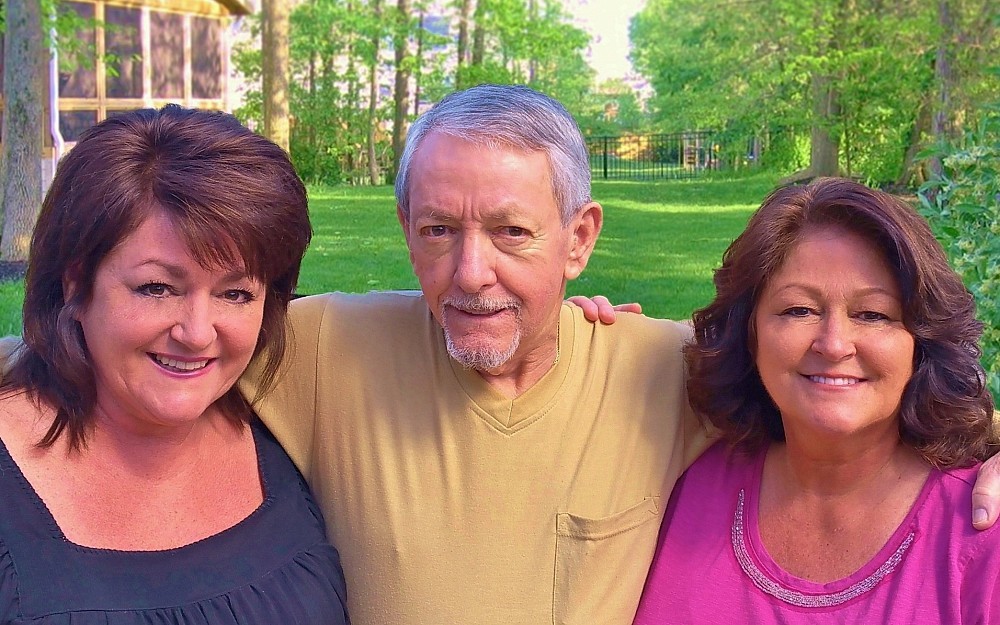
Patient Survives Stage IV, Inoperable Throat Cancer Thanks to UC Trial

It took a white lie to get David Polisini, 79, to a doctor in 2004, after months of being unable to swallow.
"Two of my daughters, Toni and Susie, showed up on my back porch and told me to put my jacket on, he says. "They told me we were just going for a ride, but the next thing I knew, we were pulling into the Clermont Mercy Hospital.
Polisini says tests ordered in the emergency room uncovered a tumor in his throat.
"It was the size of a golf ball, he says, adding that he then scheduled an appointment with his primary care physician, Francis Dumont, MD. "I was then referred to an ear, nose and throat physician within his group who said I needed to see someone at the University of Cincinnati (UC) Cancer Institute.
A biopsy was performed, and a diagnosis was confirmedit was Stage IV cancer.
"I began seeing Dr. (Bill) Barrett who explained that I would need to go through very aggressive radiation along with chemotherapy five days a week for three months, he says. "Id drive myself every day to every visit in my little Miata. The therapy really zapped my strength, but Im here because of it.
"I really dont think I realized how much trouble I was in with Stage IV inoperable cancer, but I knew I had to do what I had to do to get through it.
The radiation and chemo regimen was a Phase III clinical trial at UC, studying the effects of the use of both radiation and chemotherapy for advanced head and neck cancers.
Besides his family, Polisini credits Barrett, chair and professor of the UC Department of Radiation Oncology and director of the UC Cancer Institute, as well as the staff and care providers at the Barrett Center, where he received treatment, with being a tremendous support.
"Dr. Barrett was there with me every step of the way, he says. "He was so dedicated to helping me, as were the other nurses and staff at UC. Im just so impressed with everyone who works there. They stood by me the whole time, and more than 10 years later, Im doing fine, and the cancer hasnt come back. To me, Dr. Barrett is an angel come to Earth.
The clinical trial seems to have worked, and Polisini, who lives in Clermont County, says that while he has a primarily liquid diet, he doesnt regret a thing.
"By golly, Ill trade the ability to eat with the ability to get up every morning, he says. "I have the energy to do the things I want and have to do. I go to the Y every other day to exercise. I do my own house and lawn work. I just put a new floor on my front porch. I can only do these things because of the outstanding treatment I received at the UC Cancer Institute and the Barrett Center.
And he warns others to not ignore symptoms, like he did.
"If you have something wrong, see a doctor right away, unlike I did, he says. "Im just thankful for my daughters and Dr. Barrett for helping me.

William Barrett, MD, is chair of UC's radiation oncology department.
Tags
Related Stories
'Discovery, mentorship, momentum': UC College of Medicine's graduate programs celebrate year of success
September 22, 2026
From new mentorship honors to a growing research pipeline, see how the University of Cincinnati College of Medicine's graduate programs made this a standout year.
Tina Cheng, MD, receives American Academy of Pediatrics’ highest honor
September 22, 2026
UC Pediatrics chair Tina Cheng, MD, has received the American Academy of Pediatrics' highest honor for her decades of advancing child health.
This September, give blood for local patients fighting cancer and sickle cell disease
September 18, 2026
September is dedicated to raising awareness of several serious diseases, including sickle cell disease and childhood cancer. For patients in Greater Cincinnati fighting these diseases, awareness is only part of the equation. They also need lifesaving blood products.