Allied Health Celebrates Student Research at Annual PRaISE Conference

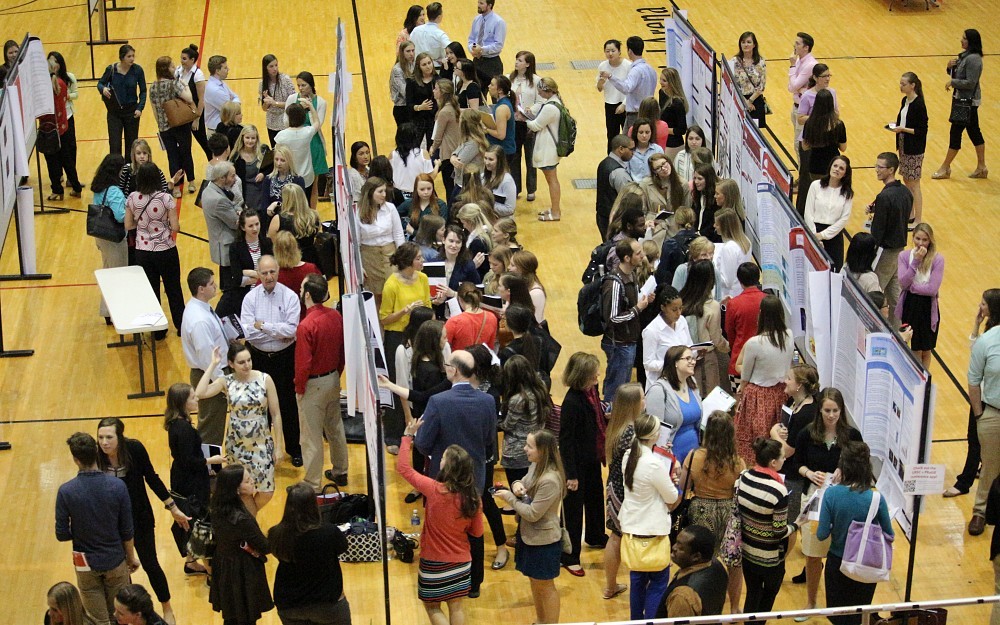
For the 18th year, the spotlight shined on undergraduate and graduate student research at the University of Cincinnati (UC) College of Allied Health Sciences (CAHS) annual Presentation of Research and Innovative/Scholarly Endeavors (PRaISE) conference on Friday, April 22, 2016 at Fifth Third Arena.
The daylong conference included student presentations, distinguished alumni awards and a keynote address from UC Vice President for Research Patrick Limbach, PhD. His talk was titled "The Power of Team-Based Research: Personal Experiences of Students and Faculty.
Kimberly Maco, a CAHS graduate student in nutritional sciences, presented a research poster focused on adolescents with Type 1 diabetes following a DASH (Dietary Approaches to Stop Hypertension) dietary pattern. She looked at meal composition, eating frequency and meal size and how those factors may contribute to the glycemic variability in these patients. Glycemic variability is the changes or swings that take place in the blood sugar level over a period of time.
Macos research concluded that the makeup of meals on a diet compliant with the DASH dietary pattern, specifically total fiber, soluble fiber and fat, may reduce glycemic variability in adolescents with Type 1 diabetes.
"In our department there are several professors studying diabetes and heart health and when you put those together theyre interesting and for me, working with the kids makes it even more interesting, Maco says. "I love the pediatric portion of nutrition so to get an opportunity to work on this study was very exciting for me.
Nutrition education at food pantries in the Cincinnati area was the focus of research done by Adam Barone, who is working on his master of nutrition in CAHS. "Theres been an increase in the usage of these pantries so they are becoming much more of a regular food source than they were intended to be, Barone says. "Its supposed to be an emergency food relief program.
Barone used mixed methods for researching nutrition education at the 41 food pantries in the Cincinnati area that participated in his study, conducting a survey as well as interviewing food pantry coordinators. "The goal was to look at the availability of nutrition education and then if it was not available, what was preventing them from offering it?
Barone says the survey of food pantries focused more on food availability, and the coordinators could rank the availability of different food items at their pantry. The survey also looked at distribution methods of the pantries, the number of clients served, hours of operation and other general information to learn what type of resources they have at their disposal.
In addition, the interviews of pantry coordinators revealed that nutrition education is not readily available, with only 12 of the 41 pantries offering some form of nutrition education. However, all 41 of the pantry coordinators saw the need for it and wanted to make nutrition education available to their clients.
Maco and Barone were among 77 CAHS graduate students who gave poster presentations during the PRaISE event.

Kim Maco with her 2016 PRaISE research

Adam Barone with his 2016 PRaISE research
Related Stories
UC radiation oncologist speaks with Local 12 news about clinical trial for head and neck cancer treatment
August 10, 2026

Dr. Sara Medek, a UC radiation oncology professor, speaks with Local 12 news about a new clinical trial aimed at reducing radiation in certain areas while still treating cancer effectively but with fewer painful side effects.
Cancer Center director charts future based on collaboration, AI
August 10, 2026

David Gius, MD, PhD, was featured in a Cincinnati Business Courier article and The Cancer Letter’s “The Directors" podcast discussing his priorities and goals as he recently took the helm as director of the University of Cincinnati Cancer Center.
UC graduates cross finish line at commencement
August 7, 2026
The University of Cincinnati recognized 2,125 graduates in two ceremonies at summer commencement Friday on campus at Fifth Third Arena.