Study Shows Area Undamaged by Stroke Remains So, Regardless of Time

CINCINNATIRadiological imaging is being used more often to evaluate stroke diagnosis and outcomes, with penumbra, or tissue that is at risk of progressing to dead tissue but is still salvageable if blood flow is returned, as a potential target for therapy.
However, there have been few studies about what happens to the penumbra without treatment to restore blood flow through the blocked arteries, known as reperfusion treatment.
A study led by Achala Vagal, MD, associate professor at the University of Cincinnati College of Medicine and a UC Health radiologist, looked at a group of untreated acute stroke patients and found that there was no evidence of time dependence on damage outcomes for the penumbra but rather an association with collateral flowor rerouting of blood through clear vessels.
These findings are being presented at the American Society of Neuroradiologys annual meeting May 25 in Washington, DC.
Vagal says their sample size was smallonly 110 patientsso larger studies are needed to examine how treatment may differ in a stroke with a delayed or unknown onset time.
"Using a large, multicenter stroke registry, we analyzed all untreated acute stroke patients who received baseline CT angiogram, an X-ray that uses a dye and camera (fluoroscopy) to take pictures of the blood flow in an artery, and CT perfusion, to show which areas of the brain were getting blood, within 24 hours of the onset of stroke, and follow-up CT angiogram or MR angiogram within 48 hours, she says. "Baseline CT angiogram results were reviewed for artery blockages and rerouting of blood flow, and follow-up imaging was reviewed to determine if blood flow was restored.
Vagal adds that CT perfusion was used to determine baseline numbers for the penumbra and that dead tissue was measured on follow up CT and MR imaging.
Results showed that there was no significant correlation between salvaged penumbra and time; however, there was a correlation between salvaged penumbra and the amount of collateral blood flow, meaning the blood flow that was rerouted.
"Larger studies are needed to understand the natural history of penumbra that could lead to future trials and have treatment implications particularly in delayed or unknown onset time, she says.
This research was funded by a National Institutes of Health Center for Clinical and Translational Science and Training (CCTST) KL2 Research Scholar Mentored Career Development Award. Vagals mentoring team for this scholar award included Pooja Khatri, UC Department of Neurology, Max Wintermark, MD, University of Stanford, and Thomas Tomsick, MD, UC Department of Radiology.

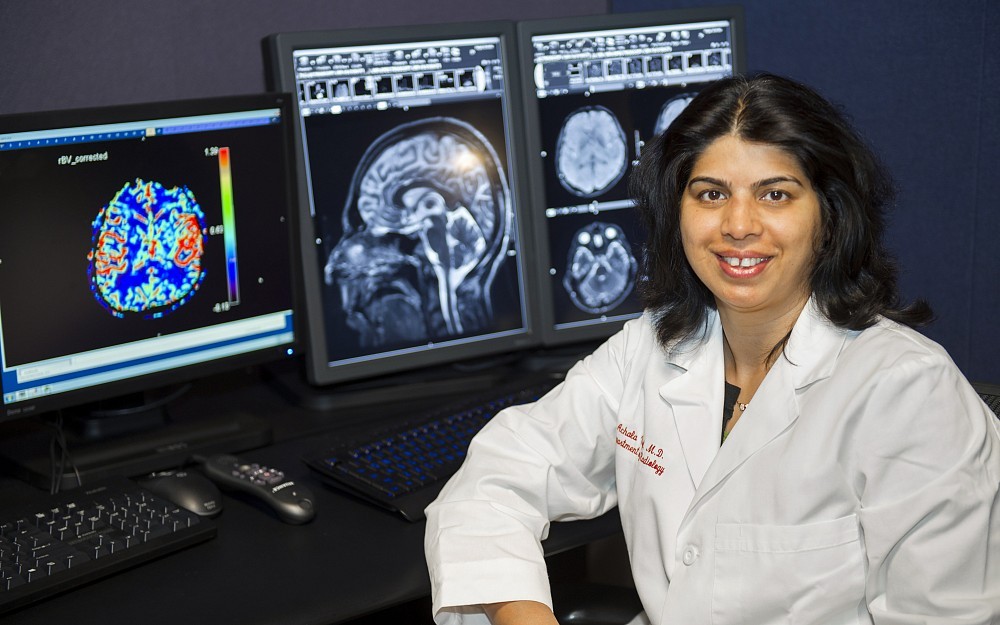
Achala Vagal, MD, associate professor at the University of Cincinnati College of Medicine and a UC Health radiologist
Related Stories
UC radiation oncologist speaks with Local 12 news about clinical trial for head and neck cancer treatment
August 10, 2026

Dr. Sara Medek, a UC radiation oncology professor, speaks with Local 12 news about a new clinical trial aimed at reducing radiation in certain areas while still treating cancer effectively but with fewer painful side effects.
Cancer Center director charts future based on collaboration, AI
August 10, 2026

David Gius, MD, PhD, was featured in a Cincinnati Business Courier article and The Cancer Letter’s “The Directors" podcast discussing his priorities and goals as he recently took the helm as director of the University of Cincinnati Cancer Center.
UC graduates cross finish line at commencement
August 7, 2026
The University of Cincinnati recognized 2,125 graduates in two ceremonies at summer commencement Friday on campus at Fifth Third Arena.