New Drug Therapies For Pre-Kidney Transplant Show Promise

CINCINNATIEarly findings by researchers at the University of Cincinnati (UC) College of Medicine suggest that the use of a second generation cancer drug, carfilzomib, may provide an improved approach for the reduction of antibodies in potential kidney transplant candidates. The research team includes members from UC Transplant Clinical Research, UCs Division of Hematology Oncology and the Cincinnati Childrens Hospital Medical Centers Biomedical Informatics division.
This pre-transplant drug therapy approach is aimed at reducing antibodies in kidney transplant candidates with greater success than with traditional methods and with reduced side effects.
Antibodies are Y-shaped proteins that in most instances are good because they help fight infection, but people can also make antibodies that work against other humans, which is often a major barrier to transplantation.
"Carfilzomib has been well tolerated by the first group of six study patients who experienced antibody reductions between 31 to 100 percent, says the studys lead author Simon Tremblay, PharmD, research associate in the UC College of Medicines transplant research programs.
The studys preliminary findings will be presented at the annual American Transplant Congress on June 13, in Boston, Massachusetts, where Tremblay will be awarded the American Transplant Societys Young Investigator award.
Since 2008, the UC research team has been developing therapies that target plasma cellsthe cells that make antibodies. The first generation of drug therapy studied was the cancer drug bortezomib, a proteasome inhibitor that, like carfilzomib, is already approved by the Food and Drug Administration for treatment of multiple myeloma. In that 50 person study, which was published in 2015, a significant decrease in antibodies was observed. Furthermore, transplanted patients had low rejection rates and the chances of developing a new antibody against their kidney was also low. In addition, in some patients, antibodies remained suppressed for several monthssomething that has not previously been described with other approaches.
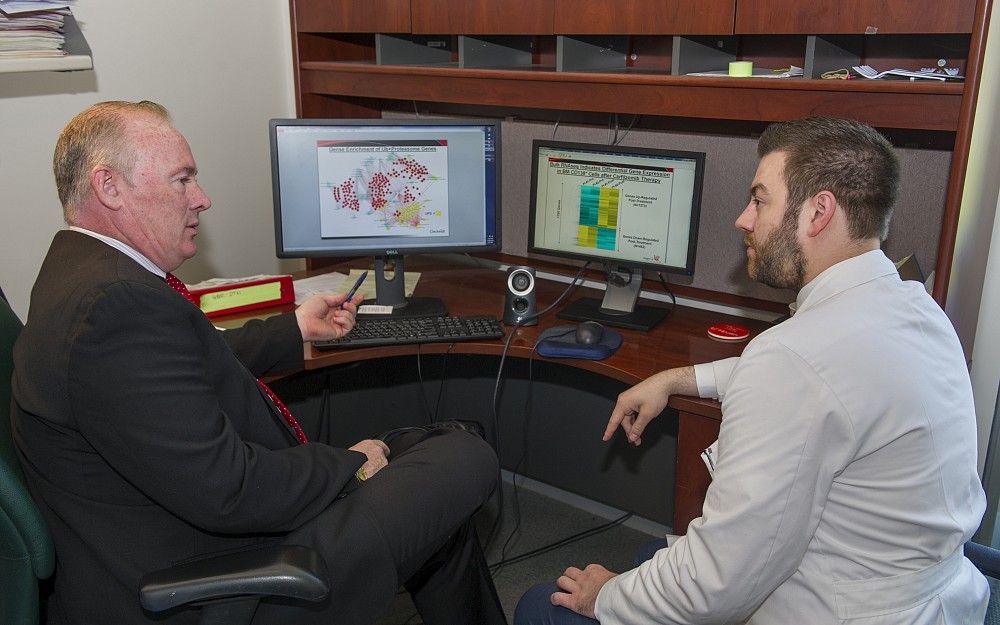
In the same scientific session, James Driscoll, MD, PhD, assistant professor in the UC College of Medicines Division of Hematology Oncology, will present the results of translational research studies in the carfilzomib-treated patients. Driscoll will present new genomic data on plasma cells isolated from patients prior to and after receiving carfilzomib therapy.
"Our gene expression profiling studies in normal human plasma cells are giving us a detailed, comprehensive view of how plasma cells survive and avoid the death inducing effects of carfilzomib, says Driscoll. These studies, he says, were performed in collaboration with Bruce Aronow, PhD, at Cincinnati Childrens.
Carfilzomib is one of four new regimensdescribed as "second-generation plasma cell targeted therapies that are being evaluated by the UC transplant Clinical Research Team, says the principal investigator on both studies, E. Steve Woodle, MD, UC Health transplant surgeon and director of the division of transplantation at the UC College of Medicine.
Additional UC researchers on the study include Adele Shields, PharmD; Rita Alloway, PharmD, Alin Girnita, MD, and Paul Brailey of the Transplant Immunology Division at the Hoxworth Blood Center.
Funding for this study came from Amgen Pharmaceuticals. Woodle and Alloway have received past grant funding and honoraria from Amgen.
Related Stories
UC radiation oncologist speaks with Local 12 news about clinical trial for head and neck cancer treatment
August 10, 2026

Dr. Sara Medek, a UC radiation oncology professor, speaks with Local 12 news about a new clinical trial aimed at reducing radiation in certain areas while still treating cancer effectively but with fewer painful side effects.
Cancer Center director charts future based on collaboration, AI
August 10, 2026

David Gius, MD, PhD, was featured in a Cincinnati Business Courier article and The Cancer Letter’s “The Directors" podcast discussing his priorities and goals as he recently took the helm as director of the University of Cincinnati Cancer Center.
UC graduates cross finish line at commencement
August 7, 2026
The University of Cincinnati recognized 2,125 graduates in two ceremonies at summer commencement Friday on campus at Fifth Third Arena.