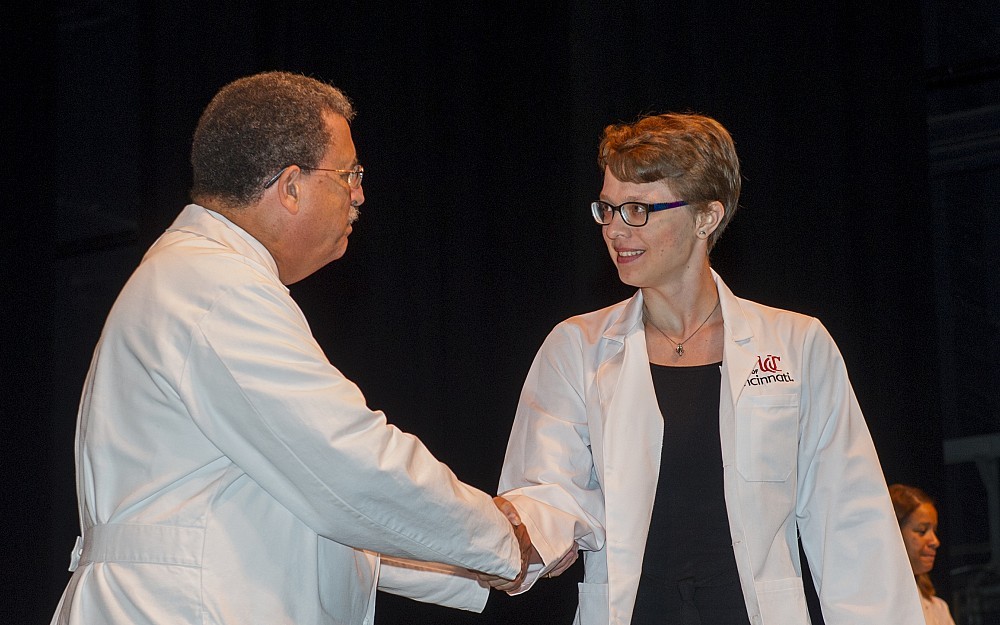
A Budding Physician-Scientist Chooses UC for a Career in Academic Medicine

The sciences have always intrigued first-year medical student Anastassia Tselikova. Physics and biology were among her best subjects in high school, and her interest in biomedical research grew while an undergraduate at UCLA. She majored in Microbiology, Immunology and Molecular Genetics.
After completing a senior honors thesis, Tselikova was approached by a professor who encouraged her to consider an MD/PhD program since it would coincide with all her interests. The professor also suggested and Tselikova applied to and was accepted to a post-baccalaureate program at the National Institutes of Health.
Her two-year fellowship at the NIH convinced Tselikova that a program combining clinical training with research experience would be a successful pathway into medicine. She is one of nine incoming medical students who are part of the Medical Scientist Training Program, a joint MD/PhD program run by the UC College of Medicine and Cincinnati Childrens Hospital Medical Center.
"I realized if I would just go down the medical school path alone, I wouldnt get the depth and breadth of scientific experience that I would love to receive with full devotion. It also aligned with my career goals of being in academic medicine, says Tselikova.
Her program could take from seven to eight years to complete before she goes on to residency.
Tselikova arrived at UC back in June, a couple of months before the official start of medical school, to do research in the laboratory of Michael Jordan, MD, an associate professor in the UC Department of Pediatrics and researcher at Cincinnati Childrens. Jordan develops novel therapies for treating histiocytic disorders and studies regulations of the immune response and immunotherapy of cancer at his lab at Cincinnati Childrens.
"Her academic record is outstanding as is her dedication to medical research, particularly in immunology, says Tim LeCras, associate director of admissions for MSTP. "We are very pleased that Anastassia decided to attend the College of Medicine at the University of Cincinnati.
LeCras says Tselikova was an ideal candidate for the newly created Sabin Fellowship in Immunology and Infectious Disease, in the MSTP and Immunology Graduate Program. Sabin fellows receive enhanced training opportunities and mentoring to help them become leaders in their field.
Tselikova says her curiosity about medicine began at an early age. She was born in Russia, and her parents immigrated to the United States following the collapse of the Soviet Union. Tselikova lived in Texas from age 4 to 6, while her father worked on a PhD in electrical engineering at Texas A&M University. The family then moved to the San Francisco Bay area where she finished high school.
Her mother had been a trained as a physician while living in Russia and held on to many medical books that she read daily with vigor. "She had just finished her medical degree in Russia, but my father had moved to the United States so she left her practice to move here and keep the family together, explains Tselikova.
"From as early as I can recall, I have been surrounded by medical textbooks. Its always been something she has kept up with throughout living in the United States. It was something that really interested her, says Tselikova.
Her mom became a homemaker to care for Tselikova and her younger brother.
"I think a lot of that passion was passed on to me at a very early age, says Tselikova. "I am not going to deny there wasnt some meaning for me very early on. But Tselikova also had what she calls a "natural inclination toward science as a youth.
"Throughout all of my primary education until the end of high school I was always very scientifically-oriented, and it was something that I was just better at than other subjects, well outside of PE, says Tselikova. "I was good at physical education, but I am not going into professional athletics.
Maybe not, but Tselikova was also a good athlete, especially as a swimmer. She became a swim instructor in seventh grade and was CPR certified in child and adult rescue. She was a competitive swimmer in high school and ranked nationally in Butterfly events. Tselikova competed in national events with her club swim team and considered applying to college as an athlete, but decided she wanted to focus on academics instead. "I didnt want to train 10 or 12 times a week as a swimmer, she says.
As an incoming med student, Tselikova is keeping her options open when it comes to clinical specialties. She says she heard tales of students changing their minds in their third or fourth-year and would like to give herself maximum flexibility. "But as far as research interest goes, I love immunology, says Tselikova. "I did research as an undergrad and at the NIH in this field.
It was the Immunology Graduate Program at UC and Cincinnati Childrens that made becoming a Bearcat irresistible when considering med schools. Laboratories and the projects underway in the program are impressive, says Tselikova.
"Cincinnati was one of my top choices based on the very quickly expanding immunology program. The graduate program and the research opportunities here were just fascinating. There have been a lot of scholarly papers that recently came out and they are expanding the program, putting more money into immunology-related research and recruiting more faculty.
Related Stories
UC radiation oncologist speaks with Local 12 news about clinical trial for head and neck cancer treatment
August 10, 2026

Dr. Sara Medek, a UC radiation oncology professor, speaks with Local 12 news about a new clinical trial aimed at reducing radiation in certain areas while still treating cancer effectively but with fewer painful side effects.
Cancer Center director charts future based on collaboration, AI
August 10, 2026

David Gius, MD, PhD, was featured in a Cincinnati Business Courier article and The Cancer Letter’s “The Directors" podcast discussing his priorities and goals as he recently took the helm as director of the University of Cincinnati Cancer Center.
UC graduates cross finish line at commencement
August 7, 2026
The University of Cincinnati recognized 2,125 graduates in two ceremonies at summer commencement Friday on campus at Fifth Third Arena.