In Case of An Emergency, UC Med Students Are Ready to be First Responders

Benjamin Wissel remembers enjoying a festival last summer when suddenly a bystander needed the help of a first responder.
"I was with a friend who was a medical student at another university, and I looked at him and said, You are a medical student; what would you do? He said, We havent had training. I dont know what to do, recalls Wissel, a first-year medical student in the College of Medicine. "I was like, Seriously?
Wissel says hes pleased UC requires all first-year medical students to complete a two-week first responder course. This years incoming class has just completed the lifesaving, skill-based training, which is now in its sixth year as part of the medical school curriculum.
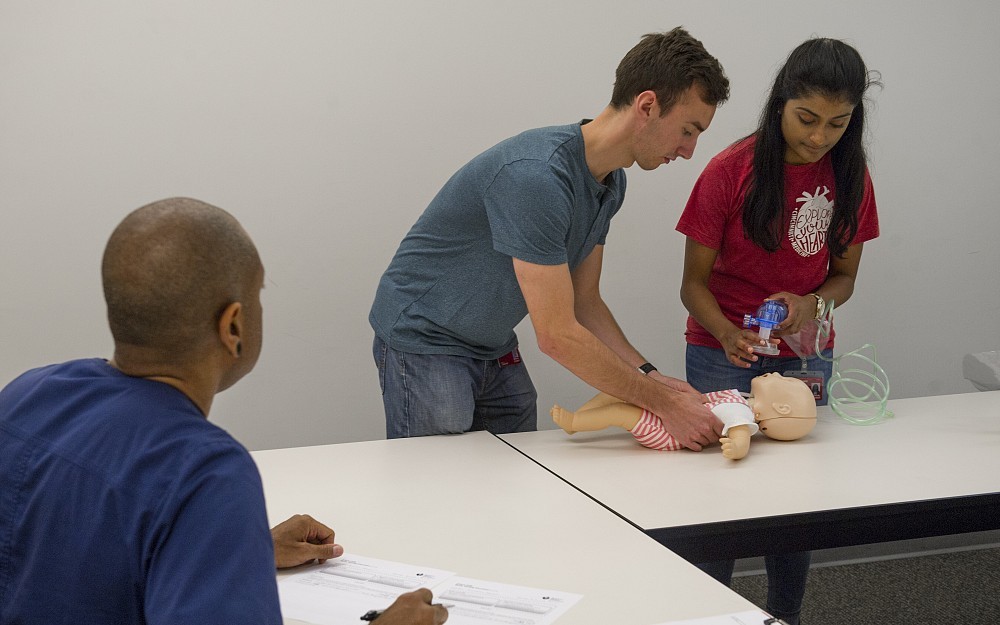
"The last training I had was in seventh-grade, and it was very basic CPR training for babysitting, says Farah Hussain, a first-year medical student who completed a skills test with Wissel. "I really had no experience before coming here. So far, UC has taught us CPR, child, infant and adult CPR, and we learned how to ventilate patients if they are low on oxygen. We know how to take vital signs such as blood pressure and how to use a barrier mask and bag to ventilate patients.
Less than 10 percent of incoming medical student have any type of medical experience entering med school, says Kay Vonderschmidt, assistant director in the Division of Emergency Medical Services in the Department of Emergency Medicine. Students receive classroom lectures along with skills training sessions on shock resuscitation, patient assessment, CPR, head and spine trauma, treatment for burns and bleeding and various other emergency aid topics, says Vonderschmidt.
Medical students often appreciate their first-responder training as they enter clinical rotations and may encounter unstable patients who may need immediate help in the event of a heart attack, diabetic emergency or some type of trauma, explains Vonderschmidt.
"Often, the first 10 minutes after an emergency can be critical for a patients survival and recovery, she says. "We want our students to know how to stabilize and maintain a patient or individual in an emergency situation until help is available.
Friends, family and often strangers have high expectations for medical students, a fact that Wissel and Hussain have encountered even though theyve only completed one month in medical school.
"I have an interest in neurology, and friends and family will ask really specific questions about the brain, and even if I were a neurologist, I am still not sure I would know the answers though I think the perception of knowledge that we have is way out of the ballpark, says Wissel.
Hussain says the first-responder training is helpful. "People already expect us to diagnose things, but we are years away from that, she says. "If there was an emergency situation, I feel better prepared about knowing what to do, or could at least get the help that a person may need.
Hussain received her undergraduate degree in neurobiology at the University of Cincinnati, while Wissel is an Ohio State graduate with a degree in biomedical engineering. Both are alumni of the ROSE program at UC.
Arthur Pancioli, MD, chairman, UC Department of Emergency Medicine, says society places medical students for the rest of their lives in the realm of medical providers from the moment they enter medical school for training.
"Ours is one of the few medical schools in the United States to recognize and address this fact by providing the training that would allow them to appropriately aid in an emergency situation, says Pancioli. "This level of preparedness has been called into action numerous times since the program began and we have many wonderful examples of lives saved by our students.
Reginald Fennell, a UC first-responder instructor, is a paramedic and nurse at Mercy West, says he was impressed with this years students who were very enthusiastic about getting some initial skills. "I think its great you have these students who have so much intellectual knowledge, but they also get the chance from day one to be of assistance if an emergency situation were to arise.

First-year med students Farah Hussain and Ben Wissel demonstrate their first-responder training in the College of Medicine. Reginald Fennell, a paramedic and nurse, looks on.
Related Stories
UC expert weighs in on current MASH treatment approaches
June 5, 2026

As MedCentral recently reported, pending broader pharmacologic approvals for metabolic dysfunction-associated steatohepatitis (MASH), lifestyle modifications remain the go-to intervention.
At least two weather patterns increase headaches, UC study suggests
June 4, 2026
University of Cincinnati physicians and collaborators identified two specific weather patterns that increase headache and migraine risk and found the preventive medication fremanezumab (Ajovy) can reduce weather‑associated headaches. The findings will be presented at the American Headache Society Annual Scientific Meeting in Orlando.
UC researcher secures $3.3M grant to study microplastics’ impact on heart
June 2, 2026
The National Institute of Environmental Health Sciences awarded a $3.3M grant to University of Cincinnati researcher Hong‑Sheng Wang, PhD, to study how microplastics and nanoplastics affect cardiovascular health.