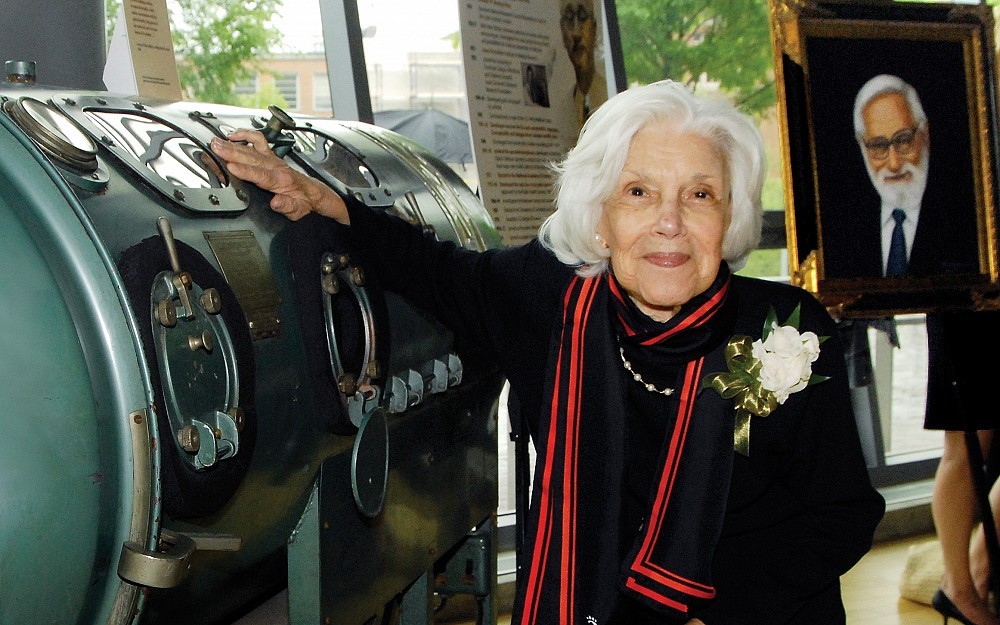
Heloisa Sabin, Wife of Dr. Albert Sabin, Dies

Heloisa Sabin, the wife of former College of Medicine faculty member Albert Sabin, MD, passed away on Oct. 12 in Washington, D.C., at the age of 98.
Following Dr. Sabins death on March 3, 1993, Mrs. Sabin donated her husbands papers to the universitys Medical Heritage Center to create the Albert B. Sabin Archives. The Medical Heritage Center is now known as the Winkler Center for the History of the Health Professions and is a part of UC Libraries. Dr. Sabin spent the majority of his career at the College of Medicine and the Childrens Hospital Research Foundation. His development of the oral poliovirus vaccine virtually eliminated polio around the world.
Mrs. Sabin returned several times to Cincinnati to contribute additional documents and photographs associated with her husband. She also participated in several events recognizing Dr. Sabins contributions to the university and to medicine, including a 50th anniversary celebration on April 23, 2010 of "Sabin Sunday, the first day of a campaign to vaccinate children in Cincinnati and Hamilton County using Dr. Sabins live-virus polio vaccine.
The frequently accessed Sabin Archives occupy nearly 400 linear feet of shelf space in the Winkler Center and includes correspondence, laboratory notebooks, manuscripts and other research papers generated by Dr. Sabin during his medical career from 1930 to 1993. The collection also contains his honors and awards, hundreds of photographs, video and audio tapes, as well as research materials such as microscope slides.
A 1995 gift from the John Hauck Foundation established the Hauck Center for the Albert B. Sabin Archives. In 2010, the Winkler Center also received a grant from the National Endowment for the Humanities to digitize correspondence and photographs in the collection. To date, more than 50,000 pages have been digitized and are available online at sabin.uc.edu.
"Her dedication to preserving and promoting Albert's important legacy was the cement that bonded our long working relationship, says Steve Marine, associate dean emeritus of the UC Libraries and former executive director of the Winkler Center. "As the University of Cincinnati administrator responsible for our medical history center, I was eager to do everything within my means to secure Albert's archives and artifacts, a treasure trove for virology researchers and medical and political historians. Heloisa was even more eager to see that Albert's history-making accomplishments were recognized and appreciated by this and future generations.
Mrs. Sabin was born in Brazil and married Dr. Sabin in 1972. She is survived by her sons, Carlos and Eduardo Jardim, six grandchildren and six great-grandchildren, as well as Dr. Sabins children, Amy Sabin Horn and Deborah Sabin, and their three children. She will be buried on Oct. 21 next to her husband in Arlington National Cemetery.
For more on Mrs. Sabin, see LiBlog, the University of Cincinnati Libraries' Blog.

Heloisa Sabin, wife of former UC College of Medicine faculty member Albert Sabin, MD, at the 2003 dedication of an Ohio historical marker honoring Dr. Sabin.
Related Stories
Selecting noninvasive tests for liver disease diagnosis, monitoring
September 3, 2026

Noninvasive tests have emerged as valuable alternatives for diagnosing, staging and monitoring MASLD and MASH, according to a recent MedCentral report.
Why can it get so hot at times?
September 3, 2026

Cincinnati is experiencing more days of extreme heat this summer than in previous decades, due in large part to warmer global temperatures. But explanations for these higher temperatures also relate to regional factors, including the city's location in a river valley and large proportion of built environment.
UC invests in the next generation of graduate leaders through fellowships focused on mentorship and research
September 3, 2026
The Next Lives Here Presidential Fellowship supports the recruitment of top doctoral students through competitive funding, mentorship and professional development.