UC Grad Students Receive COM Support in Systems Biology Training Program

Three doctoral students at the University of CincinnatiCorey Stiner, Nicholas Clark and Kelsey Elliotthave been awarded one year of grant support from the College of Medicine to continue their studies in the Advanced Multidisciplinary Training Program for Systems Biology.
Stiner is completing a PhD in chemistry, while Clarks doctoral work is in biostatistics and bioinformatics and Elliotts doctoral training is in developmental biology.
The multidisciplinary training program, run by the Department of Molecular and Cellular Physiology, is designed to prime researchers to tackle complex mechanism of human disease utilizing a cross-disciplinary approach, says Yana Zavros, PhD, associate professor in molecular and cellular physiology, and co-principal investigator for the program. The young investigators have received a stipend of $25,000 for the 2016-2017 academic year. They will work with experts from diverse disciplines who will apply their unique perspectives to address collectively a biological problem, says Zavros.
"New interdisciplinary field and investigators have always been created by close multidisciplinary collaboration, and our program is designed to enforce such collaborations as an essential element of graduate training, says Zavros.
Jarek Meller, PhD, associate professor in environmental health, and co-principal investigator for the program, says the training program involves 38 program faculty members paired with students who have matriculated into 13-degree granting PhD programs at UC.
Stiner, 28, is a graduate research assistant in the laboratory of Julio Landero, PhD, and his research is titled, "Purification and Characterization of Novel Endogenous Cardiotonic Steroids from Pig Skeletal Muscle. Landero, a research assistant professor of chemistry, and Judith Heiny, PhD, professor of molecular and cellular physiology, are Stiners mentors.
"Cardiotonic steroids are a class of compounds that can be extracted from various living organisms, says Stiner, explaining his research. "These compounds can be used in medicines to treat numerous medical conditions such as congestive heart failure, hypertension, arrhythmia, and various cancer cell lines. The goal of this project is to isolate and purify endogenous cardiotonic steroids from mammalian tissue.
"Once the endogenous cardiotonic steroids are isolated, they will be characterized to determine the molar weight and structure of the compound using mass spectrometry and NMR, says Stiner. "After these compounds are characterized, further testing will be done to determine the physiological effects of these compounds in mammalian tissues.
Clark, 29, is a graduate research assistant, in the laboratory of Mario Medvedovic, PhD, and his research is titled, "Leveraging Biomedical Big Data to Predict and Optimize Responses to Targeted Kinase Inhibitor Therapy for Glioblastoma. Medvedovic, professor of environmental health, and David Plas, PhD, associate professor of cancer biology, are Clarks mentors.
"My work with Dr. Plas is in the very beginning stages and is still taking shape, but in the simplest terms the plan is to help with his research on new potential drug therapies for glioblastoma (an extremely aggressive type of brain cancer) by making use of the huge amounts of publicly available "genomic data on cancer cells, says Clark.
"Publicly available data include, for example, the toxicity of thousands of potential treatment drugs to hundreds of cancer cell lines, gene and protein expression of cancer cells in response to treatment with these drugs, and the mutational status of cancer-related genes in these cell lines. We hope to use this large-scale data as well as smaller-scale data and knowledge from experiments in Dr. Plas lab to inform new experiments and make new insights into glioblastoma treatment, says Clark.
Elliott, 24, is a graduate research assistant in the laboratory of Samantha Brugmann, PhD, and her research is titled, "Differential Gli Activity in the Mandibular and Frontonasal Prominences during Craniofacial Development. Elliotts mentors are Brugmann, an assistant professor of surgery and Cincinnati Childrens researcher, and Matthew Weirauch, PhD, assistant professor of pediatrics and Cincinnati Childrens researcher.
"It is well established that the Sonic Hedgehog pathway and its effectors, the Gli transcription factors, are required for proper craniofacial development, the exact roles these Gli proteins play during development remains elusive, says Elliott. "Specifically, the mechanism of the Gli3 proteins ability to function as either a repressor or an activator in different developmental contexts is not well understood. Our previous studies using mice lacking functional Gli activator and Gli repressor suggest that Gli3 primarily functions as a repressor in the developing facial midline, whereas Gli3 primarily functions as an activator in the developing lower jaw.
"Based on these data, and work of other labs suggesting that the activator or repressor function of Gli proteins requires interactions with co-regulators, we hypothesized that Gli proteins associate with different co-regulators within the frontonasal prominence and the mandibular prominence to confer activator or repressor function, says Elliott. "We will test this hypothesis using a variety of Systems Biology based approaches, including ChIP-Seq and RNA-Seq to identify candidate co-factors, and test these candidates using many molecular biology assays, including the recently developed SpDamID.
The College of Medicine has awarded support to graduate students in the Advanced Multidisciplinary Training Program for Systems Biology for the past four years. Eight additional students have also received support in previous years from either the NIH funded training program or the College of Medicine. Those students are:
Jacob Bellman (graduate)
Christopher Burke
Alex Thorman,
Jeremy Riddell
Nina Bertaux-Skeirik
Amir Babar
Lily Baek
Zubin Patel
Hesamedin Hakimjavadi

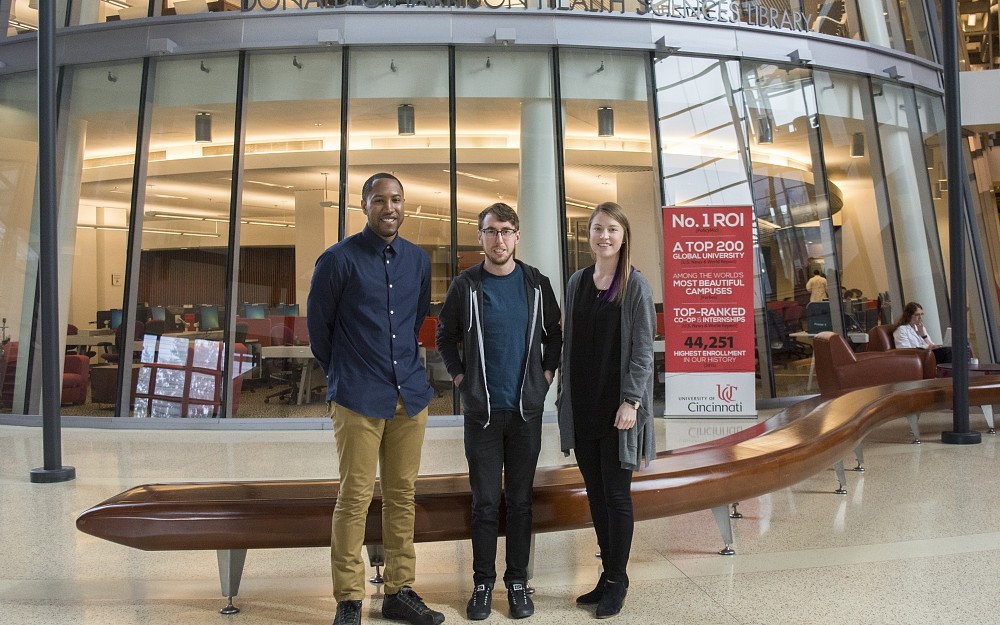
Alex Thorman, Nina Bertaux-Skeirik, Corey Stiner, Nicholas Clark, Jeremy Riddell, Amir Babar, Lily Baek and Zubin Patel are graduate students in the Advanced Multidsciplinary Training Program for Systems Biology and shown in CARE/Crawley Atrium.
Related Stories
UC expert weighs in on current MASH treatment approaches
June 5, 2026

As MedCentral recently reported, pending broader pharmacologic approvals for metabolic dysfunction-associated steatohepatitis (MASH), lifestyle modifications remain the go-to intervention.
At least two weather patterns increase headaches, UC study suggests
June 4, 2026
University of Cincinnati physicians and collaborators identified two specific weather patterns that increase headache and migraine risk and found the preventive medication fremanezumab (Ajovy) can reduce weather‑associated headaches. The findings will be presented at the American Headache Society Annual Scientific Meeting in Orlando.
UC researcher secures $3.3M grant to study microplastics’ impact on heart
June 2, 2026
The National Institute of Environmental Health Sciences awarded a $3.3M grant to University of Cincinnati researcher Hong‑Sheng Wang, PhD, to study how microplastics and nanoplastics affect cardiovascular health.