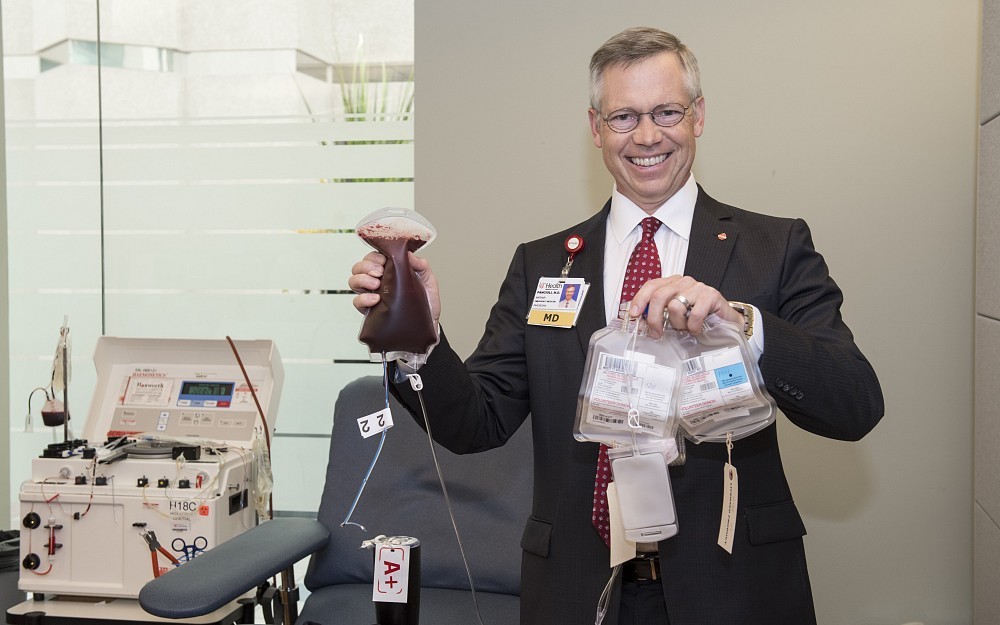
Emergency Medicine Department Chair Makes 100th Hoxworth Blood Donation

When your job calls for working with units of blood each and every day, you realize how important of a product blood is. Thats one reason why Art Pancioli, MD, Professor and Richard C. Levy Chair of Emergency Medicine at the UC College of Medicine recently made his 100th donation at Hoxworth Blood Center.
"I use these products all the time to try to save lives and this is a product that you cannot manufacture, and absolutely has to be available, says Pancioli. "Its incumbent upon all of us to make the effort and make it available. You never know when its going to be you or your family member in need of blood.
Pancioli started donating blood at the end of his residency and decided to make it a habit. It took him 20 years to make it to the triple digit donation level. "You can only give a maximum of every eight weeks, so the most you can give in a year is six. So to get to 100 takes a while.
According to Alecia Lipton, public information officer for Hoxworth, of the more than 460,000 donors in the database, Pancioli is in the top quarter of donors. 35 percent have donated more than 100 times, compared to 40 percent who have donated only once.
"If you just make it a habit, its not hard, says Panicioli. He says he can leave his office, go to Hoxworth to make a donation and be back in his office within an hour. "Its that easy. Theres nothing to it. It doesnt hurt, it doesnt take long and we have to do this. Its like anything else in lifeif you recognize it as a worthy thing, you make it a priority.
To meet demand, Hoxworth has a goal collecting 300 units of blood a day. For more information on donating blood, click here.
Related Stories
UC radiation oncologist speaks with Local 12 news about clinical trial for head and neck cancer treatment
August 10, 2026

Dr. Sara Medek, a UC radiation oncology professor, speaks with Local 12 news about a new clinical trial aimed at reducing radiation in certain areas while still treating cancer effectively but with fewer painful side effects.
Cancer Center director charts future based on collaboration, AI
August 10, 2026

David Gius, MD, PhD, was featured in a Cincinnati Business Courier article and The Cancer Letter’s “The Directors" podcast discussing his priorities and goals as he recently took the helm as director of the University of Cincinnati Cancer Center.
UC graduates cross finish line at commencement
August 7, 2026
The University of Cincinnati recognized 2,125 graduates in two ceremonies at summer commencement Friday on campus at Fifth Third Arena.