Third-Year Medical Students Celebrate the Start of their Hospital Rotations

College of Medicine Dean William Ball, MD, offered some advice for third-year medical students who started their hospital rotations this week.
"Dont hesitate to ask for help, says Ball, also senior vice president for health affairs at UC. "Dont hesitate to admit the things that you dont understand. It is not a sign of weakness, and you will not be graded on that. You will be graded on the outcome so keep those things in mind. A hospital is not a simulation center. These are real patients. These are real people.
"These are people who have come to you with the trust that you will do the best that you can to help them, he adds. "Dont let them down. Even as a medical student you will play a very important role in their care, and they will look to you not necessarily as a medical student but as someone who might be able to help them.
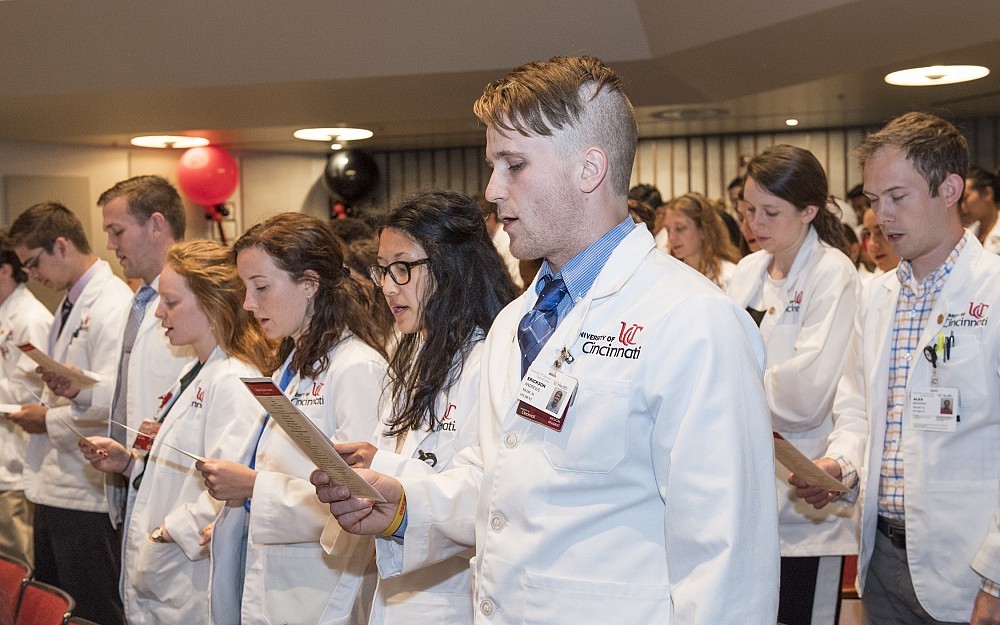
Ball was among the speakers at the colleges annual Student Clinician Ceremony held Thursday, June 22, 2017, in Kresge Auditorium. The Student Clinician Ceremony, founded by the Arnold P. Gold Foundation, is designed to recognize the important transition to third-year clinical rotations. The event celebrated this milestone while addressing some of the inherent challenges and placed an emphasis on the importance of practicing humanism in medicine and professionalism.
New clinical rotations can be very stressful for students, but they arent alone and are part of team of caregivers and medical professional at hospitals across the region including UC Medical Center, West Chester Hospital, Cincinnati Childrens Hospital Medical Center, the Cincinnati Department of Veterans Affairs (VA) Medical Center and other health systems.
"You are not an observer, says Richard Lofgren, MD, president and CEO of UC Health. "You are not a bystander. You are part of the team. I want to make sure you understand that you are welcome as a member of the team and frankly there is an expectation that you are a fully engaged member, so welcome.
"This is a really exciting part of your career transition, and there is nothing in your educational background that will prepare you for this in some aspects. You are really switching from knowledge-based to experiential learning.
Lofgren urged students to make use of two very important traits: humility and a willingness to ask questions. He says he spent his entire third-year medical rotation being humbled by classmates, residents, attending physicians, nurses and others who often knew the hospital system better than he did. Lofgren saw the value of asking questions.
"Your questions will change the outcomes of the patients, says Lofgren.
Second-year neurology resident Ashby Clay Turner, MD, told students to celebrate the occasion since its an achievement that only a select few get to experience. He also offered a few words of wisdom.
"This coming year is going to be a dramatic change from the prior two, says Turner. "I assume you have been told some days you will have meaningful encounters with the patient and contribute to the team. Remember, write down and appreciate those days.
"Remember the satisfaction that you feel. These are the moments that remind you why you are here. The challenge for this year is how you deal with the bad days, days when you make mistakes and days when your pride is damaged. It is what will question your decision to be here in the first place.
Turner said its important to develop a strategy for coping and moving past the "bad days. He says his method has been to practice the art of forgiveness. He asked students to try and put tense moments in perspective and then shared a common patient scenario.
"A patient will tell you his or her account of their symptoms, and you go and you relay them verbatim to your team, says Turner. "Then when your entire team returns to the patients room, the patient will contradict what you said and give a completely different situation entirely.
Turners advice: forgive them.
"We know that you are not lying to us, says Turner, noting patients struggle to remember experiences. "The patient isnt actively trying to sabotage you or your grade.
Another common scenario for a third-year medical student is to be near the end of an on-call shift in the hospital and be asked to handle a sudden emergency, prolonging that shift by several hours.
"I encourage you to separate what is being done to you to what is simply happening in your presence, says Turner. "The patient is not intentionally showing up at that time to ruin your night. It just happened to work out that way. Dont blame the patient for doing that. Patients are in the hospital for a reason. They are ill, they are uncomfortable and they are afraid. That being said, I urge you not to lose sight of why you applied to medical school in the first place.
Turner said third-year students have a golden opportunity to connect with patients that others sometimes simply cant.
"You will have that time to really establish relationships with patients you are taking care of. You will be able to do so in a manner that the residents you are working with will not have the time to do, says Turner. "Strive to be the member of the team who your patient trusts the most. This is providing true patient care.
Third-year students may also encounter tensions during their rotations when competition heats up among their peers, says Tuner, who also urged his audience to "be patient and forgive.
"You dont know the challenges each other are facing, says Turner, who noted he judged his medical students on how well they worked as a team.
Mistakes are also part of the experience, Turner explains.
"You will forget to ask patients crucial information, and youll walk into the wrong patients room and start talking before you recognize it, says Turner. "Learn to forgive your mistakes.
Students recited the class Oath of Professionalism taken during the White Coat Ceremony. Students presented Optime Magistrum Awards for outstanding teaching in medical school courses to Stefanie Benoit, MD, John Quinlan, MD, Laura Wexler, MD, Kathryn Wikenheiser-Brokamp, MD, PhD, Keith Stringer, MD and Barbara Tobias, MD.
Keith Luckett, MD, was presented with a Gold Apple Award while Wikenheiser-Brokamp and Maria Czyzyk-Krzeska, MD, PhD, received Silver Apple awards.

"Be humble, ask questions" was among the advice third-year medical students received at the annual Student Clinical Ceremony held in Kresge Auditorioum on Thursday, June 22, 2017.

College of Medicine Dean William Ball urged third-year medical students to ask for help when needed when performing their hospital rotations.

New third-year medical student read the class Oath of Professionalism during the Student Clinician Ceremony held in Kresge Auditorium June 22, 2017.

Second-year neurology resident Ashby Clay Turner, MD, told third-year medical students to celebrate the start of hospital rotations because it s an achievement that only a select few get to experience.

Medical students Zachary Crawford and Erickson Andrews (front) announce teaching awards for UC faculty at the Student Clinician Ceremony.

New clinical rotations can be very stressful for third-year med students, but they were reminded at the annual Student Clinician Ceremony that they aren t alone.
Related Stories
UC radiation oncologist speaks with Local 12 news about clinical trial for head and neck cancer treatment
August 10, 2026

Dr. Sara Medek, a UC radiation oncology professor, speaks with Local 12 news about a new clinical trial aimed at reducing radiation in certain areas while still treating cancer effectively but with fewer painful side effects.
Cancer Center director charts future based on collaboration, AI
August 10, 2026

David Gius, MD, PhD, was featured in a Cincinnati Business Courier article and The Cancer Letter’s “The Directors" podcast discussing his priorities and goals as he recently took the helm as director of the University of Cincinnati Cancer Center.
UC graduates cross finish line at commencement
August 7, 2026
The University of Cincinnati recognized 2,125 graduates in two ceremonies at summer commencement Friday on campus at Fifth Third Arena.