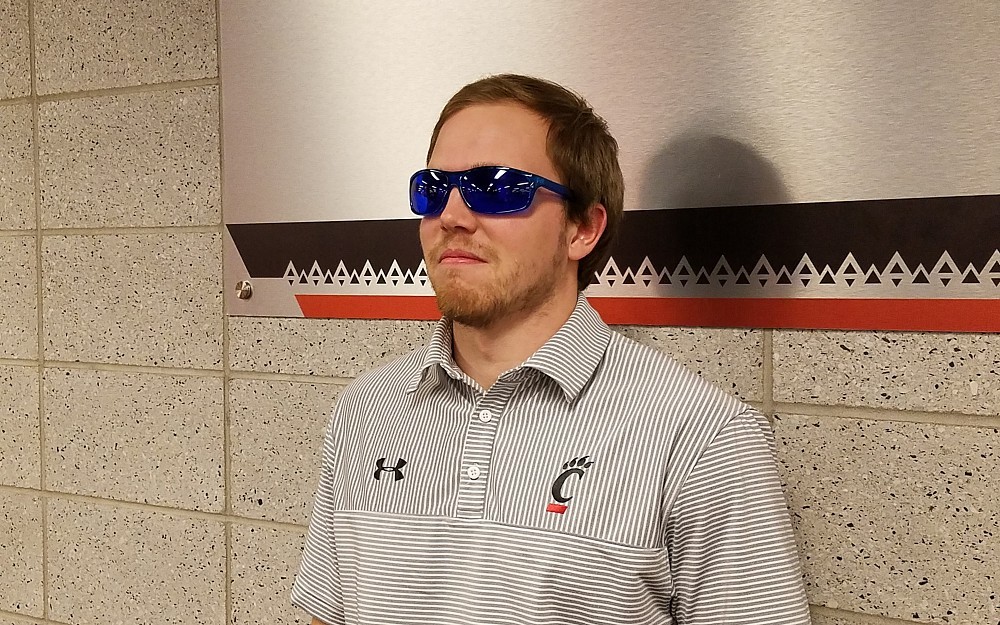
Colored Glasses May Provide Light Sensitivity Relief Post-Concussion

Following a concussion or mild traumatic brain injury (TBI), patients may suffer from light sensitivity or photophobia, making it challenging to return to normal activities. The sensitivity may also trigger or exacerbate headaches.
While sunglasses can provide some relief from photophobia, wearing them all the time is not always a practical solution, nor is it pleasant for patients to live in a dark room for days at a time. A new study from the University of Cincinnati (UC), published online in the Journal of Athletic Training, assessed the use of colored lenses in post-concussion patients and found wearing certain color-tinted sunglasses may be a good alternative to dark sunglasses.
"While sunglasses can provide some relief, they are not very practical indoors or in low light environments, says Joe Clark, PhD, professor in the Department of Neurology and Rehabilitation Medicine at the UC College of Medicine and lead author of the study. "What is needed is a light mitigation strategy that can be readily employed indoors, which can optimize relief in those who suffer from photophobia, or light sensitivity.
Clark and researchers at the College of Medicine assessed visual symptoms of 51 concussion patients and used frames with varying colored lenses to find out if certain hues provided relief from photophobia.
"We found that 85 percent of patients reporting photophobia had relief of the symptoms with one or more colors blue, green, red and purplewith no reported adverse events, Clark says.
"Sensitivity to light can be common and impact activities of daily life suggesting that light mitigation might improve quality of life in many of these patients. Photophobia is a common symptom for patients following traumatic brain injury. Our goal in this study was to provide medical staff like athletic trainers with a method and means to assess and subsequently provide relief to an athlete who may be experiencing symptoms of photophobia, Clark adds.
The goal is to help the concussion patient feel better as the brain heals. "We compare the colored glasses to being like a brace or cast but for the brain, he says. "It is temporary but prevents further injury or pain.
At least 3.8 million people in the United States sustain a concussion or traumatic brain injury every year, many not for the first time. As with many other health conditions, the presentation of concussion symptoms can vary greatlywhile some individuals exhibit very little to no change in functionality and may report no symptoms at all, others may report confusion, headache, decreased balance and vision disturbances including blurry vision, trouble focusing and sensitivity to light.
Photophobia is so common that many neurosurgical intensive care units consider it standard operating procedure to keep lights dimmed in rooms containing TBI patients says Clark.
In addition to trying colored-lens sunglasses, the article suggests other ways to mitigate photophobia including wearing a wide-brimmed hat when outdoors, adjusting digital screen and device settings to an appropriate hue and brightness or purchasing filters for screens. However, the researchers noted, they do not recommend wearing colored glasses while driving. Certain colors make seeing stop lights or emergency vehicle lights difficult.
"We believe that an athletic trainer, in consultation with team physicians, may find it useful to apply this photophobia assessment and recommend colored glasses to his or her athlete, Clark says. "The use of the colored glasses in the high school, college or other setting can allow a person to engage in some medically approved activities, while minimizing the risk of symptom exacerbation. We believe the use of the colored glasses that provide photophobia mitigation has added benefits superior to dark sunglasses, especially for indoor lighting.
Additional researchers on the study include Jon Divine, MD, a professor in the Department of Orthopaedic Surgery at the UC College of Medicine and head team physician for University of Cincinnati Athletics.
There was no funding used for this study.

Joe Clark works with student athlete on the Dynavision
Related Stories
On-site training in Speech & Hearing Clinic sets UC’s programs apart
August 27, 2026
At the University of Cincinnati’s Speech & Hearing Clinic, Doctor of Audiology and Speech-Language Pathology graduate students gain real-world experience while providing free speech and hearing services to the community.
Designing with cancer patients' needs in focus
August 27, 2026
Kristina Shin is designing garments that prioritize the comfort, function and confidence of breast cancer patients, addressing a need often overlooked by traditional fashion.
UC, NKU renew longstanding partnership supporting Army ROTC cadets
August 26, 2026
The University of Cincinnati Army ROTC and Northern Kentucky University (NKU) have renewed a longstanding partnership that supports students preparing to become Army officers and leaders in their communities. The universities formalized the renewed agreement during a signing event Aug. 11 at NKU.