Simulation Center Helps Lessen Risk in First Patient Encounter

Real world experience is usually best, but visitors to the Simulation Center in the UC College of Medicine, can get a pretty good substitute. In health care the stakes are high and the chance to make mistakes without injuring the patient is what makes the center a prize for medical educators.
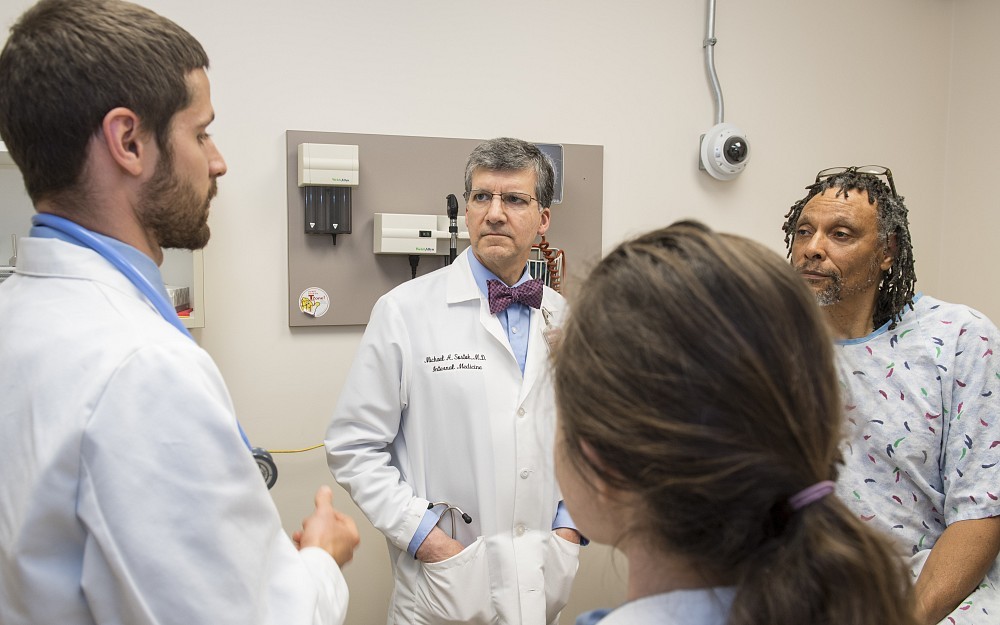
The 6,000-square-foot center has multiple functions, explains Michael Sostok, MD, medical director of the center and assistant dean of medical education. It offers a clinical skills lab which affords residents along with medical and nursing students the chance to practice procedural skills such as learning to put an IV in a patient or how to insert a nasogastric tube for feeding or administering a drug.
Students can use high fidelity simulatorstechnologically advanced mannequinsto engage in health management scenarios such as a patient in septic shock, someone suffering a heart attack or a person facing injury as a result of a gunshot wound, says Sostok. Sixteen patient exam rooms have video and audio capabilities which allow medical educators to review a student encounter with standardized patients; these are actors trained to enact medical conditions so students can determine a proper diagnosis.
The centers popularity has grown since its inception in 1999; there were only fourth-year medical students using the center then and it recorded 360 learner encounters. Last academic year, the center had residents, faculty or students from 70 unique programs throughout the Academic Health Center using it and recorded about 18,000 learner encounters, explains Sostok, also a professor in the Department of Internal Medicine.
Some of the more notable uses of the Simulation Center within the College of Medicine include medical educators using it to test the skills of new residents by implementing the Baseline Resident Assessment of Clinical Knowledge or BRACK.
Professionalism, the ability to perform a medical history and physical exam, generating a differential diagnosis list, knowing when to order appropriate tests and how to interpret those results when presented with a common medical scenario, as well as communicating a treatment plan for a patient, are all evaluated during BRACK, says Amy Bunger, PhD, assistant designated institutional official and co-principal BRACK investigator.
Faculty also review the skills of fourth-year medical students as part of the Clinical Competency Exam (CCX) offered at the Simulation Center. Student performance on the CCX helps faculty identify and help medical students who may struggle with Step 2 clinical skills on USMLE.
Sostok says the UC center opened just as the National Board of Medical Examiners was ready to establish the United States Medical Licensing Examination (USMLE) Step 2 Clinical Skills Exam for medical students. The medical examiners sought schools that could serve as pilots for the examination and College of Medicines leadership was eager to participate.
"The other factor also driving the center was health care was changing so lengths of stays were getting shorter and shorter for patients, says Sostok. "Thats good for patients and the hospital, but not so good for medical education because the patients werent around for very long. Less contact with the patient meant there were gaps in the educational curriculum and clinical curriculum for our students.
"So what we used as our vision for developing the center was we are going to give you a place where you can practice the skills that you are going to need to be good clinicians so you are ready for your first day on-call as a resident and for your first day in your outpatient clinic, says Sostok. "It has been our theme throughout the centers life.
Developing Bedside Manner; Assessing Patients
Heru Lasana, a Cincinnati resident and professional actor, has been a standardized patient with the Simulation Center for several years. He likes to think he has played a role in helping future physicians develop sensitivity toward patients and an agreeable bedside manner.
"We have a script and we make sure all the information in the script is presented in the event the student asks particular questions, says Lasana. "At the end we give them feedback about their technique and information they may or may not have asked.
"You see them at the early stages and then you see them a couple of years later down the road and you see the progress they have made and you have contributed to that progress, says Lasana. "Its really rewarding and a satisfying experience. Students take the simulated experience seriously. We keep it authentic, making sure they are dealing with patients in the best possible manner.

Michael Sostok, MD, (front right) works with medical students simulating intubation on a patient in the Simulation Center.

Keith Stringer, MD, is shown observing a BRACK evaluation in the Simulation Center.

Annie Kalscheuer, program coordinator in the Simulation Center, prepares the Clinical Skills Laboratory, for student and faculty use.
Related Stories
UC radiation oncologist speaks with Local 12 news about clinical trial for head and neck cancer treatment
August 10, 2026

Dr. Sara Medek, a UC radiation oncology professor, speaks with Local 12 news about a new clinical trial aimed at reducing radiation in certain areas while still treating cancer effectively but with fewer painful side effects.
Cancer Center director charts future based on collaboration, AI
August 10, 2026

David Gius, MD, PhD, was featured in a Cincinnati Business Courier article and The Cancer Letter’s “The Directors" podcast discussing his priorities and goals as he recently took the helm as director of the University of Cincinnati Cancer Center.
UC graduates cross finish line at commencement
August 7, 2026
The University of Cincinnati recognized 2,125 graduates in two ceremonies at summer commencement Friday on campus at Fifth Third Arena.