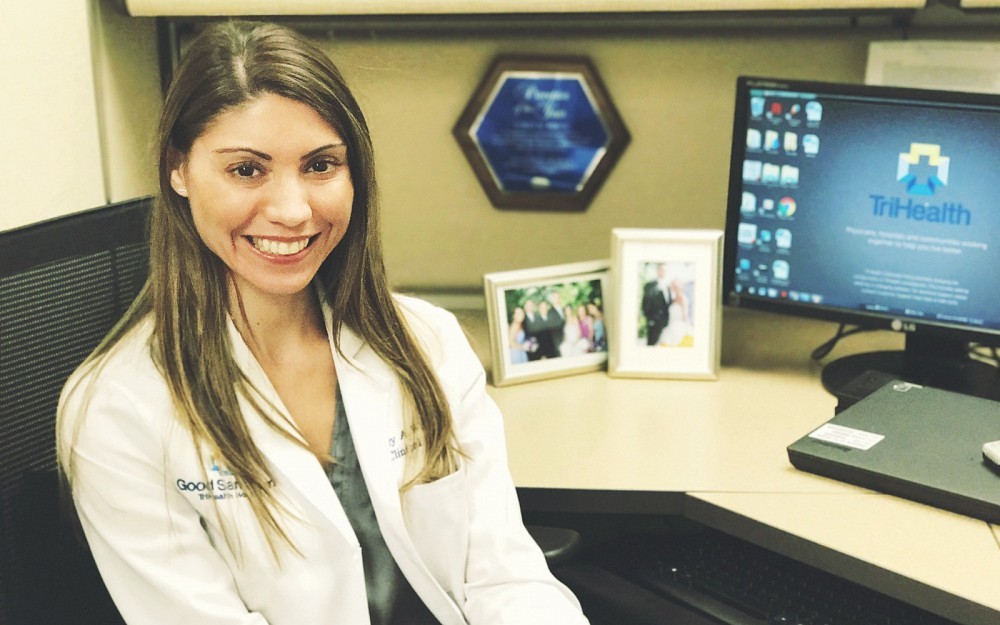
Focus on Pharmacy Practice Partner Corey Wirth

Corey Wirth, PharmD, BCPS, is a clinical pharmacy specialist at Good Samaritan Hospital, specializing in internal medicine and antimicrobial stewardship. Wirth currently precepts APPE students from the James L. Winkle College of Pharmacy during their Internal Medicine rotations, as well as PGY-1 residents during their internal medicine and infectious disease rotations.
"I am very fortunate to work within a health care system in which pharmacists are highly respected and utilized by prescribing physicians and other health care professionals. For this reason, pharmacy students on rotation with me really get the chance to show their communication skills to make necessary pharmacy recommendations which truly impact patient care, and therefore become an integral part of the interdisciplinary care team.
Wirth has precepted students from the Winkle College of Pharmacy for the past 10 years. Historically, she has taken up to 18 APPE students per year. Prior to this she coordinated longitudinal rotations for IPPE students, as well as summer shadow experiences for incoming first-year pharmacy students.
At Good Samaritan she traditionally works with at least one pharmacy intern per year on various projects, such as formulary reviews, drug use evaluations, and capstone projects. A relatively new PGY-1 residency program has just begun with a second class of two residents, for whom she serves as the internal medicine primary preceptor, and infectious disease co-preceptor.
With regard to her role in internal medicine, she is responsible for the pharmaceutical care plan of approximately 15-20 inpatients on a daily basis. She attends daily bedside rounds with an interdisciplinary team comprised of a medical attending, medical residents, medical and pharmacy students, as well as nurses. Wirth was one of the founding members of the antimicrobial stewardship team in 2009, the Antibiotic Advisory Team. This team, which includes Wirth and two other clinical pharmacists, as well as two infectious disease physicians, reviews all inpatients with an antimicrobial agent prescribed, and leaves progress notes if an intervention is deemed necessary. According to Wirth, the program has demonstrated significant cost savings by reducing antimicrobial utilization, and maintains a very high physician acceptance rate of our recommendations at approximately 80 percent.
Wirth received her PharmD from Ohio State University, and also graduated with a Specialization in Aging certificate.
"All throughout pharmacy school I interned at a long-term care pharmacy, which is where my interest in the geriatric population began, Wirth says, adding that a few months into rotations she decided to pursue a residency, but only applied to Veterans Affairs (VA) hospitals due to their focus on an older patient population. Subsequently, she completed a PGY-1 pharmacy practice residency at the Louis Stokes Cleveland VA Medical Center.
"Going into my residency year, I thought I was primarily interested in ambulatory care based on the rotations I had during pharmacy school. During my residency year my interests began to shift toward inpatient clinical pharmacy practice, especially the areas of internal medicine and infectious disease. Nearing the end of that year, I was very fortunate that my current position at Good Samaritan was newly created. Its hard to believe I have been working at Good Samaritan for the past 11 years!
Wirth says she enjoys her career and sees on a daily basis that pharmacists play a vital role in the care of patients.
Because of the personal and professional fulfillment the profession of pharmacy has provided me, I feel compelled to give back to the profession as much as possible. Therefore, teaching has become one of my greatest passions, and I place my role as a preceptor as one of my highest priorities. In order to ensure the advancement of pharmacy and sustain our place as one of the most respected health care professions by prescribers and patients, it is imperative we have strong mentors and dedicated preceptors teaching our future pharmacists. I hope that I am able to show my students on a daily basis what a tremendous impact they can have on patient care and provider education, and how proud they should feel to be a part of such a rewarding profession.
Throughout pharmacy school and her post-graduate training, Wirth says the teachers and preceptors who benefitted her the most were the ones who showed genuine enthusiasm for teaching, were able explain complex concepts in a simplistic manner, but who created a challenging environment by requiring her to be an active participant, rather than a passive observer.
"I have definitely formed my own teaching philosophy based on the experiences I had with my previous mentors, and hope that I have been successful in showing these same attributes to my students.
Tags
Related Stories
UC radiation oncologist speaks with Local 12 news about clinical trial for head and neck cancer treatment
August 10, 2026

Dr. Sara Medek, a UC radiation oncology professor, speaks with Local 12 news about a new clinical trial aimed at reducing radiation in certain areas while still treating cancer effectively but with fewer painful side effects.
Cancer Center director charts future based on collaboration, AI
August 10, 2026

David Gius, MD, PhD, was featured in a Cincinnati Business Courier article and The Cancer Letter’s “The Directors" podcast discussing his priorities and goals as he recently took the helm as director of the University of Cincinnati Cancer Center.
Bidirectional link between oral, kidney health calls for patient education, access
August 4, 2026

Despite growing awareness of the connection between oral health and chronic health conditions, patient awareness and access to dental care remain limited, according to University of Cincinnati experts who recently spoke with Healio | Nephrology News & Issues.