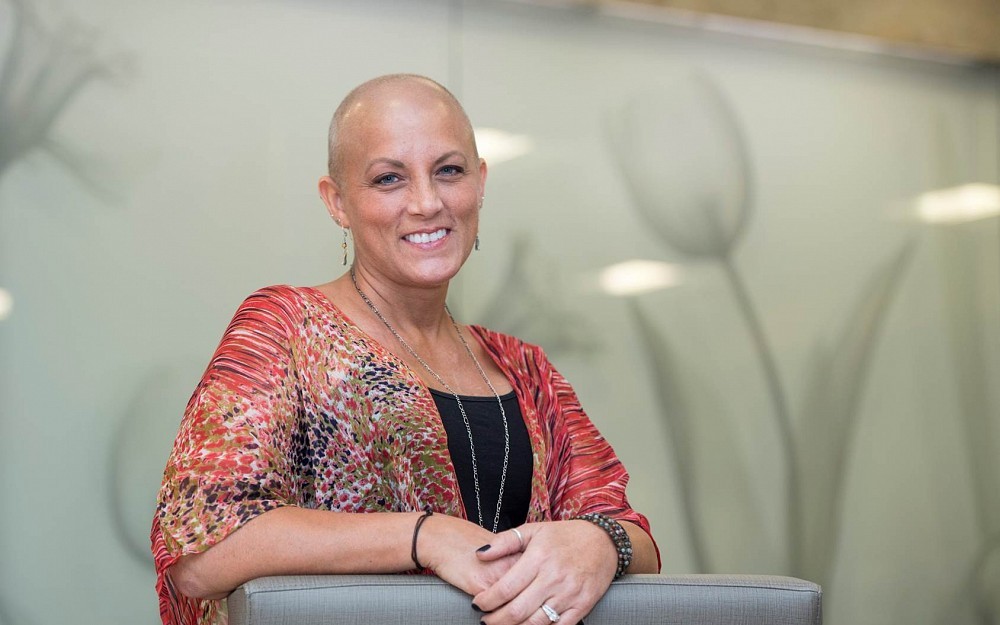
Patient Says Personalized Breast Cancer Care Led to Better Outcomes

At 47 years old, even with a history of breast cancer in her family, Jacqui Roell never thought that the lump in her left breast could be cancer.
"It was right before Christmas last yearDec. 14and I was putting on deodorant when I noticed the lump, which looked like half of a golf ball, and that my nipple was flipped over, says the registered nurse case manager with Humana. "Id never had any abnormal mammograms or problems with my breasts. My mom, who is a breast cancer survivor, wasnt diagnosed until she was 60, so I didnt think it was truly cancer, but I did call my OB-GYN who then sent me for a mammogram.
Two days later, when she went in for her 3-D mammogram, the calm remained, that is until she picked up on some very disturbing signs.
"Being a nurse is a blessing and a curse because you notice everything and you know what is happening, she says. "I got a weird vibe from the technician, and then, when they wanted me to speak to a radiologist in the consultation room, my stomach fell to my feet. I called my husband and my mom to tell them that I thought it was going to be a cancer diagnosis. When I saw the nurse navigator sitting there (nurse navigators help in scheduling follow up appointments and navigating patients through care) I pretty much knew.
Roell was told that it did, in fact, look like cancer, and a biopsy was scheduled.
"I was so angry and devastated, she says. "I thought, I take care of myself. I exercisedo yoga and pilates. I eat rightorganic fruits and vegetables. I am a nurseI take care of other people. I am not the sick one. My entire world came crashing down.
The biopsy confirmed that she had stage 2 invasive lobular carcinoma, sometimes called infiltrating lobular carcinoma, the second most common type of breast cancer. This cancer begins in the milk-producing lobules in the breast, which empty out into the ducts that carry milk to the nipple. Roell actually had two separate tumors.
"My mom had ductal carcinomaso we had different kinds of breast cancer. And genetic testing revealed that neither one of us had the BRCA genes, she adds. "I decided on mastectomy, but I wasnt able to have the surgery and begin reconstruction with expanders until after Valentines Day, which meant it was a hard Christmas and New Year holiday for me.
Roell says when she did have the surgery, three lymph nodes were removed in addition to her breasts. "The lymph node dissection revealed that it had spread to my lymph nodes and that I would have to undergo chemotherapywhich I did not want to do.
She says, playfully, this was the point when she went head-to-head with Elyse Lower, MD, professor at the University of Cincinnati (UC) College of Medicine, director of the UC Cancer Institutes Comprehensive Breast Cancer Center and a UC Health oncologist.
"My nurse knowledge came into play, and I was originally told that I would not need chemotherapy, so when I heard I would need it after all, I became a little skeptical, she says. "Dr. Lower answered all of my questions and made me feel like I had control over my treatment and the path I wanted to take. She said while most of medicine is built on fact, theres a small part that is guesswork.
With Dr. Lower on her side, and a plan in place, Roell says her attitude shifted completely.
"I took the bull by the horns, she says.
In addition to receiving traditional chemotherapy, Roell says supplements were something that she really wanted to incorporate into her treatment plan.
"That really impressed me about Dr. Lower, she says. "I wanted to add something to my personalized treatment plan, and Dr. Lower not only allowed me to do so, she instructed me on what was best and had research knowledge to back up her explanations. She let me be the boss of my care and individualize my specific treatment path. It empowered me and further helped me realize I could beat this.
Roell will complete her reconstruction in October and recently completed her chemotherapy in late August. She was also photographed by Charise Isis for the Grace Project in April.
"While a cancer diagnosis was truly devastating, a great support network, including my wonderful husband Ken who was bedside me the whole timehe was truly my rockand a great care team helped me get back on feet, she says. "Thanks to Dr. Lower listening to me and allowing me to express my needs as a patient, I was able to overcome this.
The UC Cancer Institutes Breast Cancer Center will host "We See Individual Breast Cancer: You See Personalized Care from 9 a.m. to 3 p.m. Saturday, Nov. 4, at the Kingsgate Marriott Conference Center, 151 Goodman Drive. The free educational event will focus on breast cancers differentiation at the gene level and how differences lead to personalized treatment for patients. Experts will also explain how a person can reduce breast cancer risk and minimize recurrence. Lunch will be provided.
For more information or to register, visit http://uchealth.com/events/breast-cancer/.

Jaqui with her husband Ken who was and is her biggest support during her diagnosis and treatment.
Related Stories
UC radiation oncologist speaks with Local 12 news about clinical trial for head and neck cancer treatment
August 10, 2026

Dr. Sara Medek, a UC radiation oncology professor, speaks with Local 12 news about a new clinical trial aimed at reducing radiation in certain areas while still treating cancer effectively but with fewer painful side effects.
Cancer Center director charts future based on collaboration, AI
August 10, 2026

David Gius, MD, PhD, was featured in a Cincinnati Business Courier article and The Cancer Letter’s “The Directors" podcast discussing his priorities and goals as he recently took the helm as director of the University of Cincinnati Cancer Center.
UC graduates cross finish line at commencement
August 7, 2026
The University of Cincinnati recognized 2,125 graduates in two ceremonies at summer commencement Friday on campus at Fifth Third Arena.