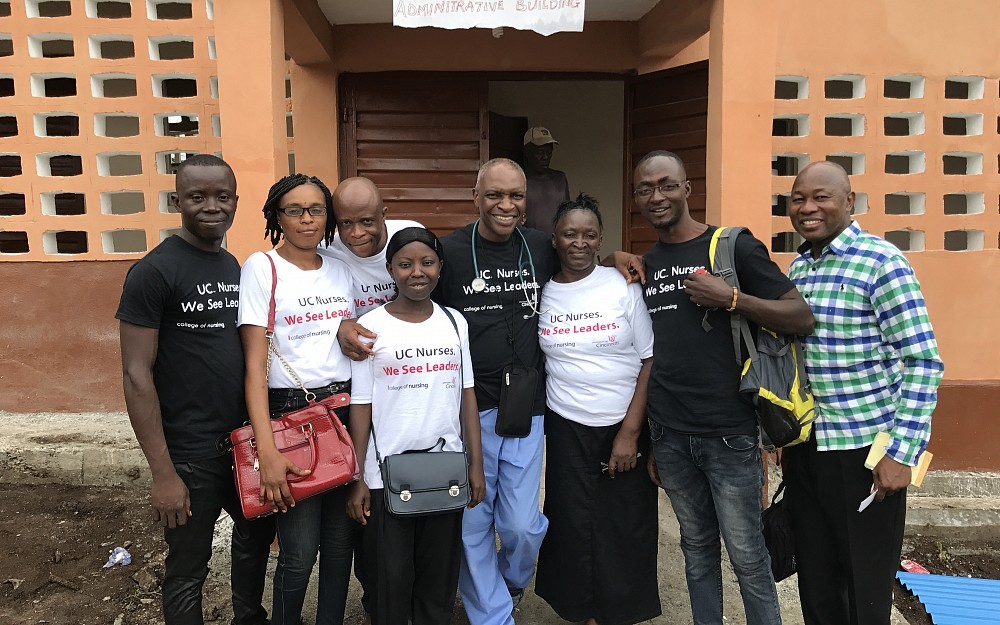
College of Nursing Faculty Founds Sickle Cell Clinic in Sierra Leone

Cheedy Jaja, PhD, associate professor at the University of Cincinnati (UC) College of Nursing, is once again taking on a major health problem in his native country of Sierra Leone. Two years after establishing an orphanage for children who lost their parents to the Ebola epidemic, Jaja has opened up a clinic for patients with sickle cell disease (SCD).
During a visit to Sierra Leone in late 2014 and early 2015 while establishing the orphanage called Dream Home, Jaja was approached by Sickle Cell Carers Awareness Network (SCCAN), a patient advocacy group. SCCAN asked if Jaja could help provide care and medication for a group of approximately 2,000 people who showed signs of SCD. At the time, no facility existed in Sierra Leone to make a definitive determination on whether people had SCD.
Upon his return to UC from Sierra Leone, Jaja received approval for a plan to use his faculty start-up funds to launch a clinical research program in his native country. He then worked out an agreement with Jericho Road, a Boston-based non-governmental organization, to use a large community health center in the Kono District of Sierra Leone as a medical home for his clinical program.
Another key piece of the puzzle came from a North Carolina-based company, BioMedomics. The company developed a point of care testing device, Sickle SCAN, that determines if a patient has SCD.
"Its a finger prick blood test, just a little drop of blood, says Jaja. "It provides immediate results and is less expensive than other testing methods.
The next step for Jaja was hiring a clinical team consisting of a physicians assistant, a registered nurse and a public health worker. The team created a clinical protocol for which aspect of SCD they planned to examine.
"Each patient will come to the clinic once a month, and they will have a free comprehensive medical screening, says Jaja. "They will be examined for different aspects of sickle cell disease and they will be provided with medication.
Jaja hopes that in the next 12 to 24 months, the program will collect definitive data on whether or not the intervention made a difference in patients lives. If the research finds that the intervention had a positive impact on SCD patients, the team will use this as a blueprint to show the Sierra Leone government how care for SCD patients can be provided. He says the clinical staff is also research staff, and everyone will be involved in data collection.
"Im going to create a database at UC with the help of the Center for Clinical and Translational Science and Training that will monitor real-time results in Sierra Leone from here, says Jaja. "What were doing in Sierra Leone is promoting the mission of the university by encouraging both faculty and students to be global citizens and to provide care to marginalized patient populations globally.
Tags
Related Stories
UC radiation oncologist speaks with Local 12 news about clinical trial for head and neck cancer treatment
August 10, 2026

Dr. Sara Medek, a UC radiation oncology professor, speaks with Local 12 news about a new clinical trial aimed at reducing radiation in certain areas while still treating cancer effectively but with fewer painful side effects.
Cancer Center director charts future based on collaboration, AI
August 10, 2026

David Gius, MD, PhD, was featured in a Cincinnati Business Courier article and The Cancer Letter’s “The Directors" podcast discussing his priorities and goals as he recently took the helm as director of the University of Cincinnati Cancer Center.
UC graduates cross finish line at commencement
August 7, 2026
The University of Cincinnati recognized 2,125 graduates in two ceremonies at summer commencement Friday on campus at Fifth Third Arena.