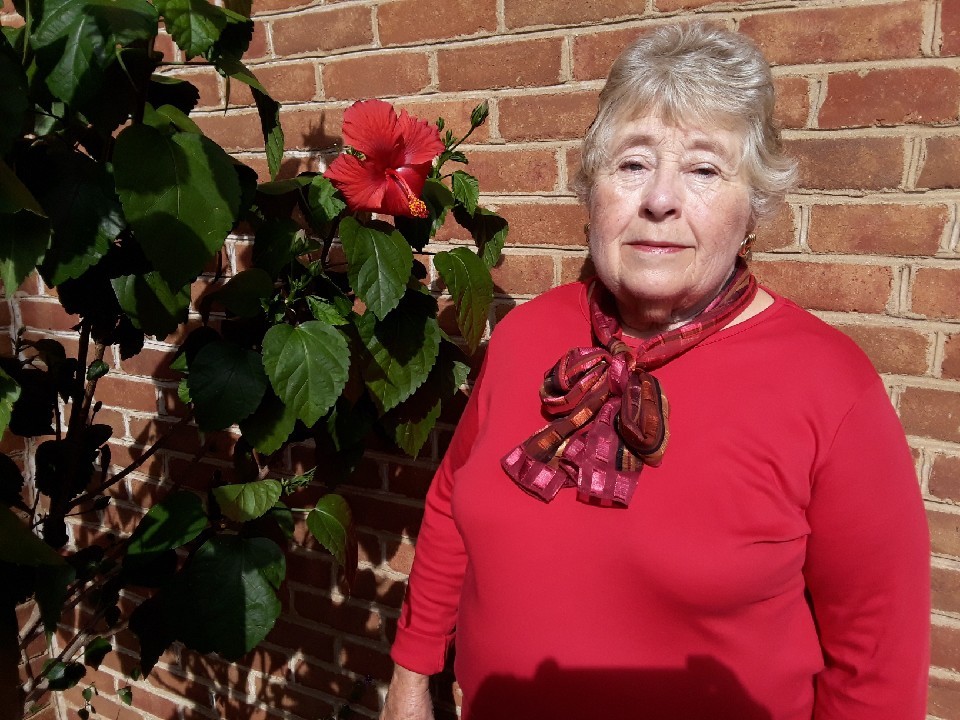
Patient Says 'Just Do It' When It Comes to Lung Cancer Screening

Mary Gamstetter, 75, says she took her first puff of a cigarette when she was 17 years old.
Eventually, she was up to smoking a carton a week.
"I always had one pack in the kitchen drawer, one by my ironing board and another in the car, she says. "Back when I started in the 50s, smoking was glamorized, and then, it just became a habit. One day, when I was hosting my mother-in-laws birthday party, my nieces and nephews were on my case to give up smoking, and so I did. It was the hardest thing Ive ever done, but I did it after 31 years of smoking.
In May 2013, when a postcard came in the mail advertising the UC Cancer Institutes new lung cancer screening program, she had a difficult time ignoring the message.
"I just kept it there in my junk drawer in the kitchen, and every time Id open the drawer, Id see it sitting there, she says. "One day, I finally decided to make an appointment.
The UC Cancer Institutes Lung Cancer Screening Program, which officially opened five years ago this month in November 2012 and has been recognized by the Lung Cancer Alliance as a Screening Center of Excellence, was the first of its kind in the Tristate. It uses a multidisciplinary team approach to provide personalized care to each patient. Screening is used to identify unrecognized disease in people who have no signs or symptoms in an attempt to intervene earlier when disease is generally more treatable.
Since that time, the program has screened over 1,200 patients resulting in the diagnosis and treatment of 26 lung cancers.
Screening is recommended for people at higher risk of lung cancer, including people over the age of 55 and who have smoked a pack of cigarettes a day for more than 30 years.
In 2011, the National Cancer Institute published data supporting chest CT scans as an effective lung cancer screening tool for a high-risk patient populations. The study showed that when current or former heavy smokers were screened with low-radiation dose CT scans versus traditional chest X-rays, there was a 20 percent reduction in lung cancer-related deaths. A separate UC-based trial evaluating chest CT scans in a population of 132 heavy smokers also supported the imaging technique as a viable screening tool in a high-risk population.
Traditional chest X-ray produces a flat, two-dimensional picture. With CT scanning, the X-ray tube is rotated around the patient during the imaging test to create a 3-D picture of the chest which can detect very small spots.
"This allows lung cancer specialists to view the lungs one slice at a time. Nodules that are too small to show up on a chest X-ray are more likely to be detected and specialists can more accurately follow up on concerning lesions, says Sandra Starnes, MD, director of thoracic surgery at the UC College of Medicine, co-director of the UC Cancer Institutes Lung Cancer Center and UC Health thoracic surgeon.
Gamstetter says a small suspicious spot was found during her first scan, but no definite cancer. She continued scheduling and receiving her yearly scans, and in 2016, they finally saw a nodule"with a marshmallow-like halothat needed to be removed.
Starnes performed a segmentectomy, removing a portion of lung that contained the lung cancer and a margin of healthy tissue around the cancer.
"I was very blessed because even though it was more than 30 years since Id stopped smoking, I was still experiencing the after effects. I had no symptoms, so I wouldnt have known, she says. "Dr. Starnes was just fantastic. She just made a few holes and didnt need to open up my whole chest to do the procedure.
Gamstetter says the surgery took place July 5, 2016she pushed back her surgery a few days because she was planning a birthday party for her son and wanted to enjoy the dayand was home by July 9.
"I have only good things to say about my care team at the UC Cancer Institute and UC Health, she says.
Now, Gamstetter receives CT scans every six months and will do so for two years. In 2019, she will go back to having scans every year.
Shes able to enjoy time golfing, gardening, serving as program chairman of the Federated Garden Clubs of Cincinnati and Vicinity and writing the Four Seasons Garden Club newsletter, The Garden Gazette. Shes also spreading the good news about lung cancer screening.
"Ive encouraged two of my friends to go have the scan done. If someone is out there questioning if they should schedule an appointment to be screened, Id say, Just do it! she says. "It saved my life. I feel extremely blessed to have found Dr. Starnes, the UC Cancer Institute and the Lung Cancer Screening Program.
Related Stories
UC radiation oncologist speaks with Local 12 news about clinical trial for head and neck cancer treatment
August 10, 2026

Dr. Sara Medek, a UC radiation oncology professor, speaks with Local 12 news about a new clinical trial aimed at reducing radiation in certain areas while still treating cancer effectively but with fewer painful side effects.
Cancer Center director charts future based on collaboration, AI
August 10, 2026

David Gius, MD, PhD, was featured in a Cincinnati Business Courier article and The Cancer Letter’s “The Directors" podcast discussing his priorities and goals as he recently took the helm as director of the University of Cincinnati Cancer Center.
UC graduates cross finish line at commencement
August 7, 2026
The University of Cincinnati recognized 2,125 graduates in two ceremonies at summer commencement Friday on campus at Fifth Third Arena.