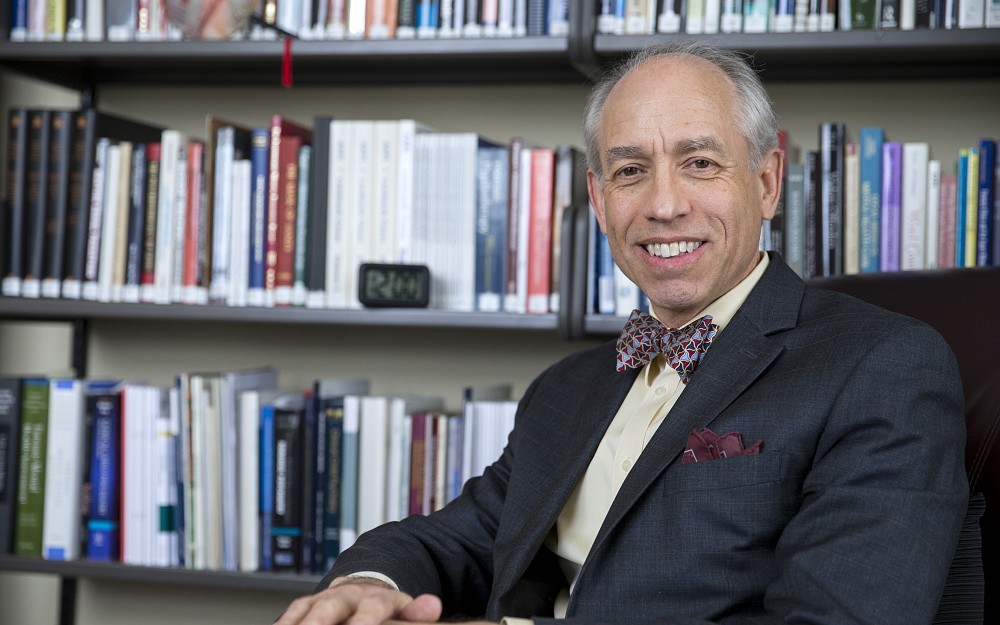
Mossman Receives Golden Apple Award from AAPL

Douglas Mossman, MD, professor of clinical psychiatry and program director of the forensic psychiatry fellowship program at the University of Cincinnati (UC) College of Medicine, is the recipient of the American Academy of Psychiatry and the Law (AAPL) 2017 Golden Apple award. Presented at the Annual Meeting of AAPL on Oct. 26, the award is given to a member of the organization who has made significant contributions to forensic psychiatry.
AAPL (pronounced "apple") is an organization of psychiatrists dedicated to excellence in practice, teaching and research in forensic psychiatry and has more than 1,500 members in North America and around the world.
Mossman has been a member of AAPL for 30 years and has served on a variety of the organizations committees. He also was AAPLs treasurer for six years, a member of the editorial board for the AAPL journal and president of the Midwest AAPL chapter in 2003-04.
He has authored more than 185 publications, including three books. In 2008, his article "Critique of Pure Risk Assessment or, Kant Meets Tarasoff received the Manfred S. Guttmacher Award from the American Psychiatric Association (APA) for outstanding contributions to the literature on forensic psychiatry.
Mossman also contributes regularly to a "Malpractice Rx column in Current Psychiatry. "Psychiatrists think that getting sued for malpractice is primarily how they could get in medicolegal trouble, but thats actually not the only way. So in the column, we look at other ways we psychiatrists might run into legal difficulties, says Mossman, who has written on the topics of HIPAA violations, licensure boards, and telepsychiatry, to name a few.
Mossman directs the forensic psychiatry fellowship in the Department of Psychiatry and Behavioral Neuroscience at UC. During their training with Mossman, fellows learn how to provide psychiatric knowledge to courts "in ways that allow them to use what they know and apply it to legal issues and to be prepared to continue to educate themselves in this subspecialty for years to come. Particularly with the advent of technology and social media, Mossman notes how his approach and what he teaches has changed.
"Facebook wasnt around 11 to 12 years ago, Mossman adds. "Now, two billion people use Facebook, and in North America most adults do [68 percent of U.S. adults per Pew Research, 2016]. All kinds of things come up with that for physicians, but particularly psychiatrists.
"All kinds of developments of the Internet age and the digital world make it possible to record, gather and assemble far more information about people really quicklyinformation of a kind that was not available just 10 years ago. All these things increase the information available to us in a forensic evaluation when considering an individuals behavior.
Mossman feels his greatest professional contributions have been his work focused on the novel application of statistical methods in forensic mental health. "It allows an investigator to conceptualize issues in forensic psychiatry and psychology in different ways, and to ask and answer questions that wouldnt otherwise be approachable, he says.
Outside of work, Mossmans sources of pride are his three daughters and his role as a cantor and musical direction at local area congregations (e.g., Temple Beth Sholom in Middletown). Mossman also enjoys music as a hobby he has written small musical arrangements for synagogue services and funny songs for his presentations to medical audiences. He plays piano and guitar.
As he racks up accolades in the lifetime achievement arenabecoming a Distinguished Life Fellow of the APA in 2016 and now a AAPL Golden Apple awardeehis bio notes these honors have placed him just a step away from official designation as an alter kokker.
Related Stories
UC radiation oncologist speaks with Local 12 news about clinical trial for head and neck cancer treatment
August 10, 2026

Dr. Sara Medek, a UC radiation oncology professor, speaks with Local 12 news about a new clinical trial aimed at reducing radiation in certain areas while still treating cancer effectively but with fewer painful side effects.
Cancer Center director charts future based on collaboration, AI
August 10, 2026

David Gius, MD, PhD, was featured in a Cincinnati Business Courier article and The Cancer Letter’s “The Directors" podcast discussing his priorities and goals as he recently took the helm as director of the University of Cincinnati Cancer Center.
UC graduates cross finish line at commencement
August 7, 2026
The University of Cincinnati recognized 2,125 graduates in two ceremonies at summer commencement Friday on campus at Fifth Third Arena.