UC College of Medicine Researchers Study BPA's Impact on Heart Health

CINCINNATIA $1.97 million five-year grant from the National Institute of Environmental Health Sciences will allow a University of Cincinnati (UC) College of Medicine researcher to continue his investigation into how Bisphenol A (BPA), a common component of polycarbonate plastics used in consumer products, may impact heart health.
Hong-Sheng Wang, PhD, associate professor in the Department of Pharmacology and Systems Physiology, and other UC researchers previously presented research showing that BPA has pro-arrhythmic effects in rodent hearts. Now he hopes to further examine the chemicals potential cardiac toxicity using other animal models and data from a human cohort. BPA is an endocrine hormone disrupter that can interfere with the actions of native estrogen and other hormones.
The study will also examine the cardiac impact of Bisphenol S (BPS), says Wang. In the past decade the movement to introduce BPS, a substitute for BPA, has grown. Researchers have also raised concerns about BPS possibly impacting human health based on research in animal models.
"Our ultimate goal is to understand the toxicity of BPA and how it relates to human hearts, says Wang, also a member of the UC Heart, Lung and Vascular Institute. "BPA at an environmentally relevant level is not likely to give a healthy heart arrhythmias, but our data show that it is a risk factor. This pro-arrhythmic effect may become more relevant in hearts that are predisposed to arrhythmias.
Wang is a principal investigator on this research project along with Jack Rubinstein, MD, associate professor in the UC Division of Cardiovascular Health and Disease and a UC Health cardiologist. Also, collaborating on this project are Susan Pinney, PhD, professor in the Department of Environmental Health, and Changchun Xie, PhD, associate professor in the Department of Environmental Health.
Wang says the research team will also examine data from the Fernald Medical Monitoring Program (FMMP) to determine what correlation BPA exposure may have with cardiac electrical abnormalities in a human cohort. FMMP contains data and bio specimens from more than 9,700 people enrolled in an 18-year medical monitoring project originally designed to examine health outcomes of residents living near a former uranium processing plant in Crosby Township, Ohio, 18 miles northwest of Cincinnati.
Researchers will review medical records and EKG data of Fernald participants and measure BPA in urine biospecimens collected on the same day, in order to look for an association between BPA level and cardio abnormality, explains Wang.
"The combination of a human cohort and a large animal model makes our research much more compelling and powerful, says Wang. "Fernald was designed to monitor the health of the local population that may have been exposed to uranium, but it unintentionally gives us this nice data set so we can look at other data points.
Interested researchers may apply to the Fernald Community Cohort, directed by Pinney, for access to data and bio specimens for research studies. For more information visit https://med.uc.edu/eh/research/projects/fcc

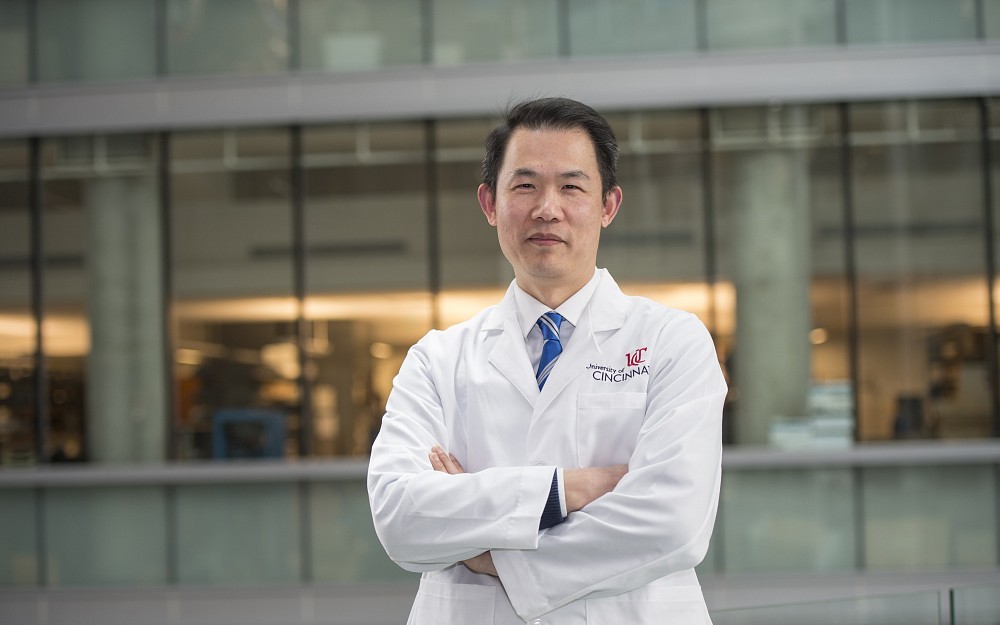
Hong-Sheng Wang, PhD, associate professor in the Department of Pharmacology and Systems Physiology, is shown in his office in the College of Medicine.
Related Stories
UC radiation oncologist speaks with Local 12 news about clinical trial for head and neck cancer treatment
August 10, 2026

Dr. Sara Medek, a UC radiation oncology professor, speaks with Local 12 news about a new clinical trial aimed at reducing radiation in certain areas while still treating cancer effectively but with fewer painful side effects.
Cancer Center director charts future based on collaboration, AI
August 10, 2026

David Gius, MD, PhD, was featured in a Cincinnati Business Courier article and The Cancer Letter’s “The Directors" podcast discussing his priorities and goals as he recently took the helm as director of the University of Cincinnati Cancer Center.
UC graduates cross finish line at commencement
August 7, 2026
The University of Cincinnati recognized 2,125 graduates in two ceremonies at summer commencement Friday on campus at Fifth Third Arena.