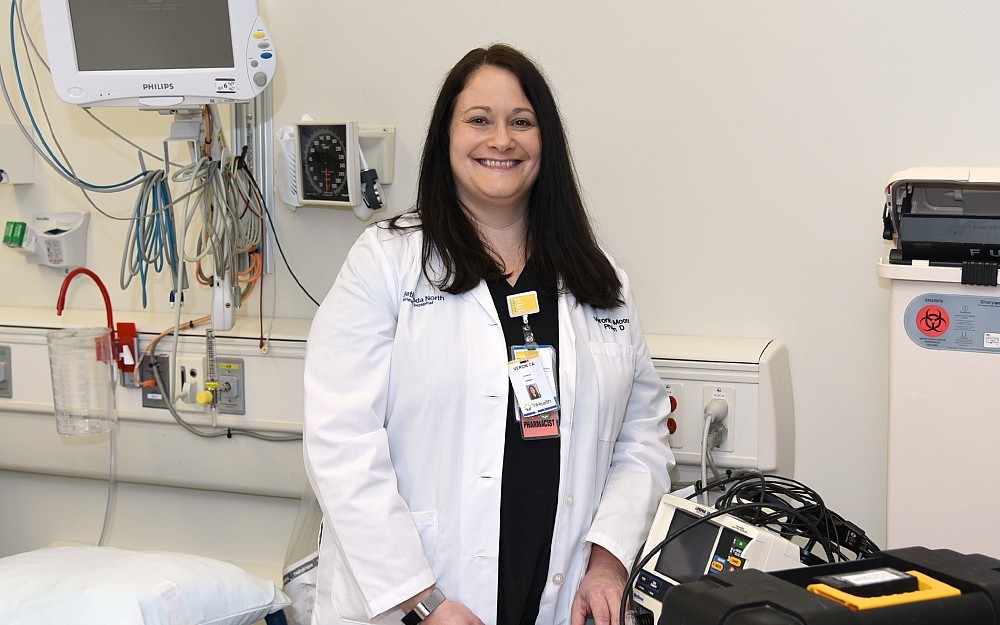
Focus On Pharmacy Practice Partners: Veronica Moore, PharmD

Veronica Moore, PharmD (07), an emergency medicine pharmacist at Bethesda North Hospital, became interested in pharmacy through a circuitous path. She was a middle school and high school science teacher for seven years, having earned a bachelors degree in biology and a masters in secondary education, but eventually began looking for a career change; and hopeful to continue in both the science and education fields. It was during a summer course for chemistry teachers at the James L. Winkle College of Pharmacy that she spoke with the instructor, Bill Cacini, PhD, (1947-2017) numerous times about a career in pharmacy. He obviously made a lasting impression. Moore applied to pharmacy school the following fall and began an exciting new chapter in her life and career path. With a background in education, teaching was still her passion and it was a goal to be involved with teaching pharmacy students. Today, she says she is lucky to be a preceptor at Bethesda, and she returns to the college to teach on a routine basis.
What is your role at Bethesda Hospital?
I have been employed as an emergency medicine pharmacist at Bethesda North Hospital since the completion of a PGY1 residency at UC Medical Center in 2007. I established this practice and at the time was the only pharmacist working in the Emergency Department (ED). The service has now grown so that there is a pharmacist decentralized to the ED both day shift and evening shift seven days a week, with 11 pharmacists now trained to cover the department. I have made strides to ensure that pharmacists are an integral component of the ED environment, most recently having developed a culture monitoring program for discharged ED patients that is solely managed by the ED pharmacists.
How are you involved as a practice partner?
I have the pleasure of serving as a preceptor for Advanced Pharmacy Practice Experience students on rotation. I am also a guest instructor in various courses at the college (Academia Elective, Advanced Therapeutics Elective, Residency Teaching Certificate), and last fall semester debuted a course of my own entitled Emergency Medicine Therapeutics. I serve as the course coordinator for this elective, as well as teach periodically throughout the semester. I am also a member of the Experiential Education Committee, where I work with faculty and other preceptors to ensure that pharmacy students have the best rotation experience possible.
Why is it important to give students experiential learning in your area of pharmacy?
I feel it is important for students to gain experiential learning in my area of practice because students are able to become part of an interdisciplinary health care team that provides direct patient care. We make therapeutic recommendations on a daily basis that improve patient outcomes and are respected as the drug information experts in the emergency department. Emergency Medicine is also a unique practice environment in that it combines elements of critical care with those of ambulatory care. You can find yourself in a code situation one minute, completing a medication history interview the next, then turn around and dose/mix alteplase for an acute ischemic stroke. Students should have the opportunity to experience this singular work environment.
Do you keep in touch with the students?
I definitely keep in touch with students that I have hosted on rotation. Each year, I am asked to write letters of recommendation for one or two students who choose to pursue a residency and keep tabs on these folks as they determine a career path. In fact, two students that I once precepted are employed as Emergency Medicine pharmacists in the Greater Cincinnati area so our preceptor relationship has transformed into a collegial one.
Tags
Related Stories
UC radiation oncologist speaks with Local 12 news about clinical trial for head and neck cancer treatment
August 10, 2026

Dr. Sara Medek, a UC radiation oncology professor, speaks with Local 12 news about a new clinical trial aimed at reducing radiation in certain areas while still treating cancer effectively but with fewer painful side effects.
Cancer Center director charts future based on collaboration, AI
August 10, 2026

David Gius, MD, PhD, was featured in a Cincinnati Business Courier article and The Cancer Letter’s “The Directors" podcast discussing his priorities and goals as he recently took the helm as director of the University of Cincinnati Cancer Center.
Bidirectional link between oral, kidney health calls for patient education, access
August 4, 2026

Despite growing awareness of the connection between oral health and chronic health conditions, patient awareness and access to dental care remain limited, according to University of Cincinnati experts who recently spoke with Healio | Nephrology News & Issues.