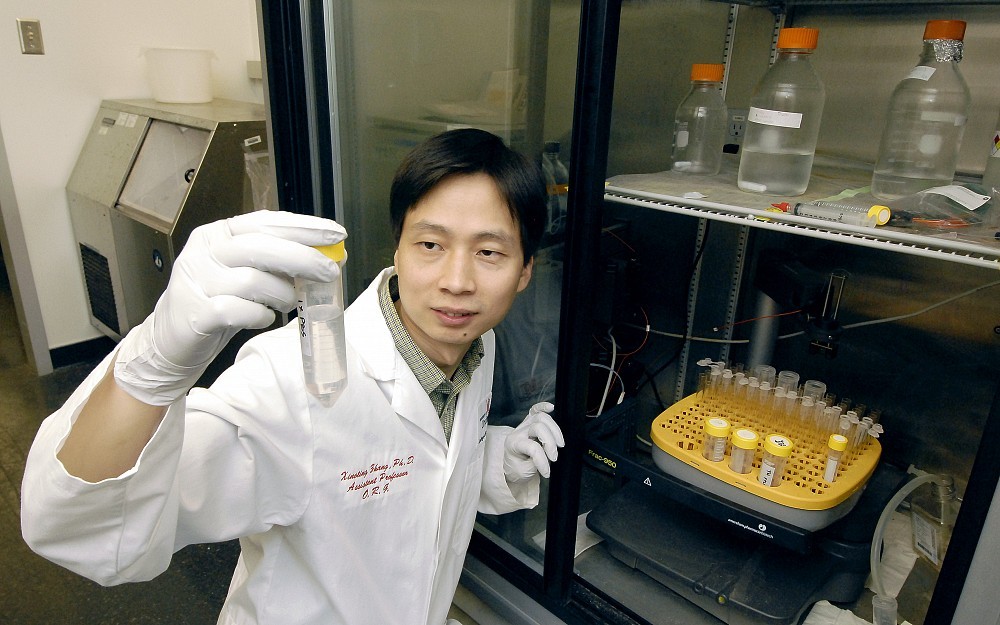
Zhang Receives Grant to Study Nanoparticle Use for Uterine Cancer Treatment

Xiaoting Zhang, PhD, associate professor in the Department of Cancer Biology at the University of Cincinnati (UC) College of Medicine, has been awarded the 2017 Schaeper Uterine Cancer Pilot Grant in the amount of $47,500 to help fund his research looking at the use of nanoparticles to target a certain protein (MED1) in the treatment of uterine cancers.
"Endometrial cancer is the most common gynecologic cancer in the United States with more than
50,000 women diagnosed annually, says Zhang, who is also a member of the Cincinnati Cancer Center and UC Cancer Institute. "Numerous studies have demonstrated that HER2 overproduction, or overexpression, is associated with progressive disease and therapy resistance.
HER2 is a protein known as human epidermal growth factor receptor 2 which promotes the growth of cancer cells. MED1 co-produces (co-expresses) and co-amplifies with HER2 in most cases, and Zhangs previous studies have shown their interaction plays key roles in anti-estrogen treatment resistance.
"In contrast to breast cancer, treatment with anti-HER2-targeted therapies, such as the small molecule chemical drug lapatinib, has provided no clinical benefit for patients with recurrent HER2 overexpressing endometrial cancer, he says. "Our lab has shown that MED1 is a key HER2 target in both anti-estrogen and anti-HER2 resistance. Using RNA nanotechnology, we have developed RNA nanoparticles to eliminate MED1 in HER2 overexpressing breast cancer models, which blocked tumor growth, metastasis and therapy resistance in both human breast cancer cell lines and animal models.
"This grant, will help us determine if MED1 is also a driver of HER2 overexpressing uterine cancer and can be targeted to improve anti-HER2 therapy resistance.
Zhang says his team will determine the role of the interaction, or "crosstalk, between HER2 and MED1 in uterine cancer and test the efficacy of targeting MED1 using RNA nanoparticles to overcome anti-HER2 resistance of uterine cancers.
"This study will help provide new information on the biology of HER2-driven uterine cancer and could prove that combination therapies using RNA nanoparticles in conjunction with FDA-approved small molecules could be a beneficial therapy for endometrial cancer, he says.
Related Stories
UC radiation oncologist speaks with Local 12 news about clinical trial for head and neck cancer treatment
August 10, 2026

Dr. Sara Medek, a UC radiation oncology professor, speaks with Local 12 news about a new clinical trial aimed at reducing radiation in certain areas while still treating cancer effectively but with fewer painful side effects.
Cancer Center director charts future based on collaboration, AI
August 10, 2026

David Gius, MD, PhD, was featured in a Cincinnati Business Courier article and The Cancer Letter’s “The Directors" podcast discussing his priorities and goals as he recently took the helm as director of the University of Cincinnati Cancer Center.
UC graduates cross finish line at commencement
August 7, 2026
The University of Cincinnati recognized 2,125 graduates in two ceremonies at summer commencement Friday on campus at Fifth Third Arena.