UC Researchers Lead Study of Cell-Based Injection for Treatment of Knee Osteoarthritis

CINCINNATIResearchers at the University of Cincinnati are part of a nationwide study to determine whether a patients own blood, with its associated cells, proteins, and growth factors, can treat knee osteoarthritis (OA).
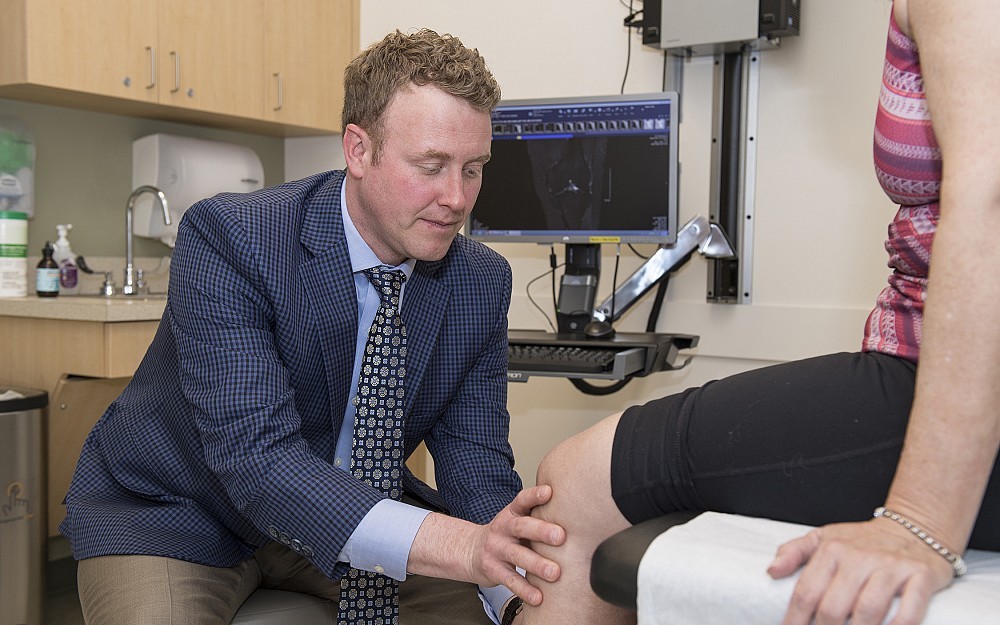
"The advancement of injection options for a wide range of joint, ligament and muscle/tendon conditions has grown exponentially over the last decade. However, there has been a paradigm shift from performing palpation guided injections using traditional cortisone and/or lubricant solutions to more precise ultrasound-guided injections using more naturally occurring biologic-type options, says principal investigator Brian Grawe, MD, an associate professor in the Department of Orthopaedic Surgery at UCs College of Medicine.
The investigational treatment is autologous, meaning the injectable solution is created from a patients own blood. Human blood is rich in cells, growth factors, and other naturally occurring substances, such as cytokines (signaling proteins), which can be useful to block inflammation and stimulate healing.
In this double-blind study, blood is drawn from the participants arm. The blood is placed in a centrifuge to separate cells and proteins that are then removed and injected into the knee. Study participants receive either an ultrasound guided injection of the investigational treatment or a placebo (saline) injection into the knee joint.
"Obviously, there is a great appeal for using ones own blood to stimulate healing rather than relying on pharmaceutical injectable for symptom management, says Grawe.
Osteoarthritis is an often painful condition that results in a gradual decline in the protective cartilage that forms the joint. The joint space and lubrication become ineffective, and ones mobility and quality of life deteriorates. Current injectables can reduce the pain, but the endpoint is frequently a total joint replacement. There appear to be many contributing factors including genetics, ones immune system, micro/macro injuries, and the bodys ability to respond to such challenges.
According to the most recent, comprehensive, data compiled by the Mayo Clinic, more than 600,000 total knee replacements are performed in the U.S. each year; with approximately 4.7 million Americans having had a total knee replacement.
The results of this study, Grawe says, could bear out the potential to stop the progressive degeneration caused by OA that often leads to knee replacement. "This could be game changing for OA of the knee, he says, noting that while surgical intervention such as knee replacement has been a clinically successful surgery, it should be the last course of action if there are less invasive, evidenced based, practices available.
UC is one of 30 sites nationwide participating in the PROGRESS IV clinical trial funded by Zimmer Biomet, a medical device company headquartered in Indiana. The research team cites no conflicts of interest.
Criteria to participate in the trial requires a Body Mass Index equal to or less than 40, OA pain in only one knee, and prior conservative treatment of that knee with unsatisfactory pain relief. To inquire about the trial, contact the research coordinator Kim Hasselfeld via email at kimberly.hasselfeld.uc.edu or by calling 513-584-3931.
Related Stories
UC radiation oncologist speaks with Local 12 news about clinical trial for head and neck cancer treatment
August 10, 2026

Dr. Sara Medek, a UC radiation oncology professor, speaks with Local 12 news about a new clinical trial aimed at reducing radiation in certain areas while still treating cancer effectively but with fewer painful side effects.
Cancer Center director charts future based on collaboration, AI
August 10, 2026

David Gius, MD, PhD, was featured in a Cincinnati Business Courier article and The Cancer Letter’s “The Directors" podcast discussing his priorities and goals as he recently took the helm as director of the University of Cincinnati Cancer Center.
UC graduates cross finish line at commencement
August 7, 2026
The University of Cincinnati recognized 2,125 graduates in two ceremonies at summer commencement Friday on campus at Fifth Third Arena.