Early Intervention Program Marks 20th Anniversary

Sunday, July 1, 2018, marks the 20th anniversary of the founding of the University of Cincinnatis (UC) Early Intervention Program (EIP). Over the past two decades, the EIP has grown dramatically and expanded its services thanks to the efforts of several individuals and organizations.
At inception, the EIP was an HIV rapid testing site located in the emergency department at University Hospital, now UC Medical Center. It focused on identifying and intervening with populations most at risk for threats to health and well-being at the earliest opportunity and helping these individuals connect with community resources to improve health outcomes. The EIP grew out of the efforts of Peter Frame, MD, a professor in the UC Division of Infectious Diseases, and Alexander Trott, MD, professor in the Department of Emergency Medicine. The EIP was the first HIV testing program implemented in an emergency department on a sustained clinical basis.
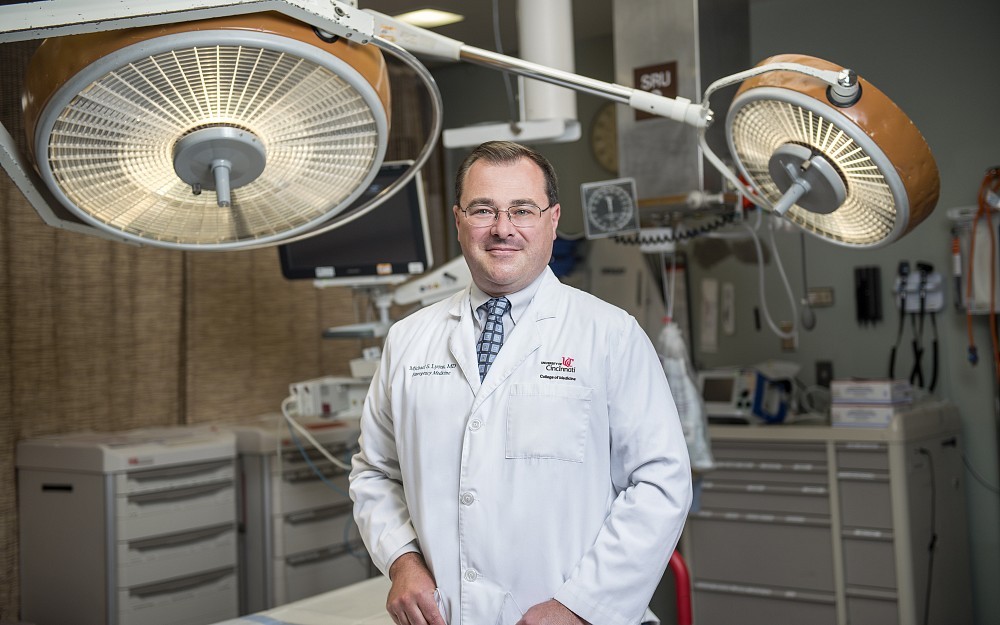
"Twenty years later, we think of the EIP as a specific systematic approach to being more proactive in health and health care and reducing fragmentation between health care settings, says Michael Lyons, MD, associate professor in the Department of Emergency Medicine and director of the EIP. "Its the way health care needs to evolve.
An essential component for accomplishing such a mission is collaboration, according to Lyons. The EIP has grown in size and scope thanks in part to the involvement of the UC Division of Infectious Diseases, which assisted the creation of the program and has been a key partner over the EIPs 20-year history. The EIP has also collaborated with the UC Division of Digestive Diseases to address hepatitis C and the UC Addiction Sciences Division to combat substance use disorders including the current opioid crisis.
The EIP has also capitalized on academic collaborations with non-clinical departments such as the UC School of Business and the UC Department of Communication, in addition to Cincinnati Childrens. Over time, the program hopes to continue this expansion, with the goal of eventually adding services for hypertension, diabetes and other large-scale health concerns.
"The idea is to look at the population, not just at the level of the individual patients, but at the health care systems response to reaching this population and improving health in a more proactive way, says Lyons. "Its getting out ahead of health care problems instead of playing catch up all the time, and a key part of that is merging missions and operations of public health and health care organizations.
Not only has the EIP grown over the past 20 years, so has the EIP team itself. What began with a small team of clinical research coordinators has grown to more than 150 people who work with the EIP, some of whom are faculty now at the UC College of Medicine.
"People have become fellows and faculty of other programs as well, says Lyons. "Its a huge farm system into the health professions through the clinical experiences provided by the EIP.
In its 20-year history, the EIP has been funded by a variety of sources, including Hamilton County Public Health, Cincinnati Health Department, Interact for Health, Ohio Department of Health, the Centers for Disease Control and Prevention, Cincinnati Health Networks Ryan White funds from the Health Resources & Services Administration and the National Institutes of Health.
The EIP has also fostered partnerships with various community-based organizations and initiatives such as Lighthouse Youth Services, Cincinnati Exchange Project, Narcan Distribution Collaborative, First Ladies Health Initiative, Freestore Food Bank, Brightview Health, Talbert House, St. Josephs Orphanage, Drop Inn Center, Central Community Health Board, Our Daily Bread and St. Vincent de Paul.
Since July 1, 1998, the EIP has brought in over $12 million for prevention services and research to improve those services, which have included almost 53,000 HIV tests that have resulted in 394 patients diagnosed and 316 linked to care, according to Lyons.
"Just imagine if on average those 394 patients had inadvertently infected just one additional person before we diagnosed them and got them into care, Lyons says. "Care prevents new infections, reduces medical costs and saves lives. Thats true of other interventions too, but the impact of the HIV screening is a perfect example of the EIP mission. Cincinnati would be a different city if we hadnt been here these past 20 years.
Related Stories
UC radiation oncologist speaks with Local 12 news about clinical trial for head and neck cancer treatment
August 10, 2026

Dr. Sara Medek, a UC radiation oncology professor, speaks with Local 12 news about a new clinical trial aimed at reducing radiation in certain areas while still treating cancer effectively but with fewer painful side effects.
Cancer Center director charts future based on collaboration, AI
August 10, 2026

David Gius, MD, PhD, was featured in a Cincinnati Business Courier article and The Cancer Letter’s “The Directors" podcast discussing his priorities and goals as he recently took the helm as director of the University of Cincinnati Cancer Center.
UC graduates cross finish line at commencement
August 7, 2026
The University of Cincinnati recognized 2,125 graduates in two ceremonies at summer commencement Friday on campus at Fifth Third Arena.