Camp Cardiac Sparks Interest in the Heart for Area High School Students

Twenty-seven high school students are attending a week-long day camp at the University of Cincinnati College of Medicine July 9-13, 2018. Known as Camp Cardiac, the event is run locally by UC medical students, but is part of an effort in 30 cities nationwide designed to offer an introduction for any high school student interested in careers in science or medicine.
"We are really hoping to give the high school students an early exposure of what medicine is like and how exciting science is in general, says Josh Spaw, a second-year medical student at UC. "These students have an early interest in cardiology and we want to give them a broad view of what the field is like and keep their interest sparked and offer ideas for what they want to do in the future.
With a focus on both education and real world experience, Camp Cardiac provides students with a unique opportunity to learn directly from experts in the medical field. UC medical students were involved as counselors and lecturers, while physicians and faculty in the College of Medicine also led sessions with high school students about the heart and cardiovascular system.
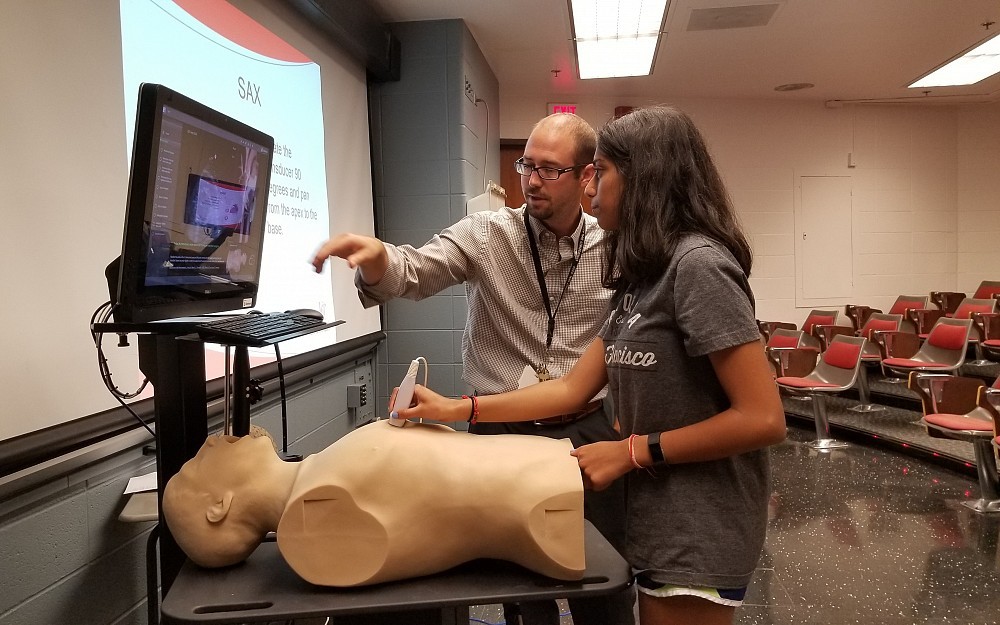
Topics during the week include sessions on heart anatomy, understanding an EKG, and lessons on integrative medicine. Students will have hands-on laboratory experiences using ultrasound, suturing and dissecting a pig heart. College admissions staff will also offer advice about higher education.
In addition, this one-week summer day camp also provides a foundation for heart healthy living with an emphasis on both diet and exercise. Although Camp Cardiac's primary focus is on care and maintenance of the heart, it provides an excellent starting point for careers in all fields of medicine.

Richard Becker, MD, director of the UC Heart, Lung and Vascular Institute, was among the faculty speakers at Camp Cardiac held in the College of Medicine July 9-13, 2018.

Yocheved Ocho, a junior at Walnut Hills High School, and Lauren Stadt, a junior at Acalenes High School in Lafayette, CA, are shown during a pig dissection instruction at Camp Cardiac.

Keshav Shah, a junior at St. Xavier High School and John Mattamana, a junior at Carroll High School, are shown with Josh Spaw (center), a second-year UC medical student, at a Camp Cardiac session.
Related Stories
Cancer Center plays key role in lab research, clinical trials for new pancreatic cancer drug
September 1, 2026

WLWT and WCPO highlighted the contributions of University of Cincinnati Cancer Center researchers that helped lead to the recent FDA approval of daraxonrasib, a new treatment for pancreatic cancer.
Cancer Center physician receives $150,000 New Investigator Research Grant to study treatment-resistant leukemia
September 1, 2026
The University of Cincinnati Cancer Center’s Sarah Skuli, MD, PhD, received a two‑year, $150,000 Leukemia Research Foundation New Investigator Grant to study TP53‑mutated leukemia, a treatment‑resistant subtype with very poor outcomes.
Heavy social media use linked to depression
August 31, 2026

U.S. News and World Report, Yahoo! News, MSN, USA Today and other national media highlight a new study by the University of Cincinnati and Northwestern University that found a correlation between heavy social media use and depression in adults.