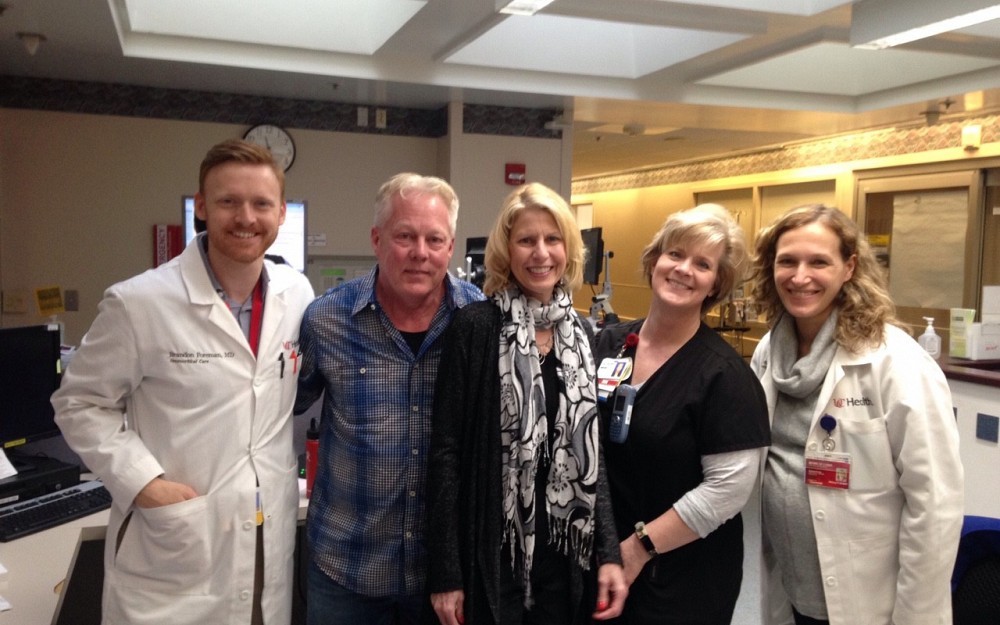
Patient on Road to Recovery Thanks to Neuroscience Team, and Time

After collapsing from a heart attack in December 2017, 51-year-old Mary Cooper remained in status epilepticus, or a constant state of seizure activity for nearly two weeks. With continuous EEG monitoring, available in the region only at UC Medical Centers neurocritical care unit, specialists at the UC Gardner Neuroscience Institute were able to get her seizure activity under control to begin the brains healing process.
"At UC, we know a lot about post-cardiac arrest seizures, so when we got the call and heard what was going on, we made room for her, says Brandon Foreman, MD, an assistant professor of neurology. "If a patient is in a coma, it can be hard for a standard EEG to determine what is going on inside the brain; that is where the continuous monitoring becomes critical.
Tags
Related Stories
Cancer Center plays key role in lab research, clinical trials for new pancreatic cancer drug
September 1, 2026

WLWT and WCPO highlighted the contributions of University of Cincinnati Cancer Center researchers that helped lead to the recent FDA approval of daraxonrasib, a new treatment for pancreatic cancer.
Cancer Center physician receives $150,000 New Investigator Research Grant to study treatment-resistant leukemia
September 1, 2026
The University of Cincinnati Cancer Center’s Sarah Skuli, MD, PhD, received a two‑year, $150,000 Leukemia Research Foundation New Investigator Grant to study TP53‑mutated leukemia, a treatment‑resistant subtype with very poor outcomes.
Heavy social media use linked to depression
August 31, 2026

U.S. News and World Report, Yahoo! News, MSN, USA Today and other national media highlight a new study by the University of Cincinnati and Northwestern University that found a correlation between heavy social media use and depression in adults.