UC Launches Second Tele-Nephrology Location

A program to provide long distance inpatient nephrology consultations, clinical support and monitoring to patients who need dialysis is growing. A service of the University of Cincinnatis (UC) Division of Nephrology, Kidney C.A.R.E. Program launched in January 2016 at its first site at Meadowview Regional Medical Center in Maysville, Kentucky, expanded to Margaret Mary Hospital (MMH) in Batesville, Indiana on Thursday, July 5, 2018.
The tele-nephrology program aims to keep patients at their local hospitalsnear their homes and support networkswhile still offering them access to the advanced specialty care available at an academic health system like UC Medical Center.
"The UC Health Tele-Nephrology program allows patients with renal disease and other kidney-related conditions to be treated at their local hospitals with direct access to world-class care from our UC College of Medicine experts, says Charuhas Thakar, MD, professor, and director of the Division of Nephrology, Kidney C.A.R.E. (Clinical Advancement, Research and Education) in the Department of Internal Medicine at the UC College of Medicine.
Thakar says that over a third of hospitals in the United States are located in rural zip codes and provide care to 20 percent of the population. An estimated 1,300 of these hospitals are considered critical access hospitals. Since the tele-nephrology program began at Meadowview Regional Medical Center they have treated more than 50 patients and provided over 200 bed-days of care. Of those patients, 81 percent were successfully treated and discharged back home into their community.
"Without our tele-nephrology services, these days of care would been delivered several miles away from that location, leading to expensive care, transportation costs, as well as opportunity costs to patients and their family members, says Thakar.
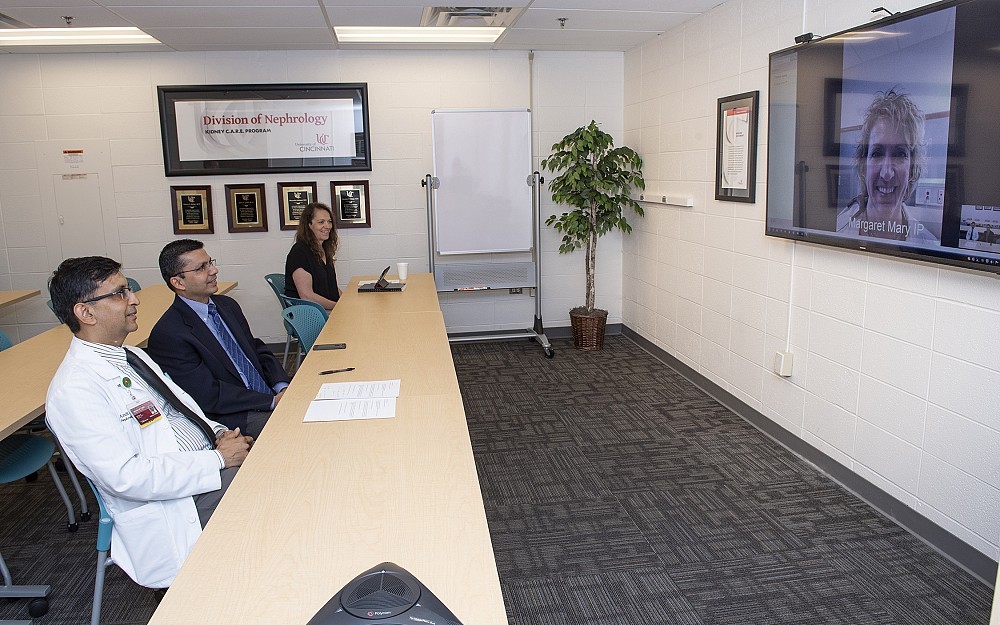
Thakar and Amit Govil, MD, professor and medical director of the Kidney Transplant Program in the Department of Internal Medicine at the UC College of Medicine tested the process with MMH via a mock patient demonstration. Govil spoke via the Vidyo conferencing platform with the mock patient and a doctor who described the patients symptoms and then discussed a plan of treatment.
"When an emergency room doctor or hospitalist in the hospital feels the need to get a kidney specialist opinion, they will contact us, says Govil. "We will determine the necessity of a consultation as well as the opportune time to do a tele visit. The tele visit will fall into two categories: a provider-to-provider tele visit and a provider-to-patient tele visit.
Thakar says there is growing interest in telemedicine due to the Centers for Medicare and Medicaid Services (CMS) making delivering care by telemedicine a priority. There is a recent effort in Congress to ease restrictions on reimbursing telemedicine treatments, and tele-nephrology is a growing part of this field.
According to Thakar, end stage renal disease (ESRD) patients make up only one percent of Medicare beneficiaries, but they consume 10 percent of the Medicare budget.
Tele-nephrology is one of the ways to bend the cost curve in terms of how we can manage these patients efficiently by technology, says Thakar. "The per-patient cost per year for people with ESRD is more than $80,000. One in three patients admitted to the hospital has chronic kidney disease or will develop the need for a nephrology consult.
Thakar says one of the objectives of this program is to develop a hub-and-spoke model in the region and beyond, and bring cutting-edge academic renal care to the bedside in rural communities where it might not be readily available.
The program is directed by Thakar and staffed by Govil and Ajay Srivastava, MD, associate professor in the Division of Nephrology, Kidney C.A.R.E. Program.
"We want to be a clinical resource to both patients and their providers in our region, Thakar says. "Our goal is to serve three to five hospitals with the current workforce we have developed, and expand in delivering ambulatory and transplant care in the near future.

Amit Govil, MD (right) and Charuhas Thakar, MD during a tele-nephrology demonstration in the Division of Nephrology, Kidney C.A.R.E. Program
Related Stories
On-site training in Speech & Hearing Clinic sets UC’s programs apart
August 27, 2026
At the University of Cincinnati’s Speech & Hearing Clinic, Doctor of Audiology and Speech-Language Pathology graduate students gain real-world experience while providing free speech and hearing services to the community.
Designing with cancer patients' needs in focus
August 27, 2026
Kristina Shin is designing garments that prioritize the comfort, function and confidence of breast cancer patients, addressing a need often overlooked by traditional fashion.
UC, NKU renew longstanding partnership supporting Army ROTC cadets
August 26, 2026
The University of Cincinnati Army ROTC and Northern Kentucky University (NKU) have renewed a longstanding partnership that supports students preparing to become Army officers and leaders in their communities. The universities formalized the renewed agreement during a signing event Aug. 11 at NKU.