NPR: How Seattle’s police chief navigated city’s protests

NPR law enforcement correspondent Martin Kaste examines how Seattle Police Chief Carmen Best has navigated the protests for racial justice in her city that erupted in the wake of the death of George Floyd. In understanding the challenges faced by even reformist-minded police chiefs in working with activists, Kaste turns to University of Cincinnati criminologist Robin Engel, a nationally renowned expert in the field of policing piolicy.
Engel, a professor of criminal justice and director of the International Association of Chiefs of Police and the University of Cincinnati Center for Police Research and Policy, tells Kaste that activists should recognize the political realities faced by chiefs such as Best.
“They have gone to the streets. And that's important. And, actually, it's powerful. It gives power to law enforcement executives that are reform minded. But the citizens also have to demonstrate a willingness to work with law enforcement executives that are making these changes,” said Engel.
Read the transcript or listen to the complete story here.
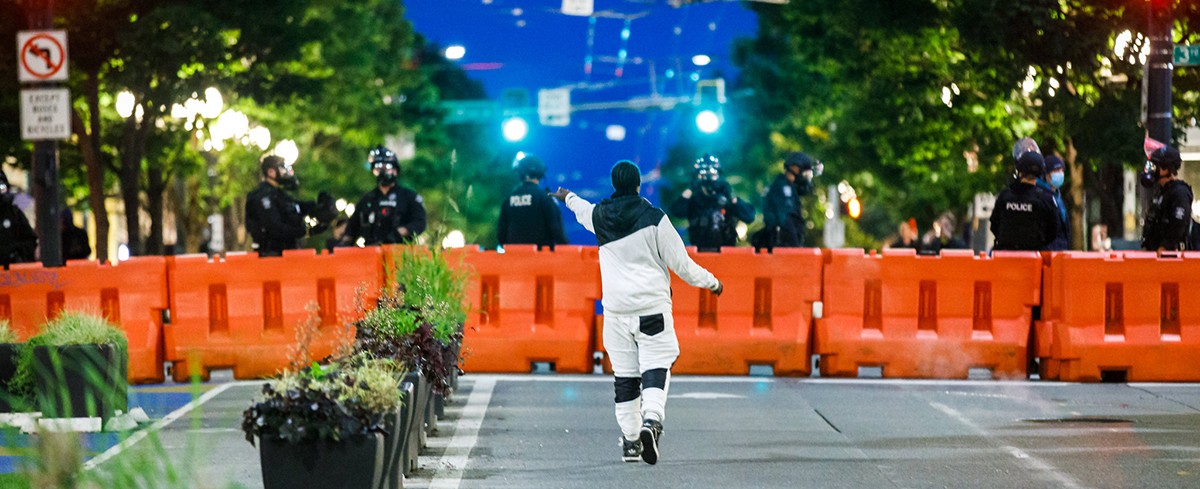
Featured image at top: A protestor stands before Seattle police officers during the George Floyd protests in Seattle, WA. Photo by Derek Simeone/(CC BY 2.0)
Related Stories
Co-op broadens horizons for architectural engineer
August 17, 2026
UC architectural engineering graduate Jeremy Ackley turned his co-op rotations with CMTA, a national engineering consulting firm in Texas, into a full-time role, showcasing the University of Cincinnati’s national co-op footprint.
Emeritus professor honored for gas turbine research
August 17, 2026
Mark Turner has been part of the University of Cincinnati's College of Engineering and Applied Science for 25 years. His work in the field of gas turbine simulation and design continues to leave a significant impact on the industry. He was honored by the American Society of Mechanical Engineers with the International Gas Turbine Institute Scholar Award. Turner is part of the Department of Aerospace Engineering and Engineering Mechanics at UC.
UC scholarship honoring a family’s matriarch continues
August 17, 2026
“I get chills thinking about what she means to our family,” says Norma Wellman Cobb’s grandson, Thomas Beach, reflecting on how his grandmother’s perseverance and unwavering belief in the power of education shaped generations.