
Bazinga! UC physicist cracks ‘Big Bang Theory’ problem
Theoretical physicists say fusion reactors could help shed light on dark matter

A physicist at the University of Cincinnati and his colleagues figured out something two of America’s most famous fictional physicists couldn’t: theoretically how to produce subatomic particles called axions in fusion reactors.
Particle physicists Sheldon Cooper and Leonard Hofstadter, roommates in the CBS sitcom “The Big Bang Theory,” worked on the problem in three episodes of Season 5 but couldn’t crack it.
Now UC physics Professor Jure Zupan and his theoretical physicist co-authors at the Fermi National Laboratory, MIT and Technion–Israel Institute of Technology think they have one solution in a study published in the Journal of High Energy Physics.
Axions are hypothetical particles that physicists suspect could help explain dark matter. Researchers are interested in dark matter because it helps explain the evolution of the universe after its creation in the Big Bang nearly 14 billion years ago.
Dark matter has never been observed directly, but physicists believe it represents a majority of the mass in the universe that is attributed to matter. Dark matter is called dark because unlike normal matter it does not absorb or reflect light. Nevertheless, physicists have identified its existence through its gravitational effects, modifying motion of galaxies in the universe and stars in the galaxies. One of the main theoretical possibilities for dark matter is that it is a very light particle, the so-called axion.
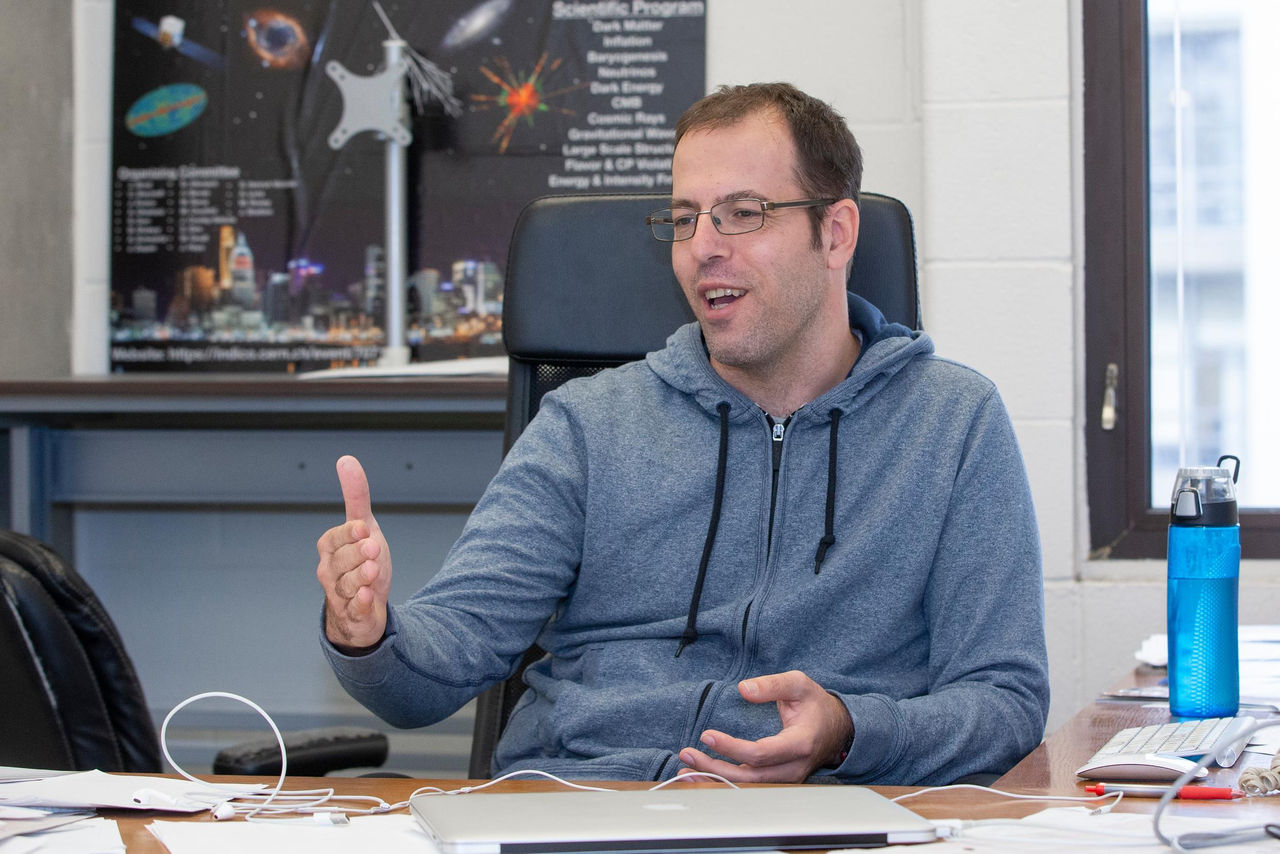
UC Professor Jure Zupan studies the secrets of dark matter. Photo/Joseph Fuqua II/UC
In their paper, Zupan and his colleagues considered a fusion reactor powered by deuterium and tritium in a vessel lined by lithium that is being developed in a global collaboration in the south of France. Such a reactor would produce not only energy but potentially also dark sector particles due to a large flux of neutrons that will be created in a fusion reactor.
“Neutrons interact with material in the walls. The resulting nuclear reactions can then create new particles,” he said.
The second way the new particles can get generated is when neutrons bounce off other particles and slow down, releasing energy in a process physicists call bremsstrahlung or “braking radiation.”
The new particles could be axions, or at least axion-like particles.
The general idea from our paper was discussed in ‘The Big Bang Theory’ years ago, but Sheldon and Leonard couldn’t make it work.
Jure Zupan, UC physicist
And that’s where the show’s fictional physicists failed, Zupan said.
“The Big Bang Theory” ran from 2007 to 2019 and earned seven Emmys. It remains among the most-watched shows of any streaming service, according to Nielsen.
“The general idea from our paper was discussed in ‘The Big Bang Theory’ years ago, but Sheldon and Leonard couldn’t make it work,” Zupan said.
In one episode, a white board features an equation and diagram that Zupan said describes how axions are generated from the sun. In a subsequent episode, another equation appears on a different board. Below the calculations in a different marker color is an unmistakable sad face.
Zupan said Leonard and Sheldon’s equation estimates the likelihood of detecting axions from their proposed fusion reactor compared to the sun — with discouraging results, which explains the sad face.
“The sun is a huge object producing a lot of power. The chance of having new particles produced from the sun that would stream to Earth is larger than having them produced in fusion reactors using the same processes as in the Sun. However, one can still produce them in reactors using a different set of processes,” he said.
The characters in the show never talk about axions or the white boards in the episodes. They’re just an Easter egg for physicists in a show famous for incorporating scientific concepts like Schrodinger’s cat and the Doppler effect into its storylines, along with cameos by Nobel laureates and “Star Trek” alumni alike.
“That’s why it’s fantastic to watch as a scientist,” Zupan said. “There are many layers to the jokes.”
Featured image at top: Researchers examined a particle physics problem that was highlighted on the show ”The Big Bang Theory.” Photo/CBS
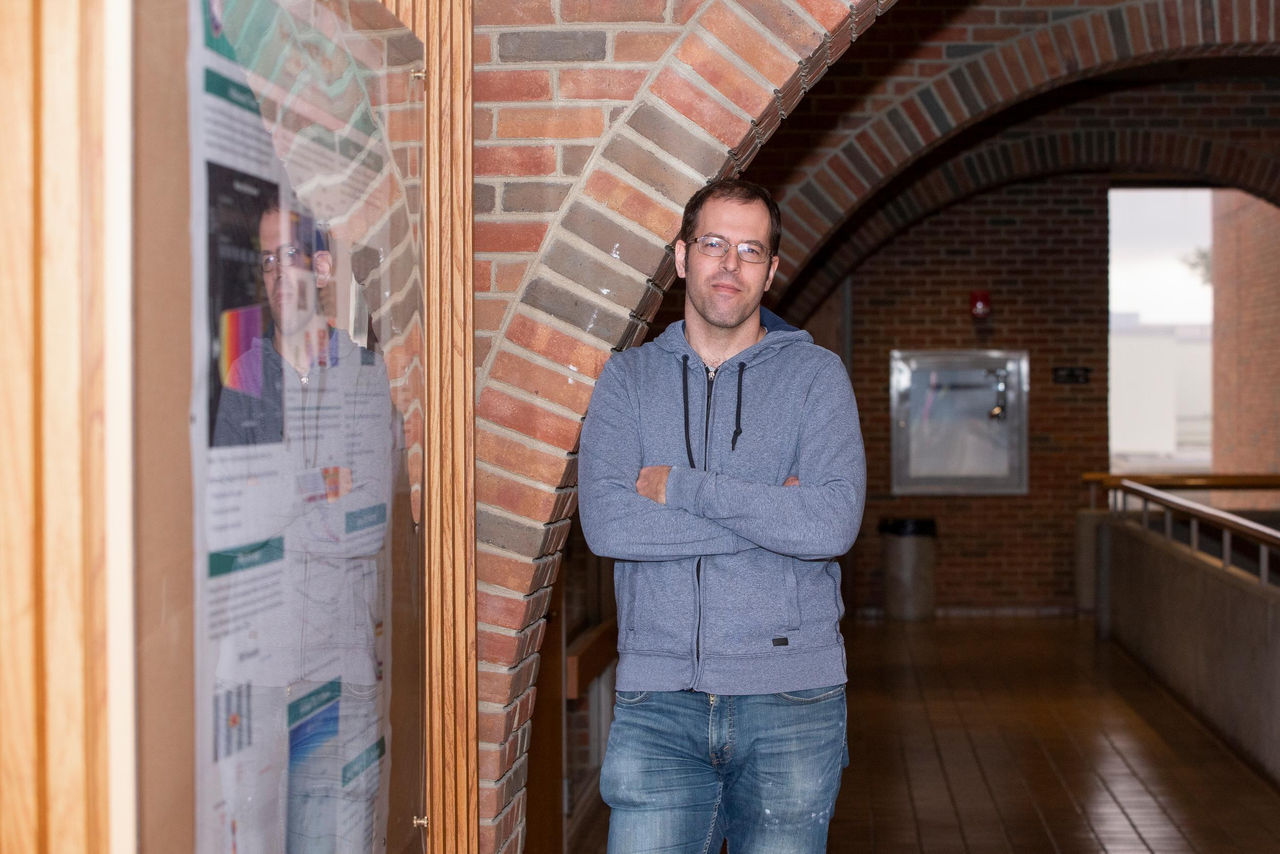
UC Professor Jure Zupan is a theoretical high-energy physicist who is investigating topics such as dark matter. Photo/Joseph Fuqua II/UC
The next groundbreaking discovery
UC is a powerhouse of discovery and impact as a Carnegie 1 research institution. From pioneering medical research to transformative engineering and social innovation, our faculty and students drive progress that reaches across the world.
Related Stories
Lonely Jupiter-like planet 900 light years away tells us more about gas giants
May 8, 2026
UC astrophysicist Paul Smith is part of an international team that is studying five distant gas giants — Jupiter-like exoplanets light years away that could shed light on the formation of our own solar system.
UC-built detector at CERN looks for enticing evidence to explain dark matter
August 4, 2026
A physicist from the University of Cincinnati and his research partners from around the world conducted an experiment at CERN’s Large Hadron Collider in Switzerland to look for evidence that might help explain one of science’s most baffling questions: dark matter.
How does trauma affect your children's children?
December 8, 2025
A University of Cincinnati professor is studying how genes respond when a person’s life is upended by natural disasters, war or other causes of sudden displacement.