UC center employs predict-and-prevent measures in manufacturing
The Center for Intelligence Maintenance Systems worked with machine tool company Mazak to reduce downtime caused by breakdowns

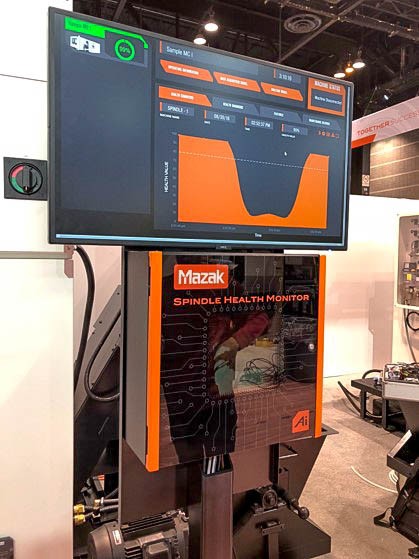
UC developed a spindle health monitor for Mazak’s machine, which assesses the individual fingerprint of each machine. Photo/Provided
Time is money. That's especially true for manufacturing companies that produce hundreds of thousands of dollars’ worth of products each month. When these industrial machines go down, all that money goes out the window.
“If you’re a company that is manufacturing a product, your top priorities are remaining on schedule and producing high-quality products,” says Hossein Davari, Ph.D., associate director of University of Cincinnati’s Center for Intelligence Maintenance Systems (IMS).
IMS recently worked with Mazak, one of the largest machine tool companies in the world, to optimize its manufacturing process and reduce potential downtime caused by breakdowns. IMS takes on nearly a dozen projects like this every year.
According to its mission statement and vision, IMS “envisions the future of maintenance as a system that enables equipment to achieve and sustain near-zero breakdown performance with self-diagnostic capabilities.” To achieve this, the center transforms raw data to insights that drive improvement in reliability, productivity and asset utilization.
“We develop predictive analytics for monitoring machine and predictive failures,” Davari said. “Mazak wanted us to develop a system like this for their machine tools.”
If you’re a company that is manufacturing a product, your top priorities are remaining on schedule and producing high-quality products.
Hossein Davari, Associate director of UC Center for Intelligence Maintenance Systems
Davari and UC Professor Jay Lee, Ph.D., led the year-long Mazak project. The team focused on the machine spindle (the machine’s rotating axis that holds the cutting tool during operation), which is usually the most expensive part of each machine.
The team developed a monitoring system for Mazak’s machine with sensors and created a fixed-cycle feature test, which assesses the individual fingerprint of each machine. Operators can use this fingerprint to compare the machine’s status to its ideal condition and derive a health metric for each of the machine's critical components.
The sensors the team installed and tested can check the system and compare it to an established baseline. Sensors collect data from observations. Researchers then take the data and use advanced analytics to identify a potential problem in any given machine weeks before it fails.
At the end of last year, IMS demonstrated its Mazak prototype at the International Manufacturing Technology Show in Chicago. The center is continuing their partnership with Mazak to bring a commercial product to market this year.
“Our goal is to reduce costs for manufacturing,” says Davari. “In the future, we hope to expand this technology to other components and have more advanced analytics to better predict and prevent failure.”
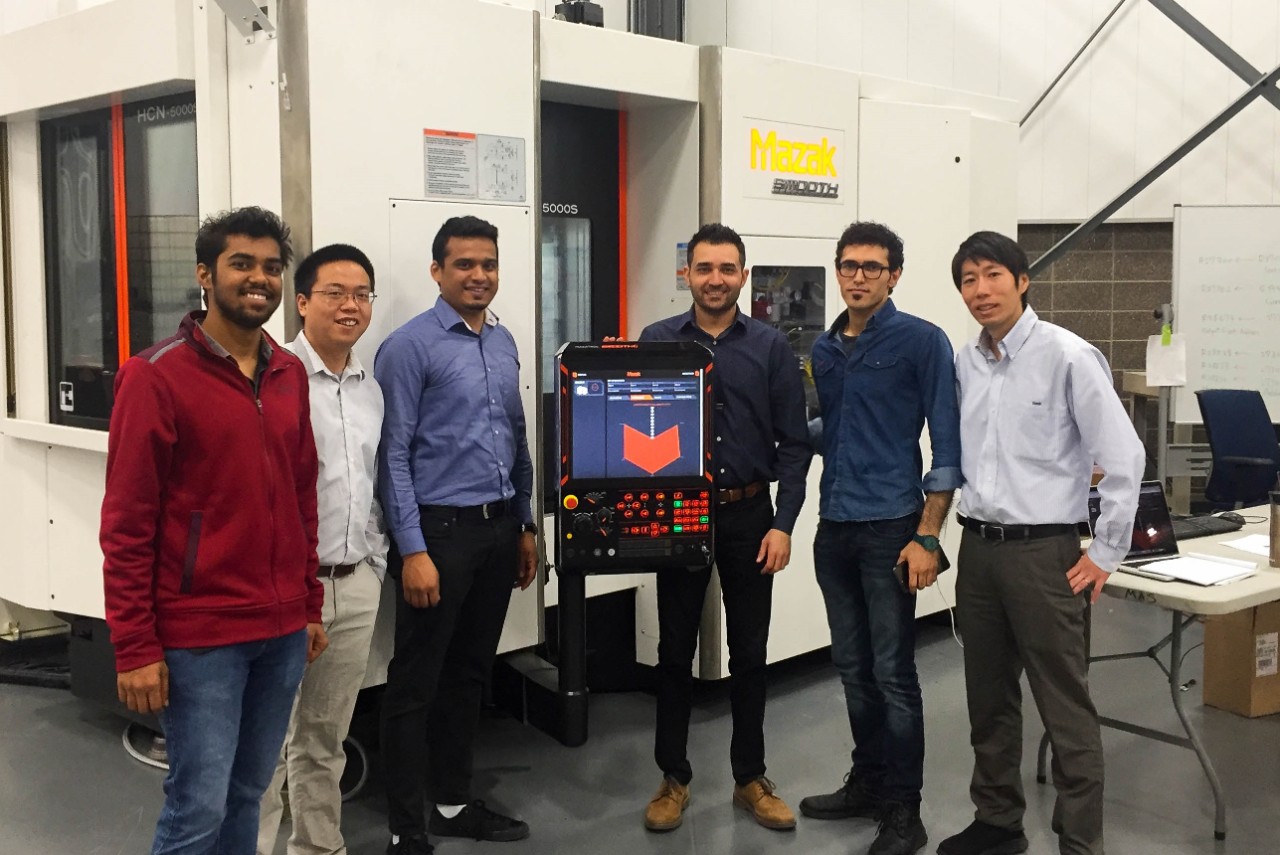
Featured image at top: UC researchers pose with the new monitoring system on Mazak's machine. Photo/Provided
Become a Bearcat
Apply to UC online or get more information about undergraduate enrollment by calling (513) 556-1100. Learn more about UC's many undergraduate and graduate programs.
Related Stories
Imaging reveals how a tumor-fighting drug triggers cellular breakdown
August 24, 2026

Optics trade publication SPIE highlighted research led by the University of Cincinnati's Jiajie Diao, PhD, published in Biophotonics Discovery that demonstrated how super-resolution microscopy can track how a drug alters several important structures within cancer cells.
Hoffman Honors Scholars program kicks off third year
August 24, 2026
This year marks the third cohort of the Hoffman Honors Scholars (HHS), which offers exceptional students in the College of Arts & Sciences, the College-Conservatory of Music and the Lindner College of Business a substantial scholarship to the University of Cincinnati, along with exclusive opportunities for leadership, service and global engagement.
A new year, a shared purpose: President Pinto welcomes Bearcats to UC’s 208th fall
August 24, 2026
President Neville G. Pinto welcomes students, faculty and staff back to UC's 208th academic year.