
International media: UC's portable lab connects to smartphone to diagnose disease
UC engineering professor Chong Ahn is improving point-of-care diagnoses with smartphone lab and app

International news media examined new technology developed by the University of Cincinnati that could help diagnose diseases remotely and more quickly.
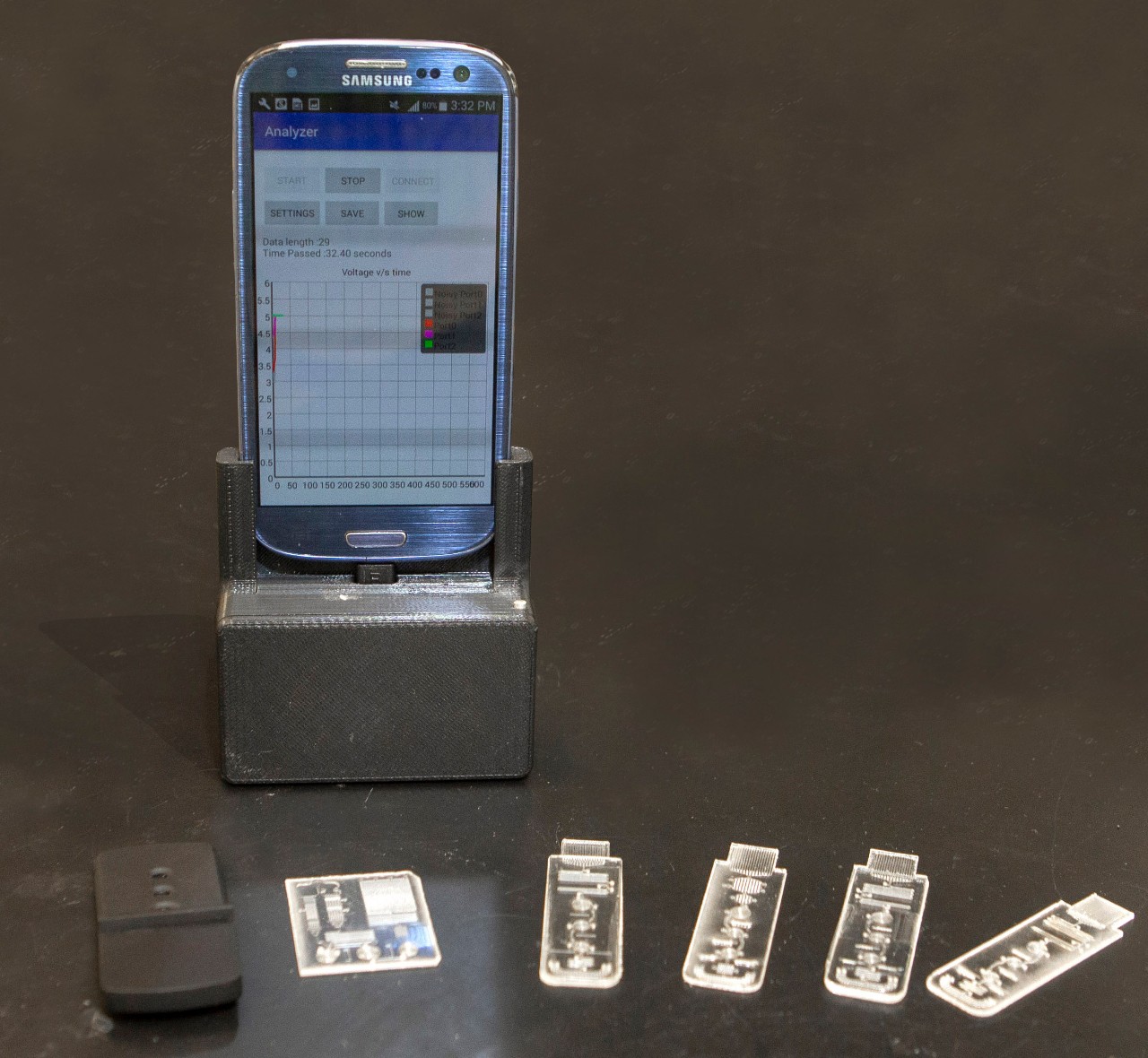
UC College of Engineering and Applied Science professor Chong Ahn created a portable point-of-care testing device that plugs into your smartphone and sends test results to your doctor through a custom UC app.
Patients place a plastic tab in their mouth to collect saliva. They insert the tab into a slot in the credit card-sized lab, which plugs into a smartphone's USB port. In a study published in the Nature journal Microsystems & Nanoengineering, Chong used the device to test for malaria. But he said point-of-care testing holds the potential to diagnose other infectious diseases or track hormones related to stress or anxiety.
"This is the future of personal healthcare," Chong's student Sthitodhi Ghosh said.
Read more about the device in UC News.
Featured image at top: Chong Ahn is a professor of biomedical and electrical engineering in UC's College of Engineering and Applied Science. Photo/Joseph Fuqua II/UC Creative Services
UC engineering professor Chong Ahn and his graduate student, Sthitodhi Ghosh, developed a portable point-of-care testing device that can diagnose infectious diseases and transmit test results to your doctor using a smartphone. Photo/Joseph Fuqua II/UC Creative Services
Chong Ahn's research in the news
The Week (India): Novel portable lab connects to smartphone, diagnoses disease
MSN (Indonesia): Lab the size of a credit card can diagnose disease
Medical Device Network: Mobile phone laboratory could help diagnose coronavirus
Engineering & Technology Magazine: Smartphone tool could help diagnose infectious diseases
The Engineer (UK): Smartphone lab offers rapid diagnosis of disease
Medgadget: Credit Card Sized Diagnostic Lab Plugs into Smartphone
Daily Excelsior: Novel portable lab connects to smartphone, diagnoses diseases
Related Stories
UC Biomedical Engineering student launches mobile healthcare platform
October 22, 2026
As a fifth-year biomedical engineering student at the University of Cincinnati College of Engineering and Applied Science, Amelia Wares has been a trailblazer in nearly every area imaginable — and this is only the beginning of her journey.
UC aerospace engineer leads global computational fluid dynamics taskforce
October 21, 2026
The American Institute of Aeronautics and Astronautics' CFD 2030 Integration Committee has announced the formation of the Computational Fluid Dynamics (CFD) Vision 2045 Team, a multi-institution working group tasked with defining where the field of computational fluid dynamics should be by 2045 to align with the changing and evolving needs of the aerospace industry. The University of Cincinnati's Prashant Khare, Bradley Jones professor and head of the Department of Aerospace Engineering, is leading this specialized group.
Still the top ‘cat
October 20, 2026

The University of Cincinnati Bearcat mascot was voted Cincinnati’s favorite mascot in a Cincinnati Enquirer reader poll, earning 45.1% of the vote and topping other local favorites.