WVXU: Satellites zoom in on invasive plants in Cincinnati
UC research offers new tool to fight Amur honeysuckle

WVXU examined an innovative project by the University of Cincinnati to use satellite images to identify invasive Amur honeysuckle from space.
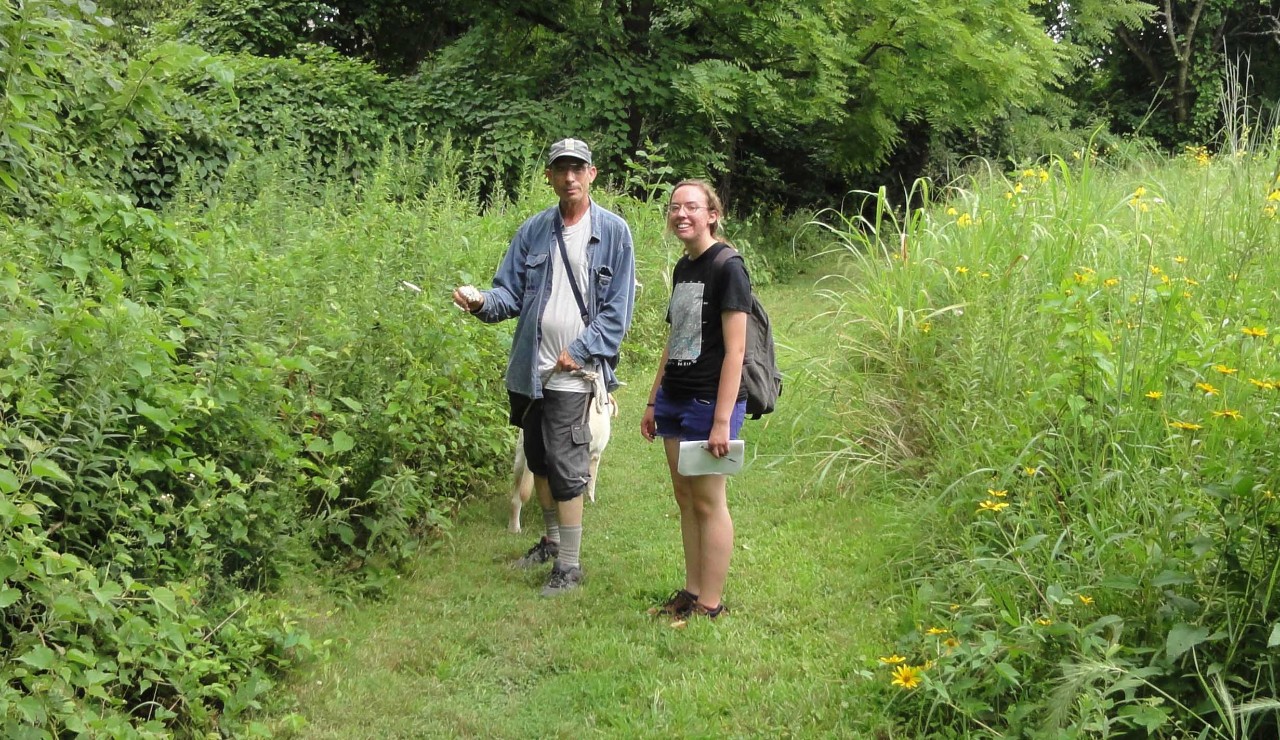
UC biology professor Denis Conover showed WVXU examples of the invasive Asian bush during a field trip with his Classification of Flowering Plants class at Burnet Woods.
Conover and UC geography graduate Bridget Taylor found that Landsat-8 images taken from orbit could identify the invasive bushes with 82% accuracy. Their study was published in the journal Ecological Restoration.
Amur honeysuckle and other invasive plants can crowd out native wildflowers and other plants.
Featured image at top: UC biology professor Denis Conover and UC graduate Bridget Taylor collaborated on a study of nonnative and invasive Amur honeysuckle. Photo/Richard Beck

UC biology professor Denis Conover spoke to WVXU about a research project that used Landsat-8 satellite images to identify invasive and nonnative Amur honeysuckle from space. Here he holds a native woody plant called devil's walking stick. Photo/Joseph Fuqua II/UC Creative + Brand
Related Stories
The subtle changes in hearing you should never ignore
July 24, 2026

It’s easy to dismiss changes in hearing as minor. But as The Washington Post recently reported, these symptoms could also signal a medical emergency that many people don’t recognize — known as sudden sensorineural hearing loss, a rapid decline in hearing that occurs suddenly or over a few days.
UC experts say proper produce washing is key defense against Cyclospora
July 24, 2026

Hamilton County Public Health reports confirmed cases of cyclosporiasis, as concerns persist. Cyclospora is a parasite that can cause a stomach illness lasting days — sometimes even weeks. University of Cincinnati medical experts say it is usually linked to contaminated water or food, often fresh produce.
What are the options for male birth control?
July 24, 2026
Despite major advances in contraception during the past several decades, responsibility for pregnancy prevention falls largely on women. As recently reported in Endocrinology Advisor, a new generation of male contraceptive candidates is advancing into early- and mid-stage clinical trials.