
Researcher develops app to reach Black community with COVID-19 information
UC physician gets boost from Association of Black Cardiologists for study

A University of Cincinnati cardiologist is partnering with researchers in St. Louis and rural Georgia to develop a smartphone app that will deliver COVID-19 information and education that is targeted toward Black communities.
“What we know across the country is that COVID has disproportionately affected the African American community and it is unmasking underlying disease,” says Donald Lynch, MD, assistant professor of cardiovascular health and disease at UC and a UC Health cardiologist.
“I want the community to be empowered,” says Lynch. “I want us to bring this mobile health-based technology into the hands of the community so it has ready access to information about COVID but also about cardiovascular disease and other areas of disease impacting African Americans disproportionately.”
Lynch’s work is being supported by the Association of Black Cardiologists, which awarded him $25,000 to complete a pilot study using the smartphone app.
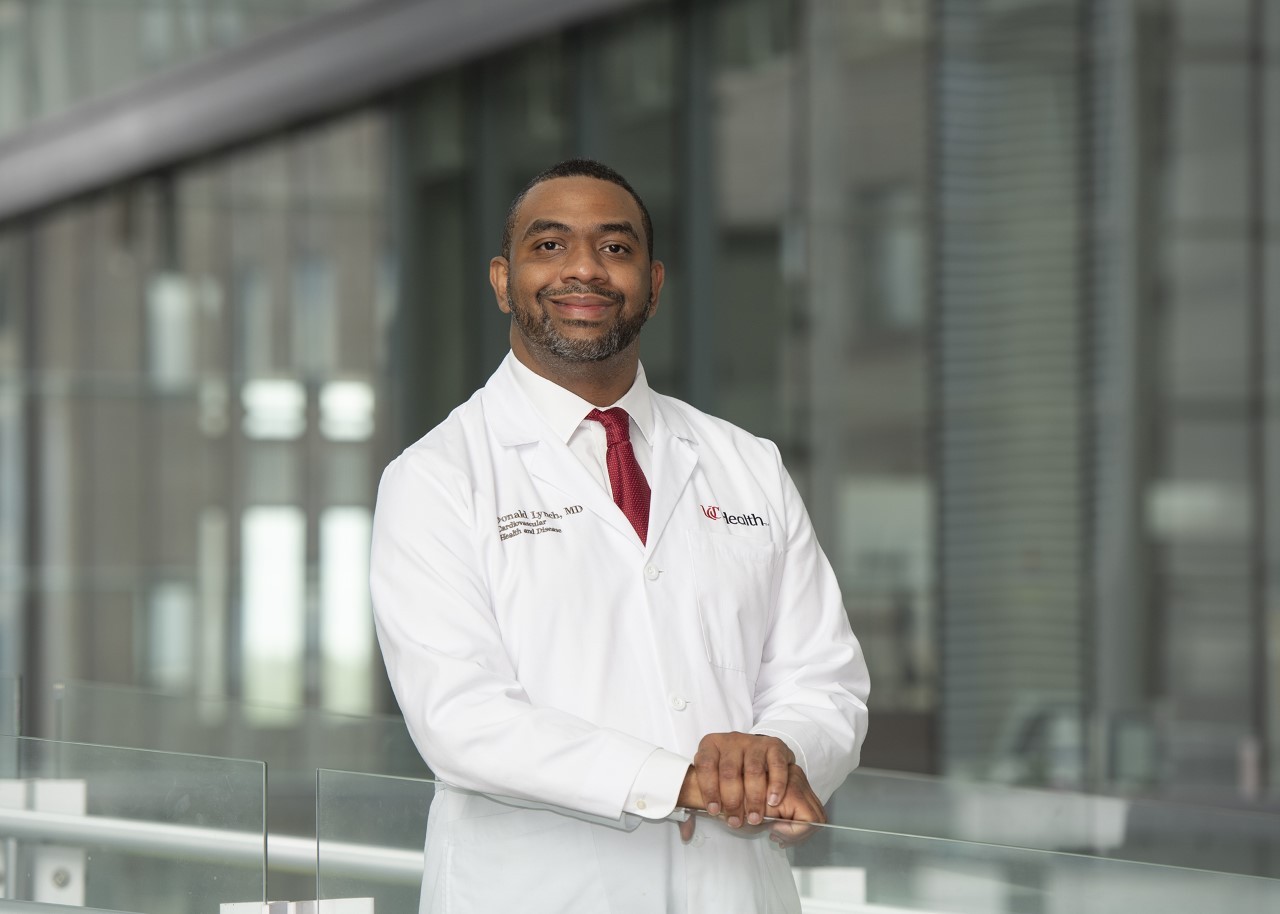
Donald Lynch portrait/Colleen Kelley/UC Creative + Brand
In Ohio as of Oct. 28, 2020, there were 205,347 cases of COVID-19 which include 18,606 hospitalizations and 5,256 deaths, as reported by the Ohio Department of Health. Black residents in Ohio accounted for 14% of the population but 16.7% of COVID-19 cases and 17.1% of COVID-19 deaths. Black residents account for 25.7% of the COVID-19 hospitalizations.
Lynch is working with public health researchers, Tilicia Mayo-Gamble, PhD, at Georgia Southern University, and Kelly Harris, PhD, at Washington University in St. Louis, to conduct a yearlong study in which the smartphone app is designed based on conversations with focus groups in Cincinnati, St. Louis and Statesboro, Georgia.
“We will have a stakeholder group in each of those communities,” says Lynch. “We will ask the stakeholders how people perceive they are receiving their health care information and information on COVID-19. We will ask questions about the use of smartphones.”
“This is an implementation science-based project,” says Lynch. “We are going to ask questions as to how satisfied they are with current available health information and what information you feel is missing. What more information is needed and where are the gaps?”
“Based on the feedback we will build our app,” says Lynch. “The stakeholder conversations will conclude at the end of three months, and we hope to get a pilot version of our app available for community members to test. We know many people have access to smartphones and we think this will work well for our study.”
Lynch is seeing heart patients who have recovered from COVID-19 now coming in for treatment with conditions that may be related to the pandemic.
“We are learning more and more about COVID every day, and we know COVID can affect the heart itself,” says Lynch. “Now we are seeing patients that are COVID-positive. They have survived and are a month or more out and they have manifestations of heart palpitations, problems regulating blood pressure and other concerns. It’s not clear if this is a result of COVID or if those symptoms were present before COVID and now we are just paying more attention to signals from our body.”
Lynch participated in the 2019 PRIDE-Functional and Translational Genomics of Blood Disorder program (PRIDE-FTG) at Augusta University in Augusta, Georgia. PRIDE (Programs to Increase Diversity among Individuals Engaged in Health-Related Research) is a research career-advancing training opportunity funded by the National Heart, Lung, and Blood Institute (NHLBI) of the NIH. There Lynch met co-investigators Mayo-Gamble and Harris. The goal of PRIDE is to train junior-level faculty to do research related to blood disorders such as hemoglobinopathies and white blood cell and platelet diseases.
Featured image at top: Donald Lynch, MD, in a UC College of Medicine laboratory. Photo/Colleen Kelley/UC Creative +Brand
Impact Lives Here
The University of Cincinnati is leading public urban universities into a new era of innovation and impact. Our faculty, staff and students are saving lives, changing outcomes and bending the future in our city's direction. Next Lives Here.
Stay up on all UC's COVID-19 stories, read more #UCtheGood content, or take a UC virtual visit and begin picturing yourself at an institution that inspires incredible stories.
Related Stories
Collaboration over consultation
October 16, 2026
New University of Cincinnati research published in the journal Health Expectations found stroke survivors participating in rehab research desire an approach that prioritizes shared decision-making, peer relationships and a focus on what they can accomplish rather than their deficits.
Cincinnati Spotlight features CCM's new Conservatory Series concerts
October 15, 2026

Cincinnati Public Radio features CCM's new Conservatory Series in its latest "Cincinnati Spotlight." The series launches on Wednesday, Oct. 21 with its inaugural "Grand Tradition" concert featuring a variety of CCM's distinguished faculty artists.
Medical devices exec touts UC co-op
October 15, 2026

UC College of Engineering and Applied Science alumnus Adam Hauke talks to Medium about the speed of innovation in developing new medical devices. Hauke is global director of product strategy & innovation at Gentherm Medical. He earned a doctorate and bachelor's degree in biomedical engineering from UC.