UC takes part in federal drone demonstration
Students in UC's UAV Master Lab develop new applications for unmanned aerial systems

The University of Cincinnati took part in a demonstration of unmanned aerial systems, demonstrating the untapped potential for drones for government and commercial applications.
The UAV Master Lab in UC’s College of Engineering and Applied Science demonstrated how autonomous unmanned aerial vehicles can be incorporated into air traffic control systems. UC developed the application with small business technology transfer grants in conjunction with the Parallax Advanced Research’s Ohio Federal Research Network.
The network helps Ohio’s research universities meet the needs of federal institutions. This coordination is designed to boost Ohio’s economy through new innovations.
The project demonstrates UC's commitment to research as described in its strategic direction called Next Lives Here.

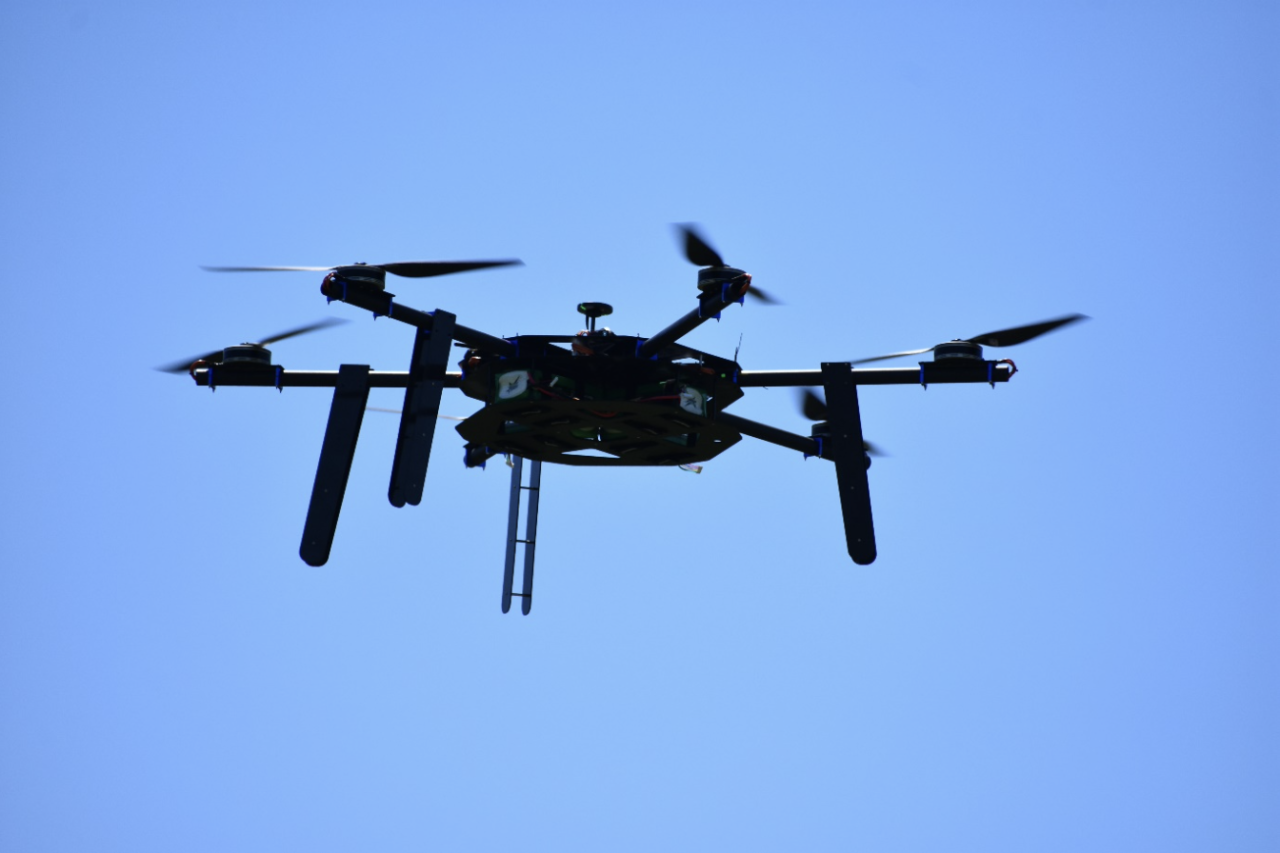
UC students in the College of Engineering and Applied Science demonstrate new technology developed in UC's Department of Aerospace Engineering and Engineering Mechanics. Photo/UC
The network hosted a drone demonstration at Springfield-Beckley Municipal Airport in Clark County, Ohio, using advanced unmanned aerial systems and SkyVision, the Ohio Department of Transportation (ODOT) ground-based detection and avoidance system. This system is designed to ensure drones can safely operate at night, over populations or beyond the line of sight of operators.
UC and other participating groups demonstrated the ability to integrate their technology with SkyVision.
Bryan Brown, senior research associate in UC’s Department of Aerospace Engineering and Engineering Mechanics, said UC demonstrated a new system it created to translate different commercial autopilots for use by Ohio’s SkyVision.
In a partnership with Sinclair Community College, UC also demonstrated a new unmanned air traffic management system to incorporate drones into airspace shared by other aircraft. One safeguard is the low operating ceiling for drones to avoid other air traffic, Brown said.
“This system is the next step beyond visual line-of-sight operations,” Brown said. “This allows us to integrate UAVs safely into the national airspace.”
UC thanked its partners, Sinclair Community College, Demeter UAV and Simlat.
Featured image at top: A UC drone. Photo/UC
Impact Lives Here
The University of Cincinnati is leading public urban universities into a new era of innovation and impact. Our faculty, staff and students are saving lives, changing outcomes and bending the future in our city's direction. Next Lives Here.
Stay up on all UC's COVID-19 stories, read more #UCtheGood content, or take a UC virtual visit and begin picturing yourself at an institution that inspires incredible stories.
Related Stories
UC selected for federal initiative to use AI to advance scientific discovery
July 22, 2026

A University of Cincinnati project to protect sources of drinking water and identify valuable underground resources is part of a national initiative to harness artificial intelligence to speed scientific breakthroughs.
Cincinnati sees record rainfall in weekend deluge
July 21, 2026

The Cincinnati Enquirer talks to UC College of Engineering and Applied Science Associate Professor Patrick Ray for context about a July 17 rainstorm that dumped a record amount of rain on parts of Cincinnati.
Engineering magnets for a cleaner future
July 20, 2026
The United States is heavily reliant on imported rare-earth materials to make permanent magnets. Ugochukwu Philip Ochieze, materials science student at the University of Cincinnati, is studying how to use common materials to create permanent magnets, eliminating the need for expensive and scarce rare-earth materials. Pursuing his PhD, Ochieze was named Graduate Student Engineer of the Month by the College of Engineering and Applied Science.