Yahoo! News: Electricity cap used to treat brain tumors

The University of Cincinnati is one of the trial sites for the TRIDENT clinical trial, testing the effectiveness of electrical field treatment for glioblastoma patients earlier in treatment regimens.
Kyle Wang, MD, a University of Cincinnati Cancer Center member and assistant professor of clinical radiation oncology in the UC College of Medicine, explained that human cells naturally use electricity to line up certain cellular structures, including materials called mitotic spindles, that are used for cell division and growth. To prevent tumor cells from growing, an alternating electric field can be focused at the tumor to disrupt this process.
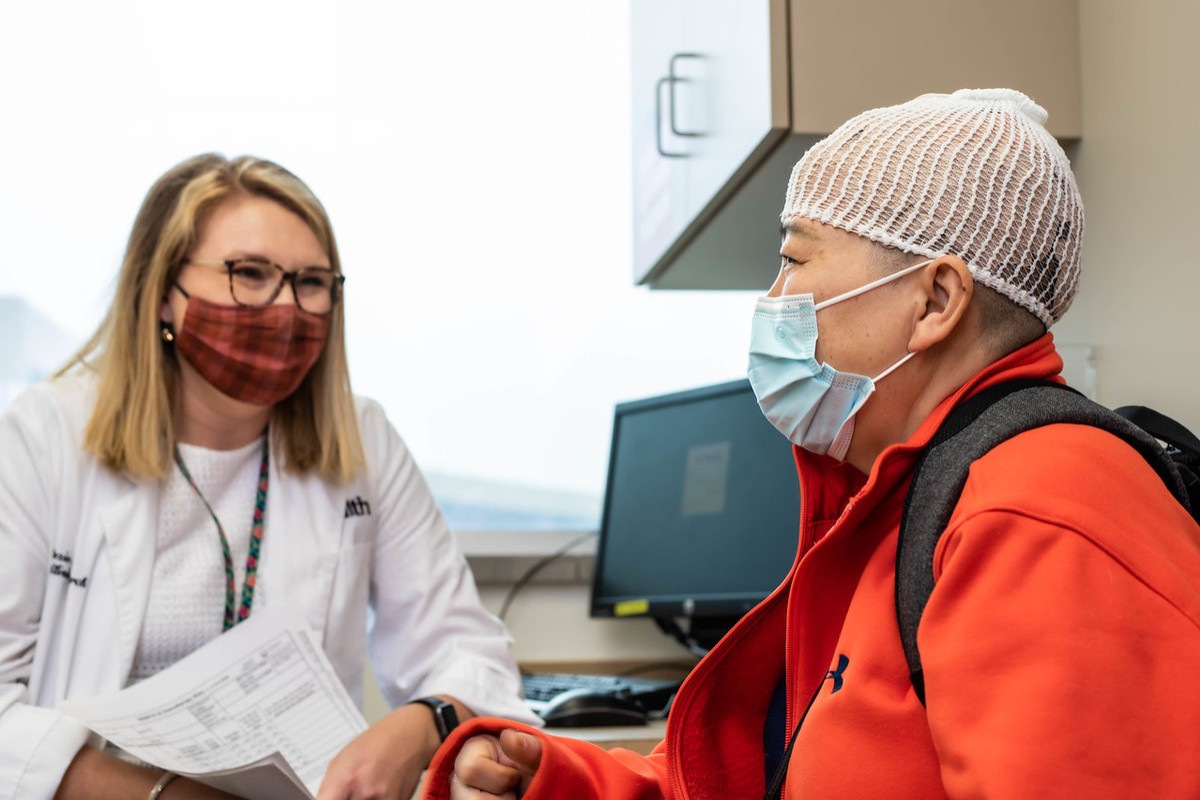
The treatment is delivered through a group of electrical arrays, a configuration of electrodes that looks like a mesh cap worn on the head, called an Optune device.
A number of local TV stations across the country, as well as Yahoo! News, have featured the research in recent segments.
Watch the Yahoo! News segment, originally aired on NewsChannel 5 Nashville.
Featured photo at top of patient Siyun Huang, right, wearing an Optune device while talking with University of Cincinnati clinical research professional Alexis Brenner, left. Photo/Leigh Vukov/UC Health.
Related Stories
UC partners join communitywide effort to improve outcomes for children and families
September 24, 2026

WLWT Channel 5 covered a signing agreement ceremony for the newly formed Hamilton County Child & Family Systems Partner Collaborative dedicated to working more efficiently together to reduce barriers for families, connect them with support early on and improve delivery of services. UC Corrections Institute and the Donald P. Klekamp College of Law are among the organizations part of the collaborative.
More young adults are having strokes than three decades ago
September 23, 2026
A University of Cincinnati-led study published in the journal Neurology found that strokes among adults ages 20 to 54 nearly doubled over almost three decades, even as short-term survival after stroke improved.
UC part of $18 million initiative to expand behavioral health workforce in Ohio
September 23, 2026

The University of Cincinnati is participating in a new $18 million statewide scholarship program, as Cleveland.com recently reported, to address critical shortages of mental health and substance use treatment providers across Ohio.