
External email header coming to faculty, staff June 8

Beginning Wednesday, June 8, faculty and staff email accounts at the University of Cincinnati will automatically add an external email header to any incoming messages sent from a non-UC affiliated email address.
About the external email header
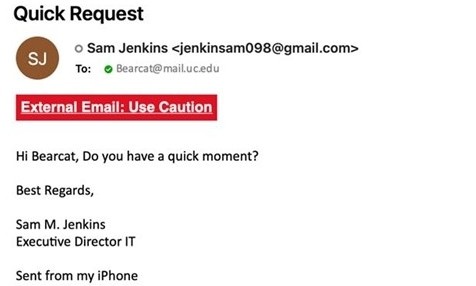
"External Email: Use Caution" (white text over UC red background) will automatically appear on messages sent from anywhere other than a uc.edu email account. Messages from legitimate uc.edu senders will not display the "External Email" header.
Recognize and report suspicious emails
Phishing emails often appear to be sent from an internal and trusted source and ask recipients to open attachments or click links. The External Email Header is a simple nudge to encourage recipients to be a little more cautious when opening emails sent from senders outside of UC.
Follow these guidelines from UC Office of Information Security before clicking links or opening attachments in email messages.
- Review the email header information. Do you recognize the sender and their email domain?
- Consider the email content. Is this message typical for this sender?
- Hover over links to review the address before clicking. Is the email trying to panic you into clicking a link?
- Review the signature. Do you recognize the sender’s name or department?
- Report the message. If you answer YES to any of the above questions, forward the email to infosec@ucmail.uc.edu. You can also select the “Report Message” button located on the right-side of your home ribbon tab.

Select the "Report Message" button on your home ribbon tab in Microsoft Outlook to report a suspicious email.
Need help?
Please contact the IT@UC Service Desk.
- Submit a ticket.
- Or, call us: Dial (513) 556-HELP (4357) or (866) 397-3382 from your personal phone. Dial 6-HELP (4357) from a university phone on campus. Then, select option 2.
Related Stories
How scammers can persuade you with AI
July 27, 2026

Spectrum News recently dove into how cloning voices with artificial intelligence is making it easier to scam people over the phone. The news outlet spoke with Kimberly Hyun, assistant professor of marketing at UC’s Lindner College of Business, to examine why AI is making it so much easier to trick people.
Claude now available in BearcatsGPT AI platform
July 27, 2026
The University of Cincinnati has added Claude as a model option within BearcatsGPT, UC’s generative AI platform. Claude availability in BearcatsGPT marks another step forward in expanding access to dependable, enterprise-supported AI tools for teaching, research, operations, and administrative work.
Decade of discovery
July 27, 2026
Every summer, UHP Discover has connected undergraduate students in the University Honors Program (UHP) to a unique array of opportunities in original interdisciplinary research. This year, the program celebrates its 10th anniversary.