Earth.com: Sleep-deprived mosquitoes are less interested in food
UC biologists found that tired mosquitoes would rather catch up on sleep than bite you

Earth.com highlighted a study by the University of Cincinnati that found that tired mosquitoes are more interested in catching up on sleep than looking for food.
By understanding the mosquitoes' circadian rhythms, researchers hope to find effective, nontoxic ways to prevent mosquito-borne illness.

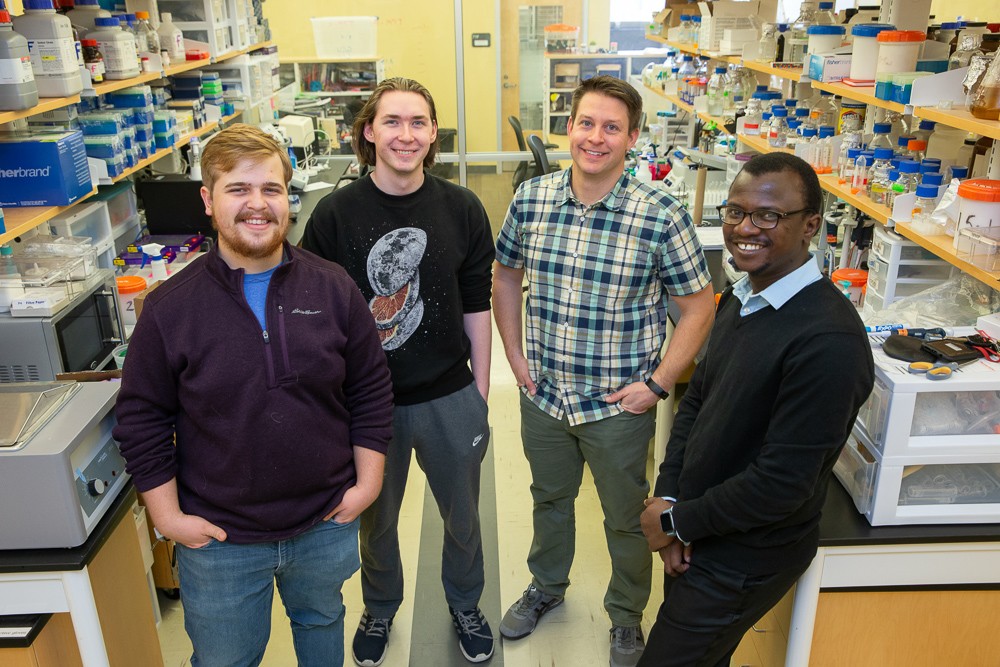
UC doctoral student Oluwaseun Ajayi, lead author of the study, said even for insects, sleep is a vital biological function. Photo/Andrew Higley/UC Marketing + Brand
“It was a bit surprising. Sleep deprived or not, a blood meal should appeal to them,” UC doctoral student and study lead author Oluwaseun Ajayi said.
The study was published in the Journal of Experimental Biology.
The researchers from UC’s College of Arts and Sciences and Virginia Tech’s Department of Biochemistry, found it challenging to study sleep patterns in mosquitoes. They spent more than a year developing protocols to study the phenomenon effectively – mosquitoes are easily disturbed by the presence of an observer, whom they detect as a potential host. This means that any experiments on mosquito sleep are likely to be confounded by the presence of the observer — a phenomenon called the observer effect — according to UC biologist Joshua Benoit.
“It’s really hard to quantify sleep in mosquitoes when, as soon as you walk in the room, you’re considered their Thanksgiving dinner,” Benoit said.
Featured image at top: UC assistant professor Joshua Benoit and his students examined the role sleep plays in three species of mosquitoes. Pictured from left are Lucas Gleitz, Evan Smith, Benoit and UC student Oluwaseun Ajayi. Photo/Andrew Higley/UC Marketing + Brand
Related Stories
Ticks that survive pesticides can withstand colder winters
July 17, 2026

Ticks that survive less-than-lethal doses of pesticide are able to withstand dangerous cold, which could help them expand their range farther north, according to researchers at the University of Cincinnati and the U.S. Department of Agriculture.
Why does it feel like so many Cincinnati restaurants close?
July 17, 2026

WLWT and the Cincinnati Enquirer cited UC research in reports on recent restaurant closures in the city.
UC has connection to city of legend behind 'Odyssey'
July 17, 2026

WVXU highlights a big connection between Cincinnati and director Christopher Nolan's new movie "The Odyssey." UC Classics Professor Carl Blegen led excavations at Troy in the 1930s. UC has a vast collection of photos and other records from the ambitious archaeological project.