Dermatology Times features UC research of nail squamous cell carcinoma treatment

Nail squamous cell carcinomas (nSCC) are rare malignant tumors that grow primarily on the fingernails of patients. There is currently no established standard of care or treatment for nSCC, and University of Cincinnati researchers recently reviewed other published research to assess treatment trends and outcomes.
The research was led by Anne Ning, MD, clinical instructor in the Department of Internal Medicine in UC's College of Medicine, and published in the journal Dermatologic Surgery.
The literature review found there has been a shift from amputation to other surgical tactics including Mohs micrographic surgery (MMS), a procedure where individual layers of skin tissue are removed one at a time until there is no cancer found, and wide surgical excision (WSE), a procedure where a whole tumor and healthy tissue around it are surgically removed.
Researchers found MMS is increasingly being selected as a first-line treatment for nSCC, with data suggesting a low rate of the cancer recurring following MMS or WSE procedures.
The researchers concluded further study and randomized controlled trials are needed to directly compare surgical treatments for nSCC.
Dermatology Times covered the study in a recent article.
Read the Dermatology Times article.
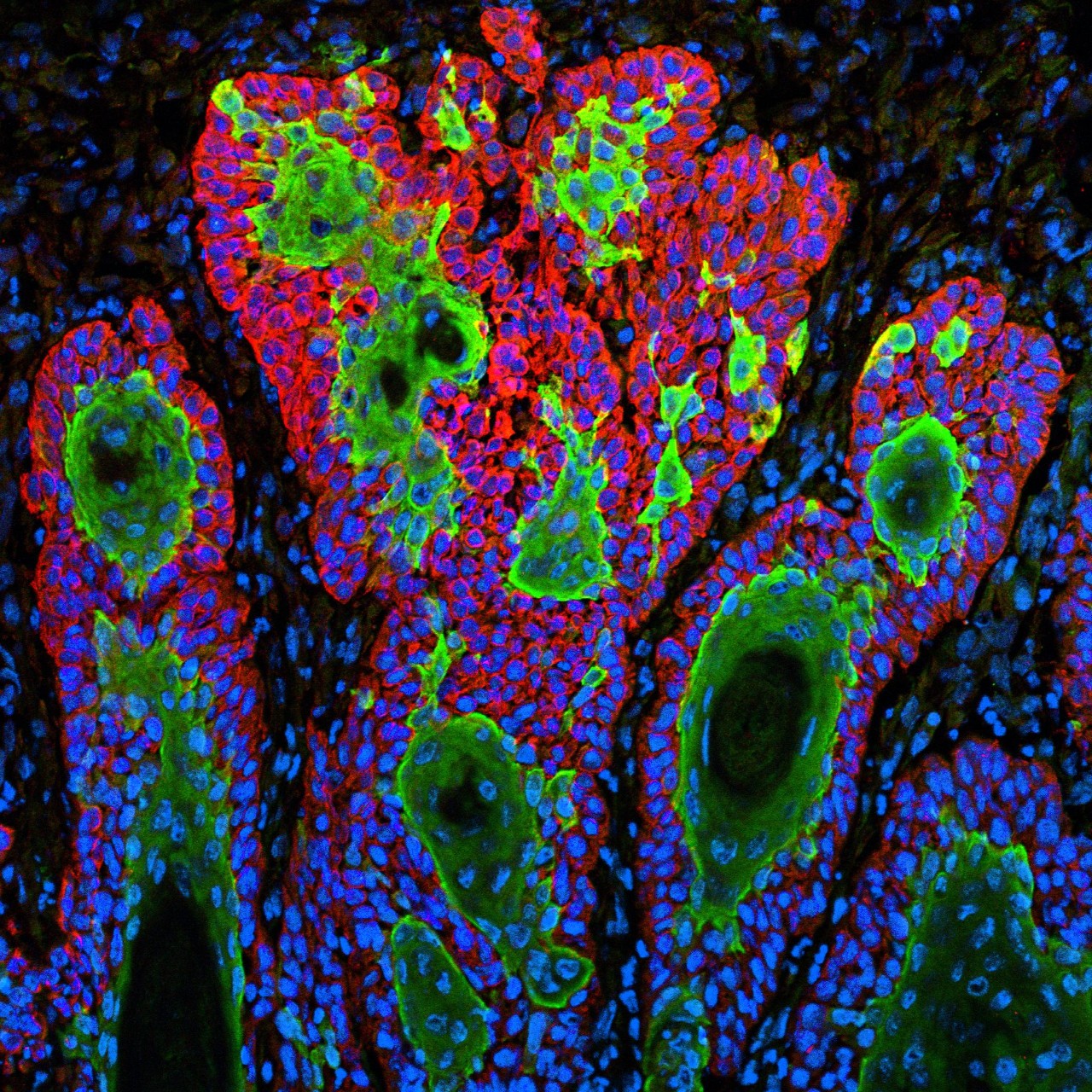
Featured photo at top of squamous cell carcinoma cells by Markus Schober and Elaine Fuchs of The Rockefeller University, provided by National Cancer Institute.
Related Stories
Emeritus professor honored for gas turbine research
August 17, 2026
Mark Turner has been part of the University of Cincinnati's College of Engineering and Applied Science for 25 years. His work in the field of gas turbine simulation and design continues to leave a significant impact on the industry. He was honored by the American Society of Mechanical Engineers with the International Gas Turbine Institute Scholar Award. Turner is part of the Department of Aerospace Engineering and Engineering Mechanics at UC.
UC expert offers advice to Cincinnati on climate change
August 14, 2026

In an op-ed, UC Associate Professor Bob Hyland talks about ways Cincinnati can become more resilient in face of climate change.
UC named a best employer in Ohio by Forbes
August 14, 2026

Forbes ranks the University of Cincinnati No. 24 on its 2026 America’s Best Employers By State list for Ohio, recognizing UC’s strong workplace culture and employee experience.