Medical News Today: Parabens may increase breast cancer risk in Black women
UC expert comments on implications of recent study

Black women in the United States are 39% more likely to die from breast cancer compared to white women and are more likely to develop breast cancer under the age of 40.
A recent study conducted by researchers at City of Hope in Los Angeles found that compounds called parabens, which are used as preservatives in hair and personal care products, increased the growth of a Black breast cancer cell line but did not increase growth in a white breast cancer cell line.
Xiaoting Zhang, PhD, professor and Thomas Boat Endowed Chair in the University of Cincinnati's Department of Cancer Biology, director of the Breast Cancer Research Program and member of the University of Cincinnati Cancer Center, was not involved in the study but commented on it for Medical News Today.
Zhang said the study findings were interesting and suggest that at least part of the reason why parabens affect cancer cells differently is due to genetic or epigenetic differences.
"It will be highly critical to further study its effect not only in cultured breast cancer cells but also in animal models and eventually in humans,” Zhang said.
Read the Medical News Today story.
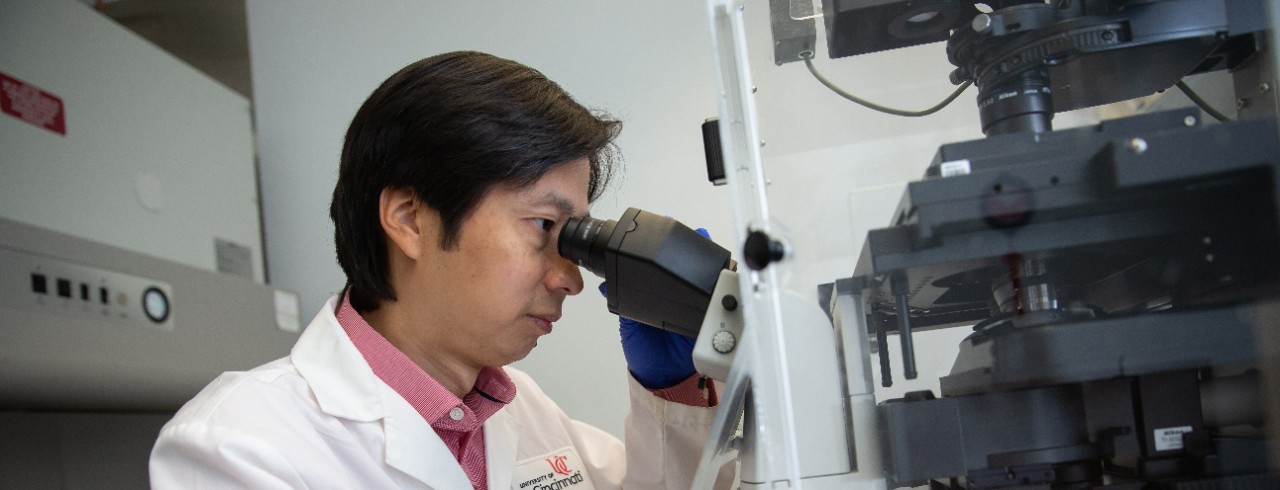
Featured photo at top of Dr. Zhang at microscope. Photo/Andrew Higley/UC Marketing + Brand
Related Stories
More young adults are having strokes than three decades ago
September 23, 2026
A University of Cincinnati-led study published in the journal Neurology found that strokes among adults ages 20 to 54 nearly doubled over almost three decades, even as short-term survival after stroke improved.
UC part of $18 million initiative to expand behavioral health workforce in Ohio
September 23, 2026

The University of Cincinnati is participating in a new $18 million statewide scholarship program, as Cleveland.com recently reported, to address critical shortages of mental health and substance use treatment providers across Ohio.
Unlike many parents, children are fearless around AI
September 23, 2026
Researchers at the University of Cincinnati found that children ages 5-10 are enthusiastic about playing with new AI toys but also tend to believe what the AI tells them. Their embrace of AI contrasts with concerns expressed by some of their parents.